
Early clearance of plasma EGFR-mutant circulating tumor DNA identifies patients with better prognosis in advanced EGFR-mutated non-small cell lung cancer, but it does not appear to identify who can safely receive osimertinib alone instead of osimertinib plus platinum-pemetrexed chemotherapy.
New exploratory biomarker data from the phase III FLAURA2 trial, presented at ESMO Congress 2026, showed that the progression-free and overall survival advantages of first-line osimertinib plus chemotherapy were maintained regardless of whether plasma EGFR mutations became undetectable during the first six weeks of treatment.
The findings address an increasingly important clinical question following FLAURA2: can very early ctDNA dynamics identify patients who need treatment intensification and spare others the additional toxicity of chemotherapy?
Based on the current analysis, the answer is no.
Plasma EGFR mutation clearance occurred rapidly with both treatment strategies and at broadly similar rates. More importantly, patients receiving osimertinib plus chemotherapy generally experienced better clinical outcomes than those receiving osimertinib monotherapy whether their ctDNA cleared at weeks 1, 2, 3, or 6 or remained detectable.
Early EGFR ctDNA clearance therefore appears to be a prognostic marker of tumor biology and treatment response rather than a predictive marker of differential benefit from adding chemotherapy.
FLAURA2 Has Already Established a Survival Advantage for Combination Therapy
FLAURA2 changed the first-line treatment discussion for patients with advanced NSCLC harboring classical sensitizing EGFR mutations.
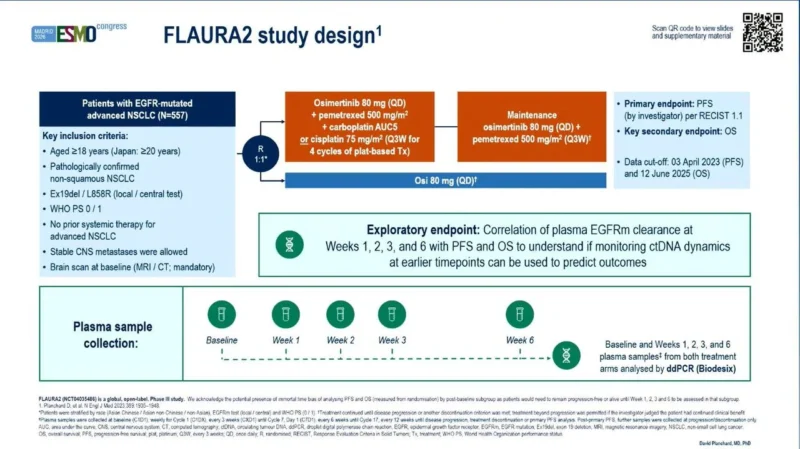
The global phase III trial randomized 557 previously untreated patients with EGFR exon 19 deletion or exon 21 L858R-mutated advanced NSCLC to osimertinib alone or osimertinib combined with platinum-pemetrexed chemotherapy.
Patients assigned to combination therapy received four cycles of platinum plus pemetrexed with osimertinib, followed by maintenance osimertinib plus pemetrexed.
The original PFS analysis demonstrated a substantial advantage for treatment intensification. Investigator-assessed median PFS was 25.5 months with osimertinib plus chemotherapy versus 16.7 months with osimertinib alone, corresponding to an HR of 0.62. Longer follow-up subsequently confirmed that this was not simply a PFS effect.
At the final OS analysis, median overall survival reached 47.5 months with osimertinib plus chemotherapy compared with 37.6 months with osimertinib monotherapy, with an HR for death of 0.77 (95% CI 0.61–0.96; P=0.02).
The combination therefore delivers a clinically meaningful efficacy advantage, but it also produces greater toxicity. In the final OS publication, grade ≥3 adverse events occurred in 70% of patients receiving the combination compared with 34% receiving osimertinib alone. That difference creates a strong rationale for biomarker-guided treatment selection.
If clinicians could identify early which patients derive little additional benefit from chemotherapy, treatment might potentially be individualized rather than intensified for everyone.
FLAURA2 Tested Whether ctDNA Could Provide That Selection Tool
The ESMO 2026 analysis examined serial plasma EGFR mutation dynamics during the earliest weeks of therapy. Blood samples were collected at baseline and at weeks 1, 2, 3, and 6.
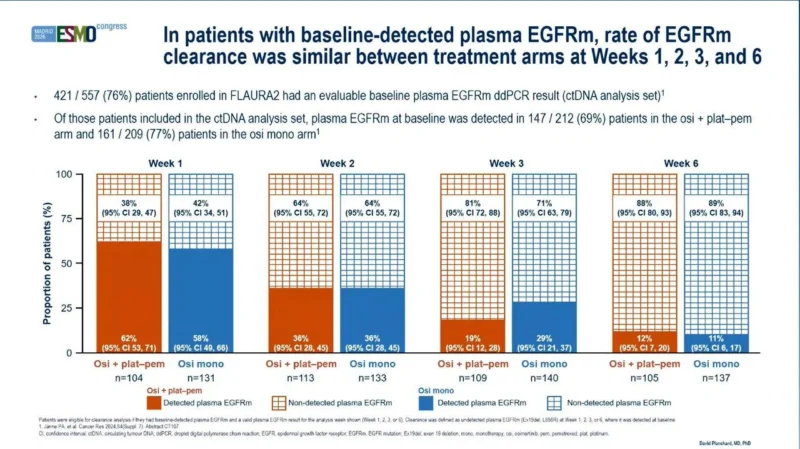
Plasma EGFR mutations were analyzed using droplet digital PCR, with clearance defined as conversion from detectable EGFR-mutant ctDNA at baseline to undetectable plasma EGFR-mutant DNA after treatment began. Among the 557 randomized patients, 421, or 76%, had an evaluable baseline plasma EGFR result.
Within this ctDNA analysis population, baseline plasma EGFR mutations were detected in 147 of 212 patients, or 69%, receiving osimertinib plus chemotherapy and 161 of 209 patients, or 77%, receiving osimertinib alone.
The analysis then asked two separate questions. First, does early EGFR mutation clearance correlate with better outcomes?
Second, and more clinically important, does clearance identify patients who derive more or less benefit from adding chemotherapy? The answers were different.
EGFR ctDNA Cleared Rapidly in Both Treatment Arms
Plasma EGFR mutation clearance increased progressively during the first six weeks of treatment. At week 1, clearance was observed in 38% of evaluable patients receiving osimertinib plus chemotherapy and 42% receiving osimertinib alone. By week 2, the rate was 64% in both treatment groups.
At week 3, clearance had occurred in 81% with combination treatment and 71% with osimertinib monotherapy. By week 6, plasma EGFR mutations were undetectable in 88% and 89%, respectively. The overall pattern is notable.
If the principal explanation for the additional benefit of chemotherapy were simply more rapid early eradication of EGFR-mutant ctDNA, one might expect consistently higher clearance rates in the combination arm.
That was not observed. Instead, the two treatment strategies generated broadly comparable early molecular clearance rates, particularly by weeks 2 and 6.
This suggests that the clinical advantage of adding platinum-pemetrexed cannot be explained simply by increasing the proportion of patients who achieve early plasma EGFR mutation clearance.
Clearance Was Prognostic
Although clearance rates were similar between treatment groups, ctDNA dynamics still carried clinical information. Patients whose plasma EGFR mutations became undetectable generally had more favorable outcomes than those with persistent detectable disease.
This confirms the prognostic value of molecular response. A rapid decline in tumor-derived DNA is biologically consistent with greater treatment sensitivity, lower residual tumor burden, or both.
This is not unique to EGFR-mutated lung cancer. Across multiple solid tumors, early ctDNA reduction has increasingly emerged as a potential marker of treatment response and disease biology. FLAURA2 strengthens that concept by demonstrating that EGFR mutation clearance as early as the first several weeks of therapy correlates with subsequent outcomes.
The critical issue, however, is that a biomarker can be prognostic without being useful for treatment selection.
Combination Therapy Improved PFS Whether ctDNA Cleared or Not
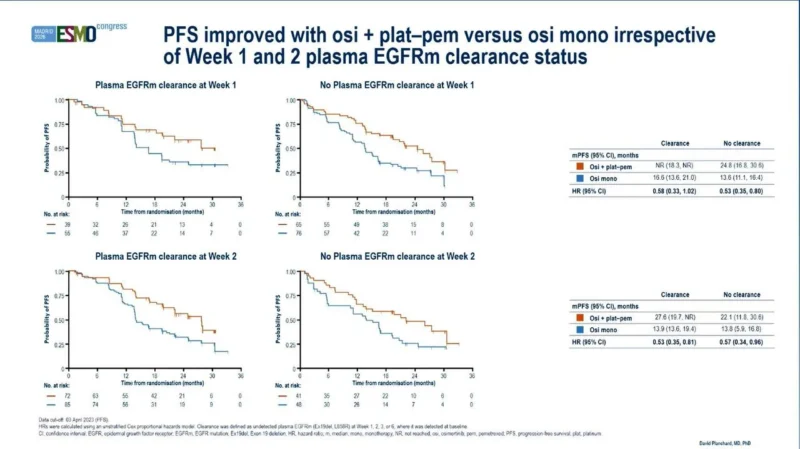
At each evaluated time point, the PFS hazard ratios generally favored osimertinib plus chemotherapy regardless of EGFR mutation clearance status. At week 1, the PFS HR was approximately 0.56 among patients who had cleared plasma EGFR mutations and 0.52 among those who had not.
At week 2, the corresponding HRs were approximately 0.52 and 0.56. At week 3, they were 0.50 among patients with clearance and 0.59 among those without clearance. At week 6, PFS HRs remained favorable at approximately 0.52 with clearance and 0.40 without clearance.
The confidence intervals were broad in some subgroups because the numbers became progressively smaller, particularly among patients with persistent detectable ctDNA at later time points.
Nevertheless, there was no consistent pattern suggesting that patients whose plasma EGFR mutation cleared early stopped benefiting from chemotherapy.
This is the major clinical message from the analysis. A patient who achieves very rapid molecular clearance after starting osimertinib cannot currently be considered biologically “safe” to de-escalate to monotherapy based on these data.
Overall Survival Showed the Same Pattern
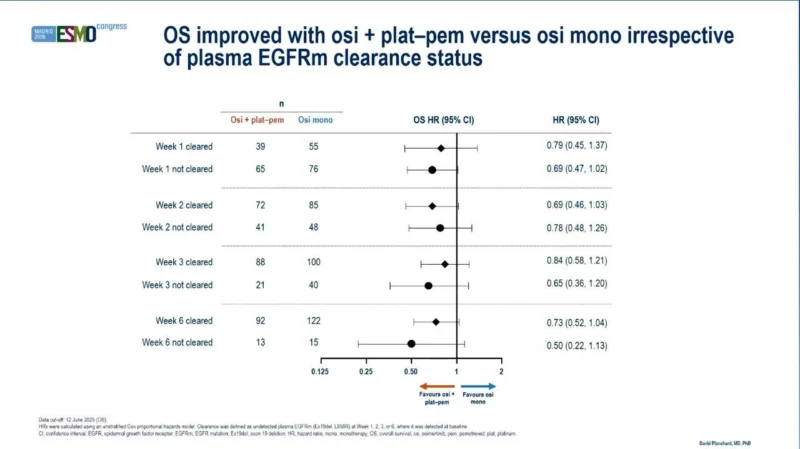
The OS analysis reinforced the PFS findings. Across clearance and non-clearance groups at weeks 1, 2, 3, and 6, the OS hazard-ratio point estimates consistently favored osimertinib plus chemotherapy.
At week 1, the OS HR was 0.79 among patients with EGFR mutation clearance and 0.69 among those without clearance. At week 2, the HRs were 0.69 and 0.78, respectively. At week 3, they were 0.84 with clearance and 0.65 without clearance. At week 6, they were 0.73 and 0.50, respectively.
Many individual confidence intervals crossed 1 because these exploratory subgroup analyses contained relatively small patient numbers and were not powered to establish statistical significance within each molecular subgroup.
The direction of effect, however, was consistent. There was no evidence that rapid EGFR ctDNA clearance defined a group in which osimertinib monotherapy produced outcomes comparable to the combination.
Why Clearance May Be Prognostic but Not Predictive
The distinction between a prognostic and predictive biomarker is central to interpreting these data. A prognostic biomarker tells clinicians something about the likely outcome of the disease. A predictive biomarker tells clinicians which treatment is more likely to work.
EGFR ctDNA clearance appears to satisfy the first definition but not the second. Patients who clear ctDNA early may simply have more treatment-sensitive disease, lower disease burden, or tumor biology associated with better outcomes regardless of treatment strategy.
The additional benefit of chemotherapy may arise through mechanisms that are not captured by whether the dominant plasma EGFR mutation becomes undetectable.
Chemotherapy could suppress tumor subclones that do not shed enough DNA to be detected by the assay, reduce heterogeneous resistant populations, delay development of resistance mechanisms, or improve disease control in compartments inadequately represented by plasma ctDNA.
A binary detectable-versus-undetectable EGFR assay may therefore be too simple to capture the biological effect of treatment intensification.
Current ddPCR Testing May Not Be Sensitive Enough for Treatment De-Escalation
The assay used in this exploratory analysis measured specific plasma EGFR mutations with droplet digital PCR. By week 6, nearly 90% of patients in both treatment groups had achieved clearance.
That creates a major challenge for predictive discrimination. When almost everyone becomes negative with either therapy, conventional clearance has limited ability to separate patients into biologically distinct groups.
A patient classified as ctDNA negative may still harbor low-level molecular residual disease below the assay’s detection threshold. The investigators therefore plan further studies using ultrasensitive multi-marker ctDNA assays.
These approaches could potentially measure several tumor-derived alterations simultaneously, quantify very low residual disease levels, and identify molecular response patterns that simple EGFR mutation clearance misses.
That may ultimately be necessary if ctDNA is to become a true treatment-selection biomarker rather than simply a marker of prognosis.
ctDNA Could Still Become Clinically Useful
The negative predictive finding does not mean that serial ctDNA monitoring has no future role in EGFR-mutated NSCLC. On the contrary, FLAURA2 confirms that molecular dynamics can provide biologically meaningful information within weeks of beginning therapy.
Future applications could include identifying patients at particularly high risk of early progression, detecting molecular resistance before radiographic progression, monitoring emergence of bypass alterations, or integrating molecular response with clinical factors such as metastatic burden and CNS disease.
What the current analysis does not support is a simple adaptive strategy in which chemotherapy is omitted or stopped because plasma EGFR mutations disappear after one or two treatment cycles.
That distinction is important because adaptive de-escalation would be clinically attractive given the greater toxicity of the chemotherapy-containing regimen. It simply requires stronger predictive evidence than current EGFR clearance data provide.
FLAURA2 Keeps Treatment Selection a Clinical Decision for Now
The choice between osimertinib monotherapy and osimertinib plus platinum-pemetrexed remains one of the central first-line decisions in EGFR-mutated advanced NSCLC.
The combination offers superior PFS and, importantly, a statistically significant overall survival advantage. The trade-off is greater toxicity, intravenous chemotherapy exposure, pemetrexed maintenance, and additional treatment burden.
For now, those decisions still need to rely primarily on clinical factors, disease characteristics, patient preferences, comorbidities, metastatic burden, and tolerance for treatment intensification.
Early ctDNA clearance cannot yet replace that judgment.
OncoDaily Takeaway
The ESMO 2026 FLAURA2 ctDNA analysis answers an important precision-oncology question—but perhaps not in the way clinicians hoped.
Plasma EGFR mutation clearance occurred rapidly with both osimertinib plus chemotherapy and osimertinib alone. By week 2, 64% of patients in both arms had cleared detectable plasma EGFR mutations, and by week 6 the rates were 88% and 89%, respectively.
Early clearance was prognostic: patients who eliminated detectable EGFR-mutant ctDNA generally had better outcomes. But it was not predictive of who benefited from chemotherapy.
Across weeks 1, 2, 3, and 6, osimertinib plus platinum-pemetrexed generally improved PFS and OS irrespective of whether plasma EGFR mutations had cleared or remained detectable.
That means an early molecular response cannot currently be used to identify patients who can safely avoid chemotherapy. The finding also provides a biological clue. The survival advantage from adding chemotherapy is unlikely to be explained simply by faster clearance of the dominant plasma EGFR mutation.
More sensitive multi-marker assays may eventually reveal molecular patterns capable of guiding treatment intensification or de-escalation. For now, however, early EGFR ctDNA clearance tells us more about prognosis than it does about which first-line FLAURA2 strategy a patient should receive.
Source
- Planchard D, et al. FLAURA2: Analysis of on-treatment plasma EGFR mutation dynamics and associated clinical outcomes in patients with EGFR-mutated advanced NSCLC treated with first-line osimertinib ± platinum-pemetrexed. Presented at ESMO Congress 2026, October 24, 2026. Clinical trial identifier NCT04035486.