
The FLAME study, presented at the 2026 ASCO Annual Meeting by Zhijie Wang from the Cancer Hospital Chinese Academy of Medical Sciences, evaluated a ctDNA-guided treatment escalation strategy in patients with locally advanced or metastatic EGFR-mutated non-small cell lung cancer receiving first-line osimertinib.
The study focused on a clinically important subgroup: patients who continued to have detectable plasma ctDNA EGFR mutations after 3 weeks of first-line osimertinib. Persistent ctDNA EGFR mutations at this early time point have been associated with poorer outcomes, raising the question of whether these patients may benefit from earlier intensification with chemotherapy rather than continuing osimertinib alone.
Study Design
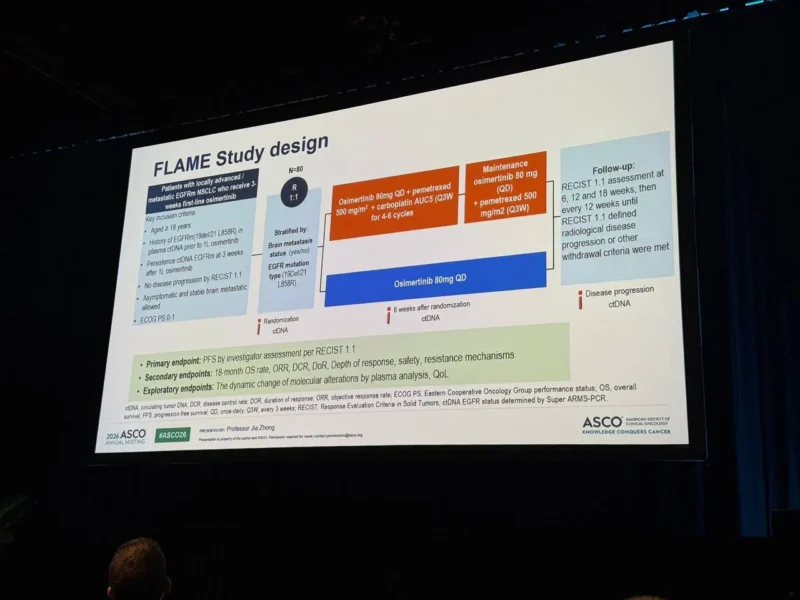
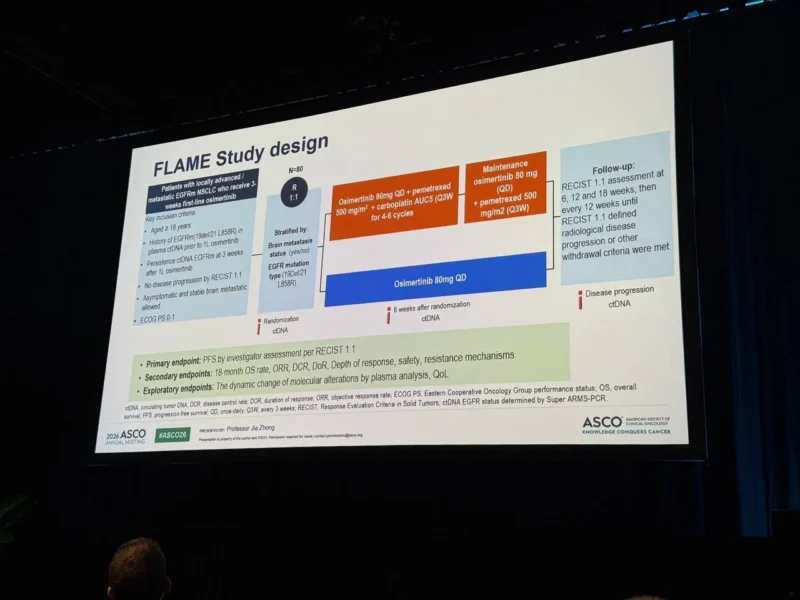
FLAME was a multicenter, randomized, controlled phase II study that enrolled patients with advanced NSCLC harboring common EGFR mutations, including EGFR exon 19 deletion or L858R. All patients initially received osimertinib, and plasma ctDNA EGFR mutation status was assessed after 3 weeks using Super ARMS-PCR.
Patients with persistent detectable plasma ctDNA EGFR mutations were randomized 1:1 to either osimertinib plus carboplatin and pemetrexed or continued osimertinib monotherapy. Randomization was stratified by CNS metastases and EGFR mutation subtype.
In the combination arm, patients received osimertinib 80 mg once daily with pemetrexed 500 mg/m² plus carboplatin AUC5 every 3 weeks for 4 to 6 cycles, followed by maintenance osimertinib plus pemetrexed. Patients in the monotherapy arm continued osimertinib 80 mg once daily.
The primary endpoint was investigator-assessed progression-free survival by RECIST 1.1. Secondary endpoints included 18-month overall survival rate, objective response rate, disease control rate, duration of response, depth of response, safety, and resistance profile. Exploratory endpoints included dynamic molecular changes by plasma analysis and quality of life.
Patient Population
Among 448 screened patients with EGFR-mutated NSCLC, 134 had persistent plasma ctDNA EGFR mutations after 3 weeks of osimertinib. In total, 80 patients were randomized, with 40 patients assigned to osimertinib plus chemotherapy and 40 patients assigned to osimertinib alone.
Baseline characteristics were generally balanced between the two arms. Median age was 58 years in the combination arm and 61 years in the osimertinib arm. Female patients represented 60% and 55% of each group, respectively. EGFR exon 19 deletion was present in 53% versus 50%, while L858R was present in 48% versus 50%. CNS metastases were reported in 35% of patients in both arms.
Key Results
At the data cutoff of January 26, 2026, osimertinib plus chemotherapy significantly prolonged progression-free survival compared with osimertinib alone.
Median progression-free survival was 23.1 months with osimertinib plus chemotherapy versus 12.7 months with osimertinib monotherapy. The hazard ratio was 0.53 with a 95% confidence interval of 0.31 to 0.92, and the difference was statistically significant with a p value of 0.024. PFS maturity was 67.5%.
Response outcomes also favored the combination arm. The investigator-assessed objective response rate was 50% with osimertinib plus chemotherapy compared with 35% with osimertinib alone. Median duration of response was 15.6 months versus 10.5 months, respectively.
Safety
Treatment-related grade 3 or higher adverse events were more frequent with osimertinib plus chemotherapy, occurring in 65% of patients compared with 10% in the osimertinib-alone arm. Investigators reported that adverse events were manageable, and no new safety signals were identified.
This safety profile highlights the expected increase in toxicity when chemotherapy is added, making patient selection an important part of the treatment escalation strategy.
Clinical Meaning
The FLAME study provides prospective randomized evidence that early ctDNA persistence after osimertinib may identify patients with EGFR-mutated NSCLC who benefit from treatment intensification. Rather than applying upfront combination therapy to all patients, FLAME used dynamic molecular assessment after 3 weeks of osimertinib to select a higher-risk group for escalation.
In patients with persistent plasma ctDNA EGFR mutations, adding chemotherapy to osimertinib improved median progression-free survival by more than 10 months compared with continuing osimertinib alone. The findings support the potential role of early molecular response monitoring as a tool for individualizing first-line treatment in EGFR-mutated NSCLC.
Key Takeaway
In the randomized phase II FLAME study, patients with locally advanced or metastatic EGFR-mutated NSCLC who had persistent plasma ctDNA EGFR mutations after 3 weeks of first-line osimertinib experienced significantly longer progression-free survival with osimertinib plus chemotherapy compared with osimertinib alone.