
The management of early-stage non–small cell lung cancer has entered a period of considerable therapeutic change. Surgery and platinum-based chemotherapy, once the foundation of curative-intent treatment, are now integrated with neoadjuvant and perioperative immunotherapy, molecularly targeted therapies, and increasingly sophisticated approaches to postoperative risk assessment. These developments have expanded treatment options and improved survival in selected populations, but they have also introduced new questions about treatment sequencing, duration, patient selection, and the long-term consequences of therapeutic intensification.
A new review published in The Lancet Respiratory Medicine examines this changing landscape and its remaining evidence gaps. Published on September 6, 2026, the article is the first installment in the journal’s Therapeutics in Lung Cancer series. It brings together evidence from major randomized trials and translational studies, with particular attention to resectable and borderline resectable disease.
The central issue emerging from the review is no longer whether immunotherapy and targeted therapies can improve outcomes after a diagnosis of early-stage NSCLC. Randomized evidence has established their efficacy in several clinical settings. The more difficult question is how to determine which patients need each treatment component, when it should be administered, and whether prolonged therapy increases the probability of cure or primarily delays recurrence.
Adjuvant Immunotherapy: An Established Approach With Inconsistent Trial Results
Adjuvant platinum-based chemotherapy historically produced only a modest improvement in survival after complete surgical resection. The introduction of immune checkpoint inhibitors created an opportunity to reduce postoperative recurrence risk, but the randomized evidence has proved more heterogeneous than initially anticipated.
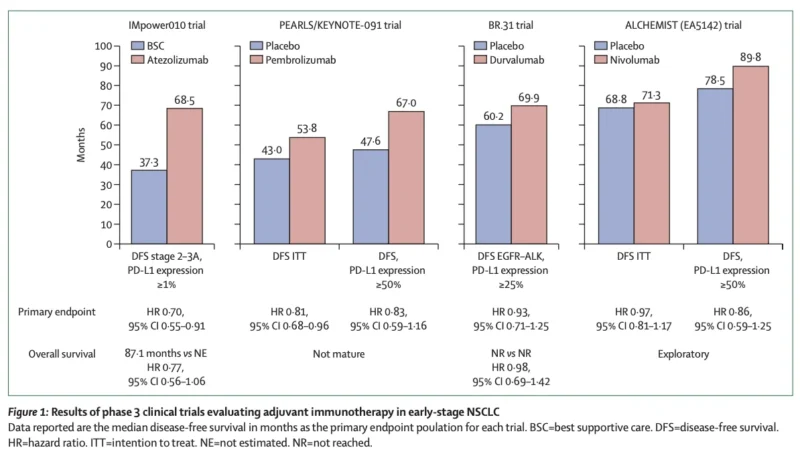
IMpower010 demonstrated improved disease-free survival with one year of atezolizumab after adjuvant platinum-based chemotherapy in patients with resected stage II–IIIA NSCLC and PD-L1 expression of at least 1%. The disease-free survival hazard ratio was 0.70, with a more pronounced treatment effect in tumors expressing PD-L1 at 50% or higher. These findings contributed to regulatory approvals, although the FDA and European Medicines Agency adopted different PD-L1 eligibility thresholds.
PEARLS/KEYNOTE-091 subsequently demonstrated a disease-free survival advantage with adjuvant pembrolizumab in the overall randomized population, with an HR of 0.81. Unlike IMpower010, however, the study did not establish a statistically significant benefit in its PD-L1-high co-primary endpoint population. More recent academic trials have complicated the interpretation of postoperative immunotherapy.
BR.31 failed to demonstrate a disease-free or overall survival benefit with adjuvant durvalumab, while ALCHEMIST-EA5142-ANVIL was stopped for futility after failing to show a disease-free survival advantage with nivolumab. The results were negative despite substantial proportions of participants receiving adjuvant chemotherapy.
These findings suggest that adjuvant immune checkpoint inhibition should not be regarded as a universally interchangeable treatment strategy. Differences in trial populations, surgical quality, staging procedures, biomarker assessment, chemotherapy exposure, and subsequent treatments may all influence the observed effect. They also highlight an unresolved biological problem: PD-L1 expression alone does not reliably explain which patients derive meaningful benefit from postoperative immunotherapy.
Neoadjuvant and Perioperative Immunotherapy Have Changed the Curative-Intent Treatment Pathway
The evidence supporting neoadjuvant and perioperative chemoimmunotherapy has developed rapidly.
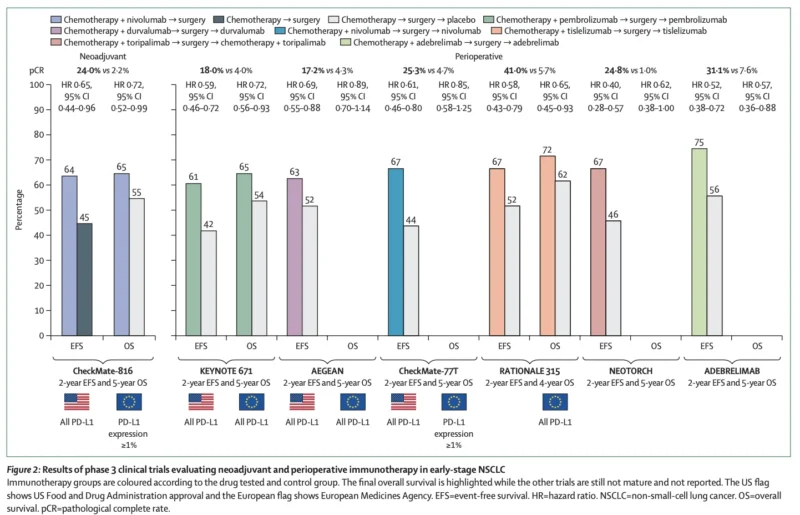
CheckMate 816 established the activity of neoadjuvant nivolumab plus chemotherapy, while KEYNOTE-671, AEGEAN, CheckMate 77T, RATIONALE-315, NEOTORCH, and the adebrelimab trial investigated perioperative approaches incorporating immunotherapy before and after surgery.
Across these randomized studies, adding immunotherapy to chemotherapy consistently increased pathological complete response rates and improved event-free survival.
The magnitude of pathological response was substantial. CheckMate 816 reported pCR in 24.0% of patients receiving nivolumab plus chemotherapy versus 2.2% with chemotherapy alone. In KEYNOTE-671, the corresponding rates were 18.0% versus 4.0%, while AEGEAN reported 17.2% versus 4.3%.
Importantly, these trials differed in patient populations, disease-stage distribution, treatment schedules, and pathological assessment. Their numerical results therefore should not be used to establish the superiority of one immunotherapy regimen over another.
The survival evidence has also matured. As summarized in the review, CheckMate 816, KEYNOTE-671, and RATIONALE-315 have demonstrated statistically significant overall survival benefits, reinforcing the clinical relevance of incorporating immunotherapy into curative-intent treatment for appropriately selected patients. Nevertheless, the availability of multiple positive regimens has created a new challenge: determining whether patients require immunotherapy both before and after surgery.
Neoadjuvant Versus Perioperative Immunotherapy Remains an Open Question
One of the most important discussions in the review concerns the contribution of postoperative immunotherapy following neoadjuvant chemoimmunotherapy. Existing perioperative trials establish the efficacy of complete treatment strategies but cannot isolate the independent benefit of their neoadjuvant and adjuvant components.
This distinction matters because a considerable proportion of patients do not complete postoperative treatment. The authors note that approximately 60% of patients initiate the adjuvant immunotherapy component in perioperative studies, while only around 37% complete the entire postoperative course.
Exploratory comparisons between CheckMate 816 and CheckMate 77T suggest that continuing nivolumab after surgery might improve event-free survival relative to a neoadjuvant-only approach. However, differences in study design, stage distribution, PD-L1 expression, and pathological response rates limit the reliability of indirect comparisons.
The available evidence also does not establish whether the postoperative component benefits all patients equally. Patients with residual viable tumor after neoadjuvant chemoimmunotherapy have a higher recurrence risk and might have a greater need for postoperative treatment. Yet it remains uncertain whether continuing the same checkpoint inhibitor is sufficient or whether a different mechanism of action would provide additional benefit.
The ongoing ADOPT trial is designed to address the independent contribution of adjuvant immunotherapy after neoadjuvant treatment. Its results will be particularly relevant when determining whether perioperative regimens can be shortened or individualized according to postoperative findings.
Pathological Complete Response Is Prognostic but Does Not Establish Cure
Pathological response has become a central endpoint in neoadjuvant lung cancer trials because it provides an early indication of treatment activity and is strongly associated with subsequent clinical outcomes. However, the review highlights an important limitation: achieving pCR does not guarantee freedom from future recurrence.
In CheckMate 816, patients achieving pCR demonstrated favorable five-year event-free and overall survival rates of 88% and 95%, respectively. More recent perioperative analyses have reported lower five-year event-free survival estimates of approximately 75%–80% among patients with pCR.
Although some of these events may represent metachronous second primary lung cancers rather than recurrence of the original tumor, the findings reinforce the need for caution when using pathological response as a substitute for long-term survival.
Consequently, pCR alone is not yet a validated basis for routinely omitting postoperative immunotherapy. Conversely, the absence of pCR identifies a population with substantial residual risk, but it does not establish which treatment should be added or substituted to improve survival.
The evolving challenge is to integrate pathological response with additional biological information rather than relying on a single postoperative endpoint.
ctDNA and Minimal Residual Disease: Strong Prognostic Signals, Unproven Treatment Guidance
Circulating tumor DNA has emerged as one of the most promising biomarkers for refining postoperative recurrence risk in early-stage NSCLC. The detection of molecular residual disease after surgery or neoadjuvant treatment frequently identifies patients with a substantially increased probability of recurrence. However, the review emphasizes that assay sensitivity, tumor shedding, sampling time, and analytical methodology strongly influence performance.
Even highly sensitive assays have an estimated negative predictive value of approximately 75% in this setting. A negative MRD result therefore cannot reliably exclude clinically important residual disease and does not currently justify treatment de-escalation.
Exploratory analyses from IMpower010 and BR.31 support the prognostic value of postoperative ctDNA but have not established a sufficiently reliable predictive role for selecting adjuvant immunotherapy.
Similarly, exploratory data from AEGEAN and CheckMate 77T demonstrate that MRD positivity after neoadjuvant treatment is associated with unfavorable outcomes. In AEGEAN, 77% of patients who were MRD-positive experienced relapse or death within 12 months after surgery, compared with 12% of MRD-negative patients.
These findings suggest that ctDNA may eventually contribute to identifying patients who require postoperative treatment intensification. However, the relevant next step is prospective demonstration that modifying treatment according to MRD status actually improves clinical outcomes. Until then, MRD should be considered a promising prognostic biomarker rather than a validated instrument for selecting or omitting curative-intent treatment.
Tumor Biology May Explain Differences in Immunotherapy Response
The review also examines the increasingly important role of the tumor immune microenvironment. Not all NSCLC tumors are equally responsive to immunotherapy, even among those without EGFR or ALK alterations. Differences in immune-cell infiltration, immune suppression, and tumor-associated genomic changes may contribute to substantial heterogeneity in treatment response.
Exploratory transcriptomic analyses from AEGEAN identified three baseline microenvironment phenotypes: immune-desert, immunosuppressed, and immune-activated. Although perioperative durvalumab improved pathological response and generally favored event-free survival across these groups, the immunosuppressed phenotype demonstrated a smaller estimated treatment effect, with an EFS HR of 0.90 compared with 0.43 and 0.41 in the immune-desert and immune-activated groups, respectively.
These findings suggest that a tumor’s pretreatment immune state may influence the effectiveness of perioperative immunotherapy. Additional complexity arises from genomic co-mutations. STK11, KEAP1, and SMARCA4 alterations have been associated with adverse biology or reduced immunotherapy sensitivity in advanced NSCLC. However, exploratory findings from early-stage trials are inconsistent, and the available evidence does not support using these alterations to determine perioperative treatment selection in routine practice.
Future biomarker development will likely require integrating genomic alterations with immune signatures, pathological response, and longitudinal ctDNA rather than searching for a single universally applicable marker.
Borderline Resectable NSCLC: Can Neoadjuvant Therapy Expand Surgical Eligibility?
The success of neoadjuvant chemoimmunotherapy in resectable disease has encouraged investigations into whether the same strategy can convert borderline or initially unresectable tumors into surgically treatable disease. This is particularly relevant for patients with selected T4 tumors or multistation, nonbulky N2 involvement, where the distinction between technically resectable and unresectable disease may vary across institutions.
However, a universally accepted definition of borderline resectability remains unavailable, complicating trial interpretation and comparison. The review describes an international retrospective cohort of 112 patients with borderline or initially unresectable stage III NSCLC, of whom 75% underwent surgical resection after neoadjuvant chemoimmunotherapy. Among resected patients, the pCR rate was 29%, with substantial nodal downstaging.
Similarly, the phase II MDT-BRIDGE study reported that 71% of patients initially classified as borderline resectable proceeded to surgery following neoadjuvant durvalumab-based chemoimmunotherapy. These observations demonstrate the feasibility of surgical conversion in selected patients. They do not, however, establish that surgery following induction treatment improves survival compared with definitive chemoradiotherapy.
The authors emphasize the importance of timely multidisciplinary reassessment, standardized definitions of resectability, and avoiding unnecessary delays in definitive radiotherapy when surgery remains unsuitable. At present, conversion strategies in borderline resectable disease remain investigational rather than an established replacement for definitive multimodality treatment.
EGFR-Mutant NSCLC: Adjuvant Osimertinib Improves Survival, but Duration Remains Unresolved
The introduction of adjuvant osimertinib has fundamentally changed the treatment of resected EGFR-mutant NSCLC. The ADAURA trial established the efficacy of three years of osimertinib in patients with completely resected stage IB–IIIA disease harboring EGFR exon 19 deletions or L858R mutations.
As summarized in the review, median disease-free survival reached 65.8 months with osimertinib versus 28.1 months with placebo, with an HR of 0.20. The trial also demonstrated a statistically significant overall survival benefit, with an HR of 0.49. However, the magnitude of DFS benefit appears to decrease after treatment discontinuation, raising a fundamental question about the long-term biological effects of adjuvant EGFR inhibition.
Does osimertinib eradicate micrometastatic disease in a substantial proportion of patients, or does prolonged kinase inhibition primarily delay the emergence of clinically detectable recurrence? The review highlights the ongoing TARGET trial, which is evaluating five years of adjuvant osimertinib, as an important attempt to explore longer treatment duration.
Nevertheless, extended treatment introduces additional concerns regarding cumulative toxicity, adherence, quality of life, and financial burden. Furthermore, longer treatment cannot automatically be assumed to improve the probability of cure without prospective comparative evidence.
Is Adjuvant Chemotherapy Still Necessary With Osimertinib?
Another unresolved issue in EGFR-mutant disease is the contribution of platinum-based chemotherapy when an effective adjuvant TKI is available. In ADAURA, chemotherapy was permitted but not mandatory, and treatment allocation was not stratified according to its use. The relative benefit of osimertinib appeared broadly similar regardless of prior chemotherapy exposure.
However, the review notes that among patients with stage II–IIIA disease receiving osimertinib, five-year overall survival was numerically higher in those who had previously received chemotherapy than in those who had not. Because chemotherapy use was not randomized, these results cannot establish its independent survival contribution.
The issue remains clinically important. Omitting chemotherapy reduces treatment-related toxicity, but it may also remove a potentially curative component of multimodality treatment. Determining whether effective targeted therapy can replace rather than supplement chemotherapy will require randomized evidence designed specifically to answer that question.
Neoadjuvant EGFR Inhibition Has Not Yet Established a New Standard
The neoadjuvant EGFR TKI landscape is developing rapidly, but the biological and clinical implications remain different from those observed with immunotherapy. NeoADAURA demonstrated that neoadjuvant osimertinib significantly increased major pathological response compared with chemotherapy alone. MPR rates were approximately 25% with osimertinib alone and 26% with osimertinib plus chemotherapy, compared with 2% in the chemotherapy control group.
However, the addition of chemotherapy did not significantly improve MPR over osimertinib alone, and pCR rates remained relatively low. More importantly, long-term survival outcomes are not yet mature, and the contribution of neoadjuvant treatment is difficult to establish when most patients subsequently receive adjuvant osimertinib.
The review therefore identifies neoadjuvant EGFR inhibition as an important emerging strategy but emphasizes that patient selection, treatment duration, combination therapy, and its additional curative value remain unresolved.
ALK-Positive NSCLC: The Success of Alectinib Creates New Sequencing Questions
The ALINA trial established two years of adjuvant alectinib as a treatment strategy for appropriately selected patients with resected ALK-positive NSCLC. Updated results summarized in the review demonstrate sustained disease control, with four-year DFS of 75.5% with alectinib versus 47.0% with platinum-based chemotherapy, corresponding to an HR of 0.35.
The trial also demonstrated a reduction in CNS relapse, an important outcome in ALK-positive disease. However, alectinib was compared with chemotherapy rather than being added to it, leaving the role of combined or sequential adjuvant chemotherapy uncertain.
Overall survival remains immature, and the long-term contribution of chemotherapy cannot be definitively excluded. The review also discusses the emerging neoadjuvant ALK TKI landscape. Early trials of alectinib, brigatinib, and lorlatinib demonstrate substantial radiographic activity, with particularly encouraging results from the phase II LORIN study in stage III disease.
Nevertheless, these results are based on relatively small populations. They do not yet establish the optimal use of neoadjuvant ALK inhibition or justify replacing established adjuvant strategies.
Targeted Adjuvant Therapy Is Expanding Beyond EGFR and ALK
Advances in molecular oncology are extending postoperative targeted treatment to additional oncogenic drivers. The review highlights LIBRETTO-432, which evaluated three years of selpercatinib versus placebo following surgery, with or without previous chemotherapy, in patients with RET fusion–positive NSCLC.
Among patients with stage II–IIIA disease, two-year investigator-assessed event-free survival was 92% with selpercatinib versus 61% with placebo, corresponding to an HR of 0.17. These results support the expansion of targeted therapy into additional molecular subsets of resected NSCLC.
However, as with other adjuvant kinase inhibitors, important questions remain regarding optimal treatment duration, CNS protection, long-term overall survival, and whether treatment should be administered to all eligible patients or reserved for those with a higher probability of recurrence.
The broader challenge is therefore becoming one of molecularly informed risk selection rather than simply identifying the presence of an actionable driver.
Radiotherapy and Immunotherapy: Improved Pathological Response Has Not Yet Established Survival Benefit
The review also evaluates the potential immunomodulatory effects of radiotherapy in early-stage NSCLC. Radiotherapy may enhance tumor-antigen release and alter the immune microenvironment, providing a biological rationale for its combination with checkpoint inhibition. Several early-phase neoadjuvant studies have reported substantial pathological response rates when stereotactic or hypofractionated radiotherapy is combined with immunotherapy and chemotherapy.
For example, SACTION-01 reported a pCR rate of 52% with SBRT followed by chemoimmunotherapy and surgery. However, the available studies are relatively small, and high pathological response rates have not consistently translated into improved survival.
The distinction is important because radiotherapy may produce profound local tumor sterilization without necessarily improving systemic control of micrometastatic disease. In medically inoperable early-stage NSCLC, the phase III KEYNOTE-867 and SWOG/NRG S1914 trials also failed to demonstrate improved outcomes when checkpoint inhibitors were added to stereotactic radiotherapy, while treatment-related toxicity increased.
Consequently, the optimal combination of radiotherapy and immunotherapy, including dose, fractionation, sequence, and treatment volume, remains investigational.
The Next Phase of Early-Stage NSCLC Requires Better Treatment Selection
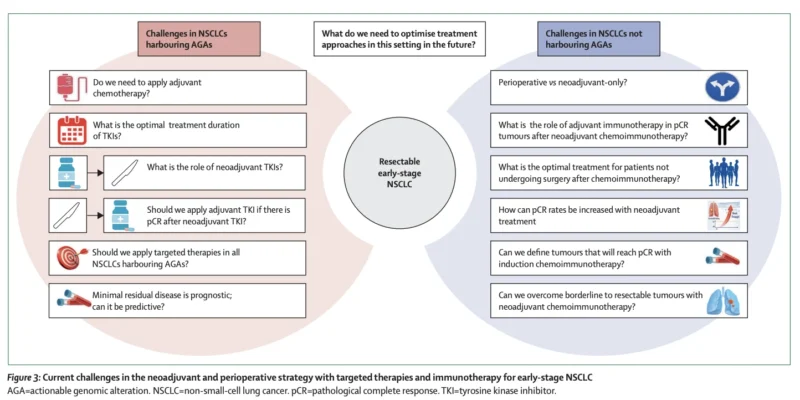
The collective evidence reviewed by Remon and colleagues suggests that the principal challenge in early-stage NSCLC has shifted. Randomized studies have already established multiple effective immunotherapy and targeted treatment strategies. What remains uncertain is how to combine these treatments rationally while minimizing unnecessary exposure. Several priorities emerge from the review.
Pathological response and MRD need to be validated as tools for guiding treatment rather than used only to describe prognosis. The independent contribution of postoperative immunotherapy must be established in randomized trials. In oncogene-driven disease, the optimal duration of adjuvant TKIs and the continued role of chemotherapy require prospective evaluation.
Equally important is the need to integrate patient-reported outcomes and long-term survivorship into treatment development. Curative-intent patients may remain on treatment for years, making chronic toxicity, quality of life, financial burden, and access important considerations.
The authors emphasize that future progress will depend not simply on adding more effective drugs to existing regimens but on identifying which treatment components are necessary for individual patients.
The Bottom Line
Early-stage NSCLC is undergoing a transition from conventional surgery-centered treatment toward integrated, biomarker-informed multimodality care.
Neoadjuvant and perioperative chemoimmunotherapy have improved pathological response, event-free survival, and, in selected trials, overall survival. Adjuvant osimertinib and alectinib have demonstrated substantial benefits in EGFR- and ALK-driven disease, while emerging data are extending targeted approaches to additional genomic alterations.
Yet several fundamental questions remain unanswered. The optimal contribution of adjuvant immunotherapy after neoadjuvant treatment is uncertain, pCR and MRD are not yet validated for routine treatment de-escalation, and the ideal duration and sequencing of targeted therapies remain incompletely defined.
The next major advance in curative-intent lung cancer may therefore come not from increasing treatment intensity across every patient population, but from developing reliable strategies to identify who needs more treatment, who can safely receive less, and how each therapeutic component contributes to the probability of cure.
Reference
- Remon J, Cascone T, Saw SPL, Frost N, Li MSC, Hendriks LEL, Levy A, Di Federico A, Chaft JE, Abdelhamid K, Awad M, Mountzios G, Peters S. Early-stage non-small-cell lung cancer: emerging treatments and evolving challenges. The Lancet Respiratory Medicine. Published online September 6, 2026. doi:10.1016/S2213-2600(26)00221-3 .