DESTINY-Lung03 Part 1 provides an important signal for the treatment of HER2-overexpressing non-small cell lung cancer (NSCLC). The study confirms that trastuzumab deruxtecan (T-DXd) monotherapy has clinically meaningful activity in previously treated metastatic HER2-overexpressing NSCLC, while also showing that combining T-DXd with durvalumab plus platinum chemotherapy created unacceptable toxicity and does not support further development of this triplet strategy in this patient population (Planchard et al.).
This is a clinically relevant distinction. HER2-directed therapy remains an unmet need in NSCLC, where HER2 overexpression by immunohistochemistry is less standardized than in breast or gastric cancer and where treatment options after prior therapy often remain limited. DESTINY-Lung03 helps clarify two messages at once: T-DXd remains active as a single agent, but more treatment is not automatically better treatment.
Why HER2-Overexpressing NSCLC Needs Better Options
NSCLC accounts for approximately 85% of lung cancers, and molecular testing has reshaped treatment for patients with actionable alterations. However, HER2 overexpression, defined in this study as IHC 3+ or IHC 2+, remains a more complex biomarker than HER2 mutation. HER2 overexpression has been reported in a variable proportion of NSCLC cases, and routine HER2 IHC testing is not yet as embedded in NSCLC practice as EGFR, ALK, ROS1, BRAF, MET, RET, NTRK, or KRAS testing (Planchard et al.).
For patients with previously treated HER2-overexpressing NSCLC, available options have often resembled the all-comer NSCLC setting, including docetaxel-based therapy. Outcomes with these approaches remain modest. This creates a strong rationale for studying HER2-directed antibody-drug conjugates such as T-DXd.
What DESTINY-Lung03 Tested
DESTINY-Lung03 is an open-label, multicenter, multi-arm phase 1b study evaluating T-DXd-based regimens in patients with HER2-overexpressing NSCLC. Part 1 included previously treated patients with locally advanced unresectable or metastatic nonsquamous NSCLC with centrally confirmed HER2 overexpression.
Three treatment approaches were evaluated:
Arm 1A tested T-DXd plus durvalumab and cisplatin. Arm 1B tested T-DXd plus durvalumab and carboplatin. Arm 1D tested T-DXd monotherapy at 5.4 mg/kg every 3 weeks.
At the April 1, 2024 data cutoff, 71 patients had received treatment: 11 in Arm 1A, 24 in Arm 1B, and 36 in Arm 1D. The overall median age was 63 years, 88.7% of patients were from Asia, 62.0% had ECOG performance status 1, and 36.6% had baseline brain or CNS metastases. Approximately half had received one prior line of therapy, and nearly half had received two prior lines. Prior targeted therapy, including EGFR tyrosine kinase inhibitors, was common (Planchard et al.).
The Safety Problem With T-DXd Plus Durvalumab And Cisplatin
The cisplatin-containing triplet was not tolerable enough to move forward. In Arm 1A, three dose-limiting toxicities were reported. These included grade 5 febrile neutropenia in one patient receiving T-DXd 4.4 mg/kg plus durvalumab and cisplatin 60 mg/m², and decreased platelet count in two patients receiving T-DXd 5.4 mg/kg plus durvalumab and cisplatin 75 mg/m², including one grade 4 and one grade 5 event.
Across the cisplatin arm, drug-related adverse events occurred in all patients, and grade 3 or higher drug-related adverse events also occurred in all patients. Drug-related serious adverse events were reported in 63.6% of patients. Two patients died due to drug-related adverse events: febrile neutropenia and decreased platelet count. Because of this toxicity profile, enrollment to this arm was closed (Planchard et al.).
The message is clear: this combination was too toxic for further development in this setting.
Carboplatin Was Also Not Safe Enough
The carboplatin-containing triplet had antitumor activity, but safety remained a major concern. In Arm 1B, three dose-limiting toxicities occurred: two cases of febrile neutropenia and one grade 4 decreased platelet count.
Drug-related adverse events occurred in 95.8% of patients, grade 3 or higher drug-related adverse events in 83.3%, and drug-related serious adverse events in 37.5%. Drug-related adverse events led to discontinuation in 16.7% of patients. Two patients died due to drug-related adverse events, including one case of febrile neutropenia and one case of ILD/pneumonitis (Planchard et al.).
Adjudicated drug-related ILD/pneumonitis occurred in 12.5% of patients in the carboplatin arm, including two grade 5 events. Although T-DXd 5.4 mg/kg plus durvalumab and carboplatin AUC 5 was selected as a recommended phase 2 dose within the study process, the overall safety and efficacy data did not support further investigation of this regimen in previously treated HER2-overexpressing NSCLC.
T-DXd Monotherapy Showed A Cleaner And More Clinically Useful Signal
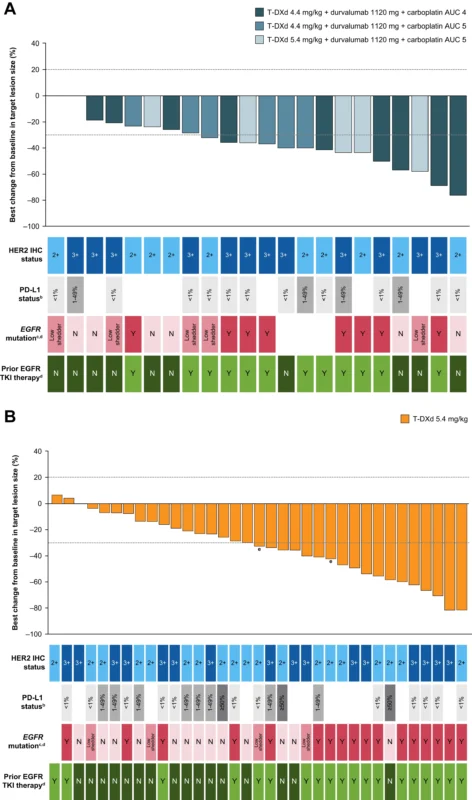
The monotherapy arm is the most clinically important part of DESTINY-Lung03 Part 1. In Arm 1D, 36 patients received T-DXd 5.4 mg/kg every 3 weeks. The confirmed objective response rate by investigator assessment was 44.4%, with all responses being partial responses. The disease control rate at 12 weeks was 77.8%.
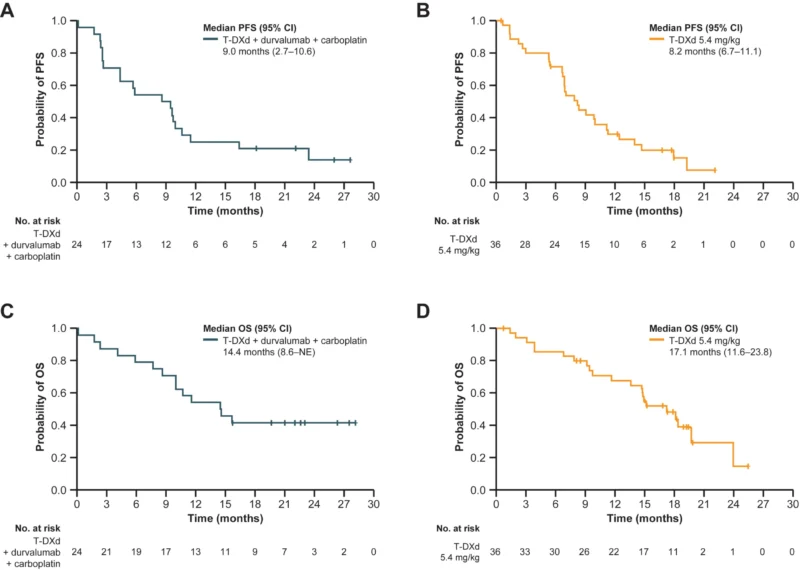
Median duration of response was 11.0 months, median progression-free survival was 8.2 months, and median overall survival was 17.1 months (Planchard et al.).
The safety profile was also more manageable than the triplet arms. Drug-related adverse events occurred in 94.4% of patients, but grade 3 or higher drug-related adverse events occurred in 41.7%, lower than in the platinum-containing arms. Drug-related serious adverse events were reported in 16.7%, and drug-related adverse events led to discontinuation in 8.3%. One patient died due to a drug-related adverse event, neutropenic colitis.
Adjudicated drug-related ILD/pneumonitis occurred in 5.6% of patients, and both cases were grade 2. This rate was consistent with prior T-DXd experience and did not reveal a new safety signal (Planchard et al.).
Activity Across HER2 IHC Subgroups
DESTINY-Lung03 also provides useful exploratory data by HER2 IHC level. In the T-DXd monotherapy arm, the confirmed ORR was 56.3% in patients with HER2 IHC 3+ disease and 35.0% in patients with HER2 IHC 2+ disease.
Median PFS was 6.9 months in the HER2 IHC 3+ subgroup and 8.2 months in the HER2 IHC 2+ subgroup. Median OS was 16.4 months and 17.1 months, respectively (Planchard et al.).
These subgroup data should be interpreted cautiously because the study was small and not powered for subgroup comparisons. However, the results reinforce that HER2 IHC status may identify a population with sensitivity to T-DXd, including patients with IHC 2+ disease, where the clinical role of HER2-directed therapy remains under investigation.
Activity In Patients With Prior EGFR TKI Exposure
One of the most interesting signals was seen in patients with prior EGFR TKI exposure. In the monotherapy arm, the confirmed ORR was 68.4% in patients with prior EGFR TKI exposure compared with 17.6% in those without prior EGFR TKI exposure.
Median PFS was 8.2 months in patients with prior EGFR TKI exposure and 7.1 months in those without. Median OS was 19.6 months and 14.7 months, respectively (Planchard et al.).
This finding is hypothesis-generating. HER2 amplification has been described as one potential resistance mechanism after EGFR TKI therapy in EGFR-mutant NSCLC, and the DESTINY-Lung03 data raise the possibility that HER2 overexpression may also be clinically relevant in some post-EGFR TKI settings. However, the sample size was small, EGFR mutation status was retrospectively assessed using liquid biopsy, and further validation is needed.
Why The Triplet Failed Despite Activity
The carboplatin-containing triplet produced a confirmed ORR of 37.5%, median duration of response of 7.7 months, median PFS of 9.0 months, and median OS of 14.4 months. These results show that the regimen was active, but the efficacy did not clearly outperform T-DXd monotherapy enough to justify the added toxicity (Planchard et al.).
This is an important clinical lesson. Combining an ADC with immunotherapy and chemotherapy may sound biologically attractive, but the therapeutic window matters. In this study, the burden of hematologic toxicity, serious adverse events, treatment discontinuations, and fatal events outweighed the potential benefit of the triplet strategy.
Clinical Meaning
DESTINY-Lung03 Part 1 strengthens the evidence supporting T-DXd monotherapy in previously treated HER2-overexpressing NSCLC. The study confirms activity in HER2 IHC 3+ disease and provides additional evidence of activity in HER2 IHC 2+ tumors.
At the same time, it shows that T-DXd plus durvalumab and platinum chemotherapy is not a viable strategy in this previously treated population. The toxicity profile, especially in the cisplatin arm and with ILD/pneumonitis in the carboplatin arm, limits further development.
The broader implication is that HER2 overexpression deserves more attention in NSCLC diagnostic workup. Unlike HER2-mutant NSCLC, HER2-overexpressing NSCLC remains a less clearly defined clinical category, and standardized HER2 IHC assessment in NSCLC is still needed. DESTINY-Lung03 supports the concept that HER2 IHC can identify patients who may benefit from HER2-directed therapy, but also highlights the need for optimized testing frameworks specific to lung cancer.
Limitations
The study has several limitations. It was a phase 1b study with small sample sizes across treatment arms. The monotherapy arm included only 36 patients, and subgroup analyses by HER2 IHC status, EGFR mutation status, and prior EGFR TKI exposure were exploratory.
HER2 overexpression was assessed using available tissue, often archival, and repeat biopsy at progression was encouraged but not required. HER2 expression may change over time or after treatment, which complicates interpretation. EGFR mutation status was assessed retrospectively using plasma ctDNA, which may miss mutations in low-shedding tumors.
Because no formal statistical comparisons were performed, the findings should be interpreted as supportive and hypothesis-generating rather than definitive.
Conclusion
DESTINY-Lung03 Part 1 confirms that T-DXd monotherapy has meaningful antitumor activity in previously treated HER2-overexpressing NSCLC, with a confirmed ORR of 44.4%, median PFS of 8.2 months, and median OS of 17.1 months. The safety profile was manageable and consistent with prior T-DXd experience.
In contrast, T-DXd plus durvalumab and platinum chemotherapy was associated with unacceptable toxicity and does not support further investigation in this previously treated population.
The study reinforces HER2 overexpression as an actionable biomarker in NSCLC and supports broader consideration of HER2 IHC testing in NSCLC diagnostic workflows. The next step is not simply combining more agents, but identifying the right HER2-directed strategy for the right patient.