
Proactive dermatologic management may substantially reduce one of the most important treatment burdens associated with first-line amivantamab plus lazertinib in EGFR-mutated advanced non-small cell lung cancer, and a new strategy delaying the introduction of amivantamab appears to lower early skin toxicity even further.
Updated results from new non-randomized cohorts of the phase II COCOON study, presented at ESMO Congress 2026, showed that simplified prophylaxis accompanying subcutaneous amivantamab plus lazertinib was associated with relatively low rates of moderate-to-severe dermatologic adverse events.
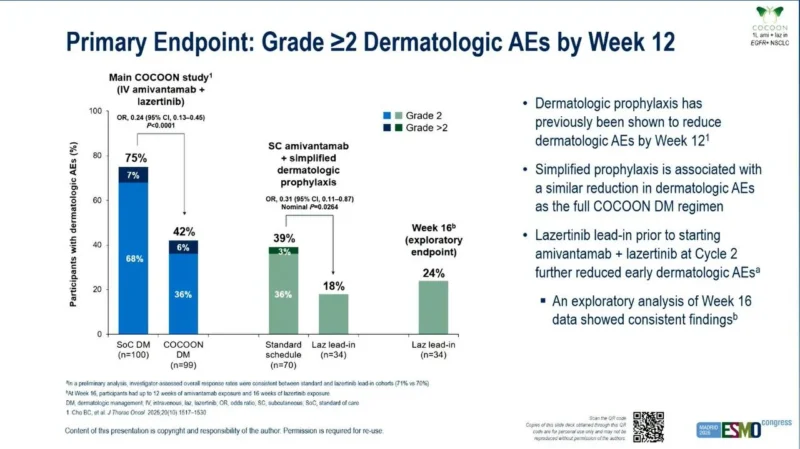
The most striking signal came from a cohort using a lazertinib lead-in before introducing subcutaneous amivantamab. By week 12, grade ≥2 dermatologic adverse events occurred in 39% of patients receiving subcutaneous amivantamab on the standard schedule compared with 18% in the lazertinib lead-in cohort.
At week 16, when patients in the lead-in cohort had accumulated up to 12 weeks of exposure to amivantamab, the incidence remained 24%.
These updated presentation data suggest that combining simplified prophylactic skin management with delayed introduction of amivantamab may further reduce early dermatologic toxicity without an obvious loss of antitumor activity.
However, the two subcutaneous cohorts were non-randomized, and the study did not prespecify formal comparisons between them. The 39% versus 18% difference should therefore be viewed as a clinically compelling signal rather than definitive evidence that the lead-in strategy is superior.
Dermatologic Toxicity Has Been a Major Challenge With Amivantamab Plus Lazertinib
Amivantamab plus lazertinib has established an important first-line role in EGFR exon 19 deletion or L858R-mutated advanced NSCLC.Its efficacy comes with a characteristic toxicity profile driven partly by amivantamab’s EGFR-directed activity.
Rash, dermatitis acneiform, pruritus, paronychia, scalp reactions, skin fissures and other cutaneous toxicities can become clinically significant. Although many events are not life-threatening, they may interfere with daily activities, affect quality of life and lead to dose interruptions, dose reductions or treatment discontinuation.
The original COCOON study demonstrated that proactive management can substantially change this experience. In the randomized main COCOON study using intravenous amivantamab plus lazertinib, an enhanced dermatologic-management regimen reduced grade ≥2 dermatologic adverse events during the first 12 weeks from 75% with standard management to 42% with COCOON management.
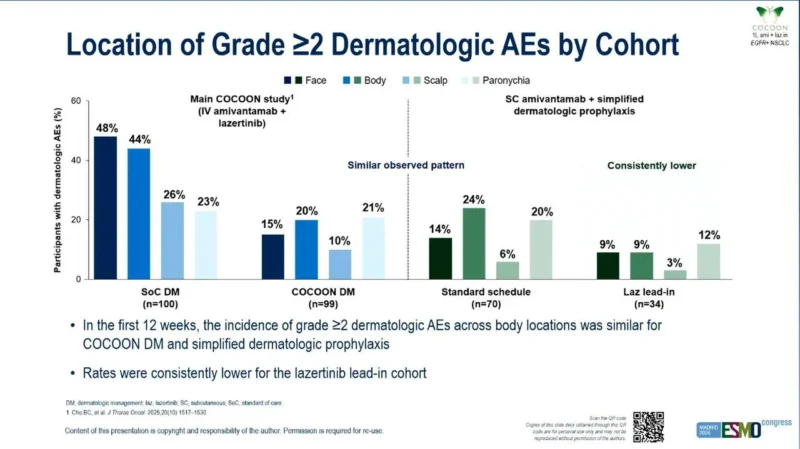
The benefit was seen across several body sites. Facial grade ≥2 events decreased from 48% to 15%, body events from 44% to 20%, and scalp events from 26% to 10%.
Those findings established that skin toxicity with EGFR-directed therapy should not simply be accepted and treated reactively after it appears. The ESMO 2026 update asks whether that strategy can now be simplified and optimized further.
The New COCOON Cohorts Used Subcutaneous Amivantamab
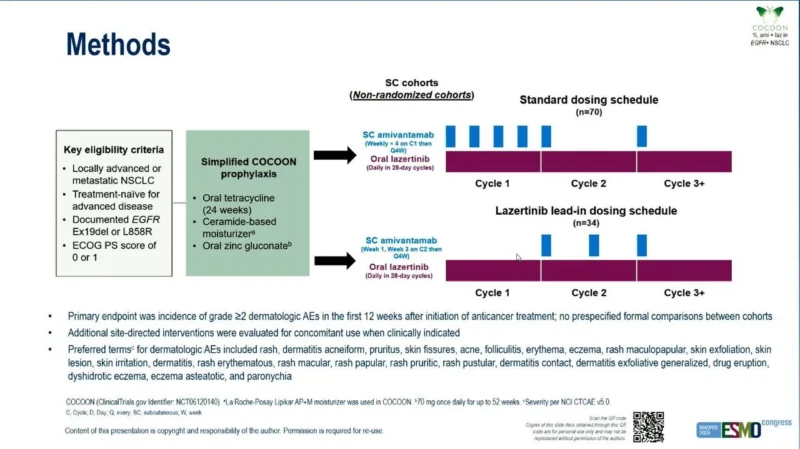
The new analysis evaluated patients with previously untreated locally advanced or metastatic NSCLC harboring EGFR exon 19 deletion or L858R mutations.
Patients had ECOG performance status 0 or 1 and received subcutaneous amivantamab together with daily oral lazertinib. Unlike the original COCOON dermatologic regimen, the simplified prophylactic strategy used oral tetracycline for 24 weeks, a ceramide-based moisturizer and oral zinc gluconate.
The regimen removed some of the more complex site-directed prophylactic components used previously, including routine scalp clindamycin and chlorhexidine nail care. The rationale was practical.
A preventive strategy is most likely to influence routine clinical care if it is effective, easy to explain, easy for patients to follow and sustainable over months of treatment.
Subcutaneous amivantamab also changes the treatment experience by reducing administration burden compared with the intravenous formulation, making optimization of supportive care increasingly relevant as the regimen becomes easier to deliver. Contemporary clinical programs have also incorporated prophylactic skin management with SC amivantamab.
Two Different Amivantamab Starting Strategies Were Evaluated
The ESMO presentation included two non-randomized subcutaneous cohorts. Seventy patients received amivantamab according to the standard starting schedule together with lazertinib and simplified dermatologic prophylaxis.
A separate cohort of 34 patients began treatment with lazertinib alone before subcutaneous amivantamab was introduced, creating a lazertinib lead-in period. Once amivantamab was started in the lead-in cohort, it was administered during cycle 2 and then transitioned to the less frequent maintenance schedule.
The biological rationale is plausible. Dermatologic toxicity appears particularly concentrated during the early period of amivantamab exposure. Temporally separating initiation of lazertinib from introduction of amivantamab could reduce the abrupt intensity of EGFR-pathway inhibition during the first weeks of therapy.
The study was not designed to prove that mechanism, but the clinical results support further evaluation of the concept.
Grade ≥2 Dermatologic Toxicity Fell to 18% With Lazertinib Lead-In
With the standard subcutaneous schedule plus simplified prophylaxis, 39% of patients experienced grade ≥2 dermatologic adverse events during the first 12 weeks. In the lazertinib lead-in cohort, the corresponding rate was only 18%.
That represents a large numerical reduction in early clinically meaningful skin toxicity. The finding becomes particularly interesting when placed alongside the original randomized COCOON experience.
In the main IV study, grade ≥2 dermatologic adverse events occurred in 75% with standard dermatologic care and 42% with the full COCOON prophylactic regimen.
The new standard-schedule SC cohort produced a similar rate of 39% with the simplified prophylactic regimen, suggesting that the simplified strategy may preserve much of the benefit of the original COCOON approach.
The lazertinib lead-in cohort reduced the rate numerically even further to 18%. Because these are different cohorts and not a randomized comparison, that progression from 75% to 42%, 39% and 18% should not be treated as a formal comparative hierarchy. Nevertheless, the pattern is clinically provocative.
The Lead-In Benefit Persisted After Longer Amivantamab Exposure
One potential concern is that the lower week-12 rate in the lead-in cohort could simply reflect less cumulative exposure to amivantamab. The investigators therefore also examined dermatologic adverse events at week 16.
By that point, patients in the lead-in cohort had received up to approximately 12 weeks of amivantamab exposure. The incidence of grade ≥2 dermatologic toxicity was still only 24%.
This exploratory result strengthens the possibility that the lead-in strategy may genuinely modify the early toxicity pattern rather than merely postpone the same events by several weeks. Longer follow-up will be needed to determine whether the difference remains durable.
Skin Toxicity Was Lower Across Multiple Body Sites
The presentation also examined where dermatologic events occurred. With the standard SC schedule, grade ≥2 events occurred on the face in 14%, body in 24%, scalp in 6%, and paronychia was reported in 20%.
Rates were consistently lower with lazertinib lead-in. Grade ≥2 facial events occurred in 9%, body events in 9%, scalp events in 3%, and paronychia in 12%. The consistency across anatomical locations makes the signal more convincing than a reduction driven by only one type of toxicity.
It also compares favorably with the original IV COCOON experience, particularly for facial and body reactions.
Fewer Dermatologic Events Translated Into Fewer Treatment Modifications
Reducing rash is clinically useful, but the more important question is whether prophylaxis allows patients to stay on therapy more consistently. The ESMO presentation suggests that it may.
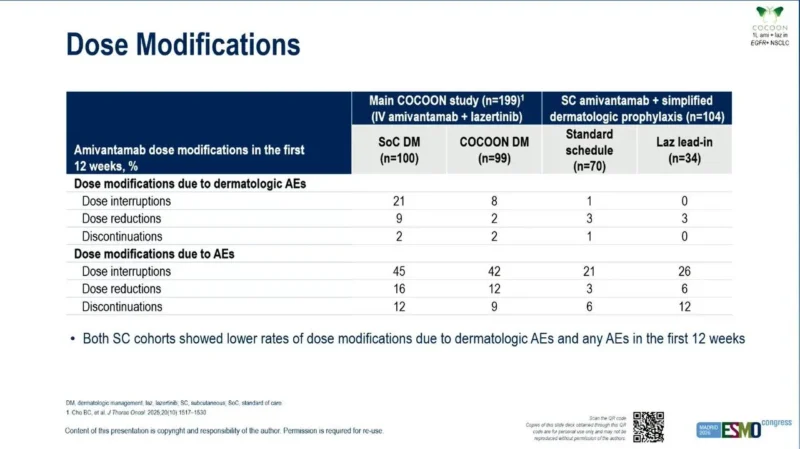
During the first 12 weeks, dermatologic adverse events led to an amivantamab interruption in only 1% of patients receiving the standard SC schedule with simplified prophylaxis and in none of the patients in the lazertinib lead-in cohort.
Dose reductions because of dermatologic toxicity occurred in 3% of each cohort. Dermatologic adverse events led to discontinuation in 1% with the standard SC schedule and 0% with the lead-in strategy.
These rates are substantially lower than those seen historically when dermatologic toxicity was managed less proactively. The main randomized COCOON trial had already demonstrated that preventive management reduces the need for reactive medications and can reduce treatment modifications related to skin toxicity.
The new findings suggest that combining simplified prophylaxis with SC administration may improve treatment continuity further.
Overall Dose Modification Still Occurred
The favorable dermatologic results should not be interpreted as meaning the regimen eliminates treatment-management requirements.
When adverse events of any type were considered, dose interruptions occurred in 21% of patients receiving the standard SC schedule and 26% receiving lazertinib lead-in. Dose reductions occurred in approximately 3% and 6%, respectively, while discontinuations due to any adverse event occurred in approximately 6% and 12%.
The lead-in strategy therefore appears most clearly differentiated for early dermatologic toxicity rather than for every category of treatment-related adverse event. Longer follow-up will also be needed before making conclusions about overall treatment discontinuation, particularly given the small lead-in cohort.
The Preliminary Efficacy Signal Appeared Preserved
Any strategy that delays introduction of an active anticancer drug raises an obvious concern: could improved tolerability come at the expense of tumor control? The preliminary data are reassuring but immature.
According to the final ESMO presentation, investigator-assessed response rates were approximately 71% with the standard SC schedule and 70% with lazertinib lead-in. This suggests that delaying amivantamab introduction did not produce an obvious early efficacy penalty.
However, response rate alone cannot establish long-term equivalence. Progression-free survival, depth and durability of response, CNS control and ultimately overall survival will require longer follow-up before the therapeutic consequences of lead-in dosing can be fully assessed.
The efficacy observation should therefore remain supportive rather than definitive.
Zinc Supplementation Adds a New Supportive-Care Component
The simplified regimen also introduced oral zinc gluconate. This reflects growing interest in the relationship between EGFR inhibition, zinc homeostasis and dermatologic toxicity.
EGFR-targeted treatment can be associated with secondary zinc deficiency, and lower zinc levels have been linked with more severe skin toxicity. Whether zinc supplementation itself accounts for a meaningful portion of the improvement observed in the new COCOON cohorts cannot be determined from this study design.
The simplified regimen changed several components simultaneously and was not randomized against an identical regimen without zinc. The results support the complete prophylactic package rather than proving efficacy of any individual component.
A Practical Shift From Reactive to Preventive Toxicity Management
The broader importance of COCOON extends beyond the specific percentages. Targeted therapies are increasingly effective enough that management of chronic toxicity can determine whether patients remain on treatment long enough to realize the full clinical benefit.
Historically, EGFR-related skin toxicity was often handled reactively: patients developed rash or paronychia, and treatment began only after symptoms appeared. COCOON supports the opposite strategy.
Dermatologic management begins before clinically important toxicity develops. That shift resembles prophylactic approaches already standard in other areas of oncology, where clinicians routinely anticipate predictable adverse events rather than waiting for them to become severe.
The new SC data suggest this preventive model can potentially be made simpler rather than more complicated.
The Non-Randomized Design Remains the Major Limitation
The most important caution is methodological. The standard-schedule and lazertinib lead-in SC cohorts were not randomized. The trial specified no formal statistical comparison between the two groups.
The lead-in cohort also included only 34 patients, making the 18% toxicity estimate sensitive to a relatively small number of events.
Differences in follow-up, patient characteristics or other unmeasured factors could contribute to the observed numerical difference. For that reason, it would be premature to conclude that lazertinib lead-in is definitively superior to simultaneous treatment initiation.
The signal is strong enough to justify further study, but randomized confirmation would provide considerably greater confidence.
OncoDaily Takeaway
The ESMO 2026 COCOON update suggests that dermatologic toxicity with amivantamab plus lazertinib may be increasingly preventable rather than inevitable.
The original randomized COCOON trial reduced grade ≥2 dermatologic adverse events with IV amivantamab plus lazertinib from 75% to 42% using proactive dermatologic management.
The updated presentation now shows a 39% rate with subcutaneous amivantamab using a simplified prophylactic regimen based on prolonged oral tetracycline, ceramide-based moisturizer and zinc supplementation. More strikingly, introducing amivantamab only after a lazertinib lead-in reduced the week-12 incidence to 18%, with a week-16 rate of 24% despite longer subsequent amivantamab exposure.
Dermatologic toxicity was lower across the face, body, scalp and nails, and treatment interruptions or discontinuations specifically caused by dermatologic events were uncommon. Preliminary response rates remained similar at approximately 71% versus 70%, although longer efficacy follow-up is essential.
Because the new cohorts were small and non-randomized, these findings should not yet establish lazertinib lead-in as the definitive administration strategy. But they point toward an increasingly important evolution in EGFR-mutated NSCLC care: optimization of a successful treatment is moving beyond efficacy toward making that efficacy easier for patients to sustain.
If confirmed, the combination of subcutaneous administration, simplified prophylaxis and strategic treatment sequencing could substantially change the practical experience of first-line amivantamab plus lazertinib.
Source
- Cho BC, Tan JL, Li W, et al. Improving prevention of moderate to severe dermatologic adverse events in EGFR-mutant advanced NSCLC treated with first-line subcutaneous amivantamab plus lazertinib: First results from a new COCOON cohort. Presented at ESMO Congress 2026, October 24, 2026. Clinical trial identifier NCT06120140. The ESMO congress listing identifies Byoung Chul Cho and colleagues as the study authors.