





A new systematic review and meta-analysis published in JAMA Oncology suggests that chemoimmunotherapy may provide superior survival outcomes compared with PD-(L)1 inhibitor monotherapy in treatment-naïve patients with advanced non–small cell lung cancer (NSCLC) and high PD-L1 expression.
The study, led by Alessandro Di Federico and colleagues, addressed one of the most important ongoing treatment questions in thoracic oncology: for patients with advanced NSCLC and PD-L1 expression ≥50%, is immune checkpoint inhibitor monotherapy enough, or does adding chemotherapy improve outcomes?
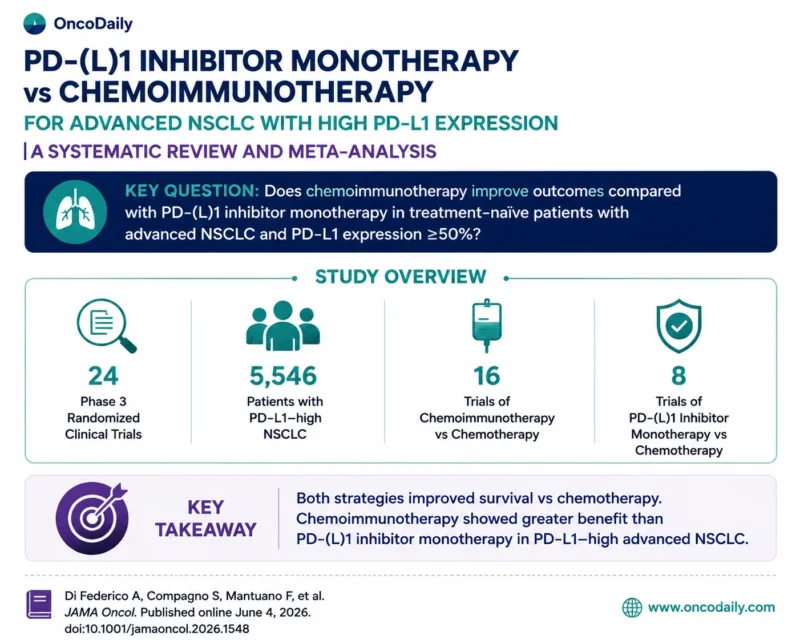
The analysis included 24 phase 3 randomized clinical trials and 5,546 patients with PD-L1–high NSCLC. Across complementary analytic approaches, chemoimmunotherapy was associated with significantly longer overall survival and progression-free survival compared with PD-(L)1 inhibitor monotherapy (Di Federico et al., 2026).
Why This Question Matters
For patients with advanced NSCLC and high PD-L1 expression, PD-(L)1 inhibitor monotherapy is often used as a first-line treatment strategy. This approach can offer durable benefit while avoiding the added toxicity of chemotherapy in selected patients.
However, high PD-L1 expression does not guarantee response to immunotherapy alone. Some patients progress early, and identifying who needs more intensive upfront therapy remains a major clinical challenge.
Chemoimmunotherapy may provide broader early disease control by combining the immune activation of PD-(L)1 blockade with the cytotoxic and immune-modulating effects of chemotherapy. Until now, direct prospective comparisons between PD-(L)1 monotherapy and chemoimmunotherapy in PD-L1–high NSCLC have been limited, making indirect evidence from randomized trials clinically relevant.
How The Meta-Analysis Was Conducted
The investigators searched PubMed, Embase, and major oncology conference proceedings for phase 3 randomized clinical trials published before August 3, 2025.
Eligible studies enrolled patients with untreated advanced NSCLC, evaluated either PD-(L)1 inhibitor monotherapy or chemoimmunotherapy versus chemotherapy alone, and reported outcomes in patients with high PD-L1 expression.
The primary outcome was overall survival, while progression-free survival was the secondary outcome. The authors used several complementary methods, including hazard ratio synthesis, meta-regression, network meta-analysis, and reconstructed individual patient data from published Kaplan-Meier curves (Di Federico et al., 2026).
Both Strategies Improved Outcomes Versus Chemotherapy
Compared with chemotherapy alone, both treatment approaches improved survival.
Chemoimmunotherapy was associated with improved overall survival, with a hazard ratio of 0.63 and a 95% confidence interval of 0.56–0.72. It also improved progression-free survival, with a hazard ratio of 0.44 and a 95% confidence interval of 0.39–0.49.
PD-(L)1 inhibitor monotherapy also improved outcomes compared with chemotherapy. The overall survival hazard ratio was 0.74 with a 95% confidence interval of 0.69–0.80, while the progression-free survival hazard ratio was 0.70 with a 95% confidence interval of 0.65–0.76 (Di Federico et al., 2026).
These results confirm that both immunotherapy-based strategies are active in PD-L1–high advanced NSCLC. The key question is whether the combination approach provides additional benefit beyond monotherapy.
Chemoimmunotherapy Showed Greater Benefit Than Monotherapy
The analysis suggested that chemoimmunotherapy was associated with greater benefit than PD-(L)1 inhibitor monotherapy.
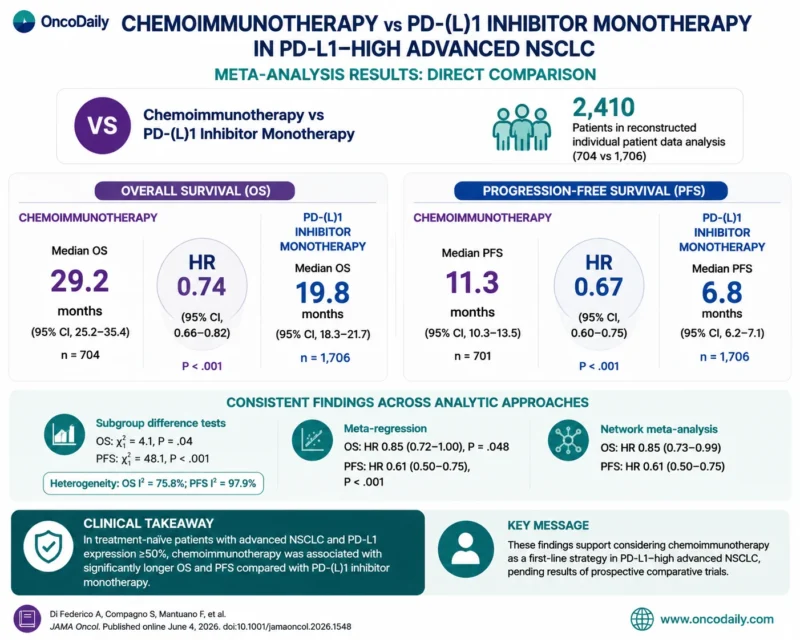
Subgroup difference testing favored chemoimmunotherapy for both overall survival and progression-free survival. This finding was consistent across meta-regression and network meta-analysis.
In the network meta-analysis, chemoimmunotherapy was associated with improved overall survival compared with PD-(L)1 monotherapy, with a hazard ratio of 0.85 and a 95% confidence interval of 0.73–0.99. The progression-free survival advantage was stronger, with a hazard ratio of 0.61 and a 95% confidence interval of 0.50–0.75 (Di Federico et al., 2026).
The reconstructed individual patient data analysis also supported this conclusion. Median overall survival was 29.2 months with chemoimmunotherapy compared with 19.8 months with PD-(L)1 inhibitor monotherapy. This corresponded to a hazard ratio of 0.74 and a 95% confidence interval of 0.66–0.82.
Median progression-free survival was also longer with chemoimmunotherapy: 11.3 months versus 6.8 months, with a hazard ratio of 0.67 and a 95% confidence interval of 0.60–0.75.
Clinical Meaning
This meta-analysis supports the idea that adding chemotherapy to PD-(L)1 blockade may improve both disease control and survival in patients with advanced NSCLC and PD-L1 expression of 50% or higher.
The findings are clinically important because PD-L1–high disease is often treated with immunotherapy alone, especially when clinicians want to reduce chemotherapy exposure. However, the data suggest that some patients may benefit from a more intensive first-line strategy.
The strongest signal was seen for progression-free survival, where chemoimmunotherapy showed a clear advantage. This matters particularly for patients with high tumor burden, symptomatic disease, aggressive clinical features, or concern for early progression on immunotherapy alone.
At the same time, the study does not eliminate the role of PD-(L)1 monotherapy. Monotherapy remains a meaningful option for selected patients, especially those who may not tolerate chemotherapy or who prioritize avoiding chemotherapy-related toxicity.
The main limitation is that this was not a direct head-to-head randomized trial of chemoimmunotherapy versus PD-(L)1 monotherapy. The findings are based on comparisons across trials and reconstructed data, although the investigators used multiple analytic methods to strengthen the reliability of the results.
Key Takeaway
This JAMA Oncology meta-analysis suggests that chemoimmunotherapy is associated with longer overall survival and progression-free survival than PD-(L)1 inhibitor monotherapy in treatment-naïve patients with advanced NSCLC and PD-L1 expression of 50% or higher.
The results support consideration of chemoimmunotherapy as a first-line strategy in PD-L1–high advanced NSCLC, while highlighting the need for prospective comparative trials to define which patients can safely receive monotherapy and which may need combination treatment upfront.
