The era in which metastatic non-small-cell lung cancer was treated primarily according to histology is increasingly distant.
For many patients today, the first treatment decision is determined not simply by whether the tumor is adenocarcinoma or squamous carcinoma, nor by PD-L1 expression alone, but by a molecular question: What is driving this cancer?
The ASCO Living Guideline Version 2026.3.3 for stage IV NSCLC with driver alterations captures how far this concept has evolved.
The guideline spans EGFR, ALK, ROS1, BRAF V600E, MET exon 14 skipping, RET, NTRK, HER2, KRAS G12C and NRG1-driven disease and addresses both first-line and subsequent therapy. But its most important message is broader than a list of targeted drugs. Precision oncology in NSCLC has entered a second generation.
Finding the driver is only the beginning.
Clinicians increasingly need to determine which targeted strategy should be used first, whether treatment should be intensified, how CNS disease changes drug selection, what resistance mechanism emerges at progression, and how the next therapy should be sequenced.
That is where the 2026 guideline becomes particularly relevant.
Molecular Testing Is No Longer Preliminary Work, It Is the First Treatment Decision
Perhaps the most clinically important recommendation appears before any drug is discussed. ASCO strongly recommends validated broad multigene profiling using tissue and/or blood, together with tissue immunohistochemistry for PD-L1, HER2 and MET.
The guideline favors comprehensive NGS, ideally incorporating RNA-based sequencing to improve fusion detection, and emphasizes that combining tissue and plasma testing can increase diagnostic yield.
This recommendation reflects a fundamental change in metastatic NSCLC management. Starting systemic therapy before molecular information is available can now mean committing a patient to the wrong therapeutic pathway.
That is particularly relevant when PD-L1 expression is high. A strongly positive PD-L1 result does not eliminate the need for molecular testing, and ASCO explicitly states that PD-L1 alone should not guide treatment decisions in this setting.
The practical guidance is equally important. If clinical deterioration requires urgent treatment before molecular results return, ASCO suggests starting histology-appropriate chemotherapy without immunotherapy while awaiting testing.
That may appear to be a small operational detail. In reality, it summarizes the entire philosophy of the guideline: do not let treatment urgency erase tumor biology.
Copyright © 2026 American Society of Clinical Oncology. All rights reserved
EGFR Has Moved From “Which TKI?” to “How Much Frontline Therapy?”
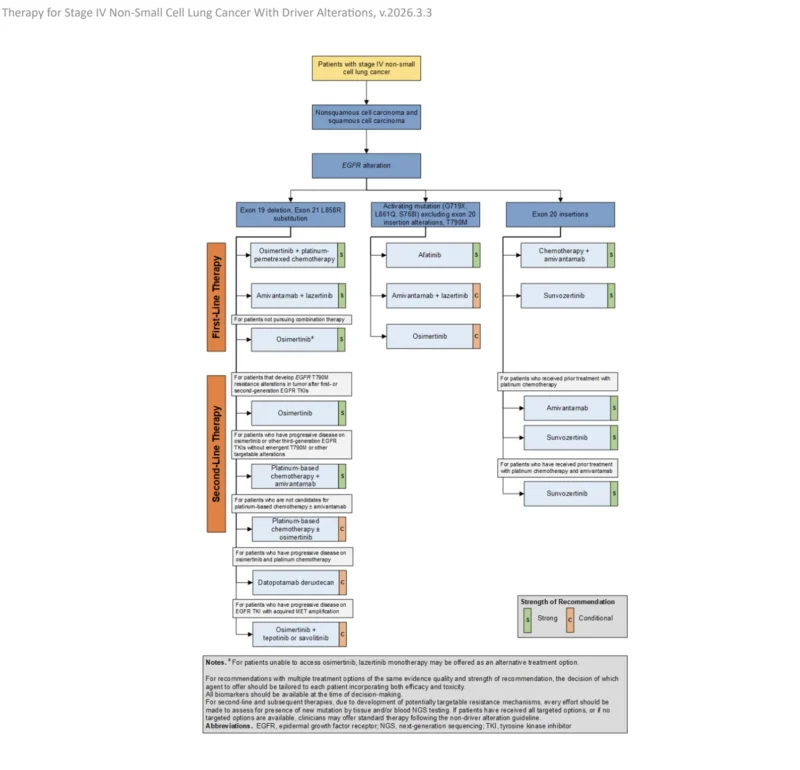
For common EGFR mutations, exon 19 deletions and exon 21 L858R—the most important change in recent years has been the transition from a monotherapy question to an intensification question.
ASCO now recommends offering either osimertinib plus platinum-pemetrexed chemotherapy or amivantamab plus lazertinib as frontline options. Osimertinib monotherapy remains appropriate for patients who do not pursue combination treatment.
The evidence behind this shift is substantial. In FLAURA2, osimertinib plus chemotherapy extended median PFS from 16.7 to 25.5 months and ultimately improved median OS from 37.6 to 47.5 months.
The benefit was particularly notable among patients with CNS metastases, where median PFS increased from 13.8 to 24.9 months. MARIPOSA demonstrated a similar principle through a different biological strategy.
Amivantamab plus lazertinib produced median PFS of 23.7 versus 16.6 months with osimertinib and, with longer follow-up, demonstrated an OS benefit with an HR for death of 0.75. Three-year OS was 60% versus 51%.
These regimens therefore make the frontline discussion more sophisticated. The question is no longer whether osimertinib is active. It clearly is.
The question is whether an individual patient has enough risk, and enough capacity to tolerate additional therapy, to justify intensification. That decision must incorporate CNS disease, disease burden, performance status, comorbidities, patient preference and toxicity.
Combination therapy improves disease control but comes at a cost. Grade ≥3 adverse events occurred in 64% with osimertinib-chemotherapy versus 27% with osimertinib alone in FLAURA2, while the amivantamab-lazertinib strategy carries substantial dermatologic toxicity, infusion reactions and thromboembolic risk.
ASCO therefore retains osimertinib monotherapy as an important option, particularly for patients with poorer performance status or those who prioritize a less intensive strategy. The guideline is not declaring monotherapy obsolete. It is making frontline EGFR therapy risk-adapted.
EGFR Exon 20 Insertions Finally Have a True Targeted Frontline Choice
One of the clearest updates in Version 2026.3.3 concerns EGFR exon 20 insertion-positive NSCLC. Recommendation 1.6 now states that clinicians should offer either sunvozertinib monotherapy or platinum-doublet chemotherapy plus amivantamab.
The addition of sunvozertinib is particularly noteworthy. In WU-KONG28, frontline sunvozertinib produced median PFS of 10.3 months versus 7.5 months with carboplatin-pemetrexed, with HR 0.65.
The response rate was 58.9% compared with 31.1% for chemotherapy. This gives exon 20 insertion disease something it historically lacked: a targeted oral frontline option capable of outperforming conventional chemotherapy.
At the same time, PAPILLON established platinum-pemetrexed plus amivantamab as another effective strategy, producing a PFS HR of 0.40 and response rates of 73% versus 47% with chemotherapy alone. The therapeutic problem is therefore changing.
Previously, the challenge was finding an active targeted agent. Now it is determining how to sequence multiple active exon 20 strategies. ASCO explicitly acknowledges that the optimal sequencing of amivantamab and sunvozertinib remains undefined.
That will likely become an increasingly important question as longer-term survival and resistance data emerge.
ALK Disease Shows Why CNS Prevention Is Becoming an Endpoint of Its Own
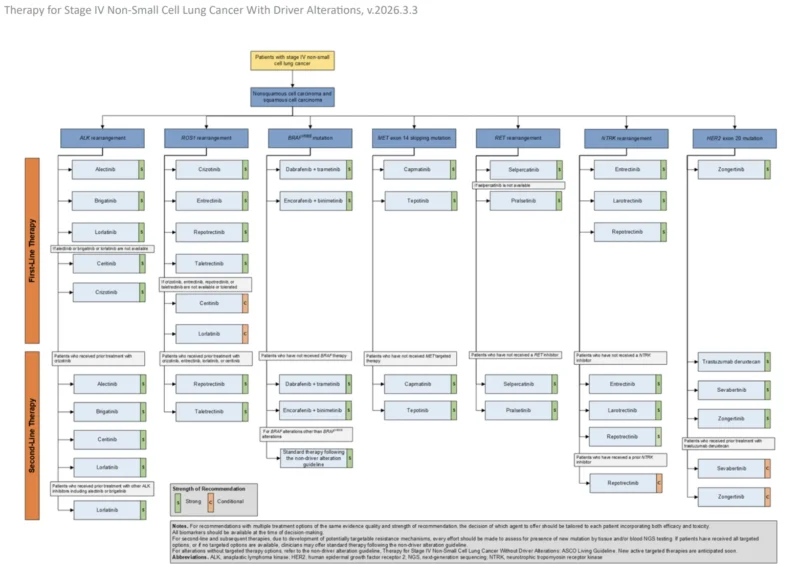
The updated CROWN data may represent one of the most remarkable examples of long-term targeted therapy control in metastatic lung cancer. ASCO continues to strongly recommend alectinib, brigatinib or lorlatinib for first-line ALK-positive NSCLC.
But the updated lorlatinib data increasingly differentiate the options. At seven years, PFS was 56% with lorlatinib versus 4% with crizotinib among patients without baseline brain metastases.
Among patients who already had brain metastases, seven-year PFS remained 53%. Perhaps even more striking, the probability of remaining free from brain metastases at seven years was 96% with lorlatinib versus 22% with crizotinib.
This changes how we should think about CNS efficacy. Historically, CNS activity was evaluated as the ability to shrink existing brain metastases. With highly CNS-penetrant TKIs, the objective increasingly becomes something more ambitious: preventing brain metastases from appearing in the first place.
That is particularly relevant in ALK-positive disease, where patients may live for many years and the CNS can become a major sanctuary site. However, the guideline appropriately does not equate maximal efficacy with universal suitability.
Lorlatinib carries substantial metabolic and neurologic toxicity. Grade 3–4 adverse events were reported in 77%, including hypertriglyceridemia, weight gain, hypercholesterolemia, hypertension and cognitive effects.
ASCO therefore recognizes alectinib and brigatinib as strong alternatives, particularly for older or frail patients or those with relevant cardiac or CNS comorbidities.
This is precision oncology at a more mature stage. The question is not simply: Which drug has the longest PFS?
It is: Which efficacy-toxicity profile is best for this patient who may remain on treatment for years?
Copyright © 2026 American Society of Clinical Oncology. All rights reserved
ROS1 Is Becoming Another Long-Duration Targeted Disease
Updated TRUST data further reinforce how dramatically some oncogene-driven NSCLCs can be transformed by modern TKIs.
ASCO lists crizotinib, entrectinib, repotrectinib or taletrectinib as first-line options for ROS1-rearranged NSCLC. Taletrectinib is the notable updated story.
In TKI-naïve patients in the long-term TRUST-1 analysis, confirmed ORR reached 90.3%, while median duration of response was 49.7 months and median PFS was 49.6 months.
Intracranial ORR was 87.7% among patients with measurable brain metastases. Four years of median disease control from an oral targeted therapy is a striking benchmark in metastatic NSCLC. And again, resistance biology increasingly determines what happens next.
After prior crizotinib, entrectinib, lorlatinib or ceritinib, ASCO supports repotrectinib or taletrectinib. Both retain activity against the important ROS1 G2032R resistance mutation and show intracranial efficacy.
That makes molecular reassessment at progression increasingly valuable. A progression biopsy or ctDNA assay may no longer merely confirm that resistance has occurred. It may identify which next-generation inhibitor still fits the resistance mechanism.
HER2-Mutant NSCLC Is Moving Toward the Same Targeted-Therapy Model as EGFR and ALK
HER2-mutant NSCLC has historically lagged behind other driver-defined diseases in the development of selective oral inhibitors. That gap is narrowing rapidly. For treatment-naïve HER2 activating mutations, ASCO now states that clinicians may offer zongertinib.
In treatment-naïve HER2 tyrosine kinase domain-mutant NSCLC in Beamion LUNG-1, zongertinib produced an ORR of 76%, with complete responses in 11% and median PFS around 14.5 months. Intracranial activity was also observed.
This is conceptually important. HER2-mutant lung cancer is beginning to resemble other oncogene-addicted NSCLC subtypes in which an oral kinase inhibitor can move toward the frontline.
At later lines, the guideline recognizes several different HER2-directed strategies.
Patients may receive trastuzumab deruxtecan, zongertinib or sevabertinib, and after prior T-DXd, zongertinib or sevabertinib may remain options. This creates another sequencing problem.
- ADC first?
- TKI first?
- Which HER2 mutation matters?
- How should CNS disease influence selection?
- Can TKIs rescue disease after ADC resistance?
The guideline cannot yet answer all of these questions because much of the HER2 evidence remains early-phase and nonrandomized.
But the trajectory is clear.
HER2-mutant NSCLC is rapidly becoming a true molecularly targeted disease rather than simply a subgroup receiving a later-line ADC.
Rare Drivers Are No Longer Footnotes, They Are Independent Therapeutic Pathways
The breadth of the ASCO guideline may be as important as any individual recommendation. BRAF V600E, MET exon 14 skipping, RET and NTRK alterations each now have distinct targeted pathways.
For BRAF V600E disease, ASCO supports dabrafenib plus trametinib or encorafenib plus binimetinib. For MET exon 14 skipping disease, capmatinib and tepotinib remain central targeted options, with meaningful systemic and CNS activity.
RET fusion-positive NSCLC is particularly illustrative of why identifying rare alterations matters. ASCO strongly recommends frontline selpercatinib, supported by LIBRETTO-431, where median PFS reached 24.8 months versus 11.2 months with platinum-based therapy ± pembrolizumab.
NTRK fusion-positive disease can be treated with entrectinib, larotrectinib or repotrectinib, despite the rarity of these alterations. The guideline even extends precision therapy into extremely uncommon molecular populations.
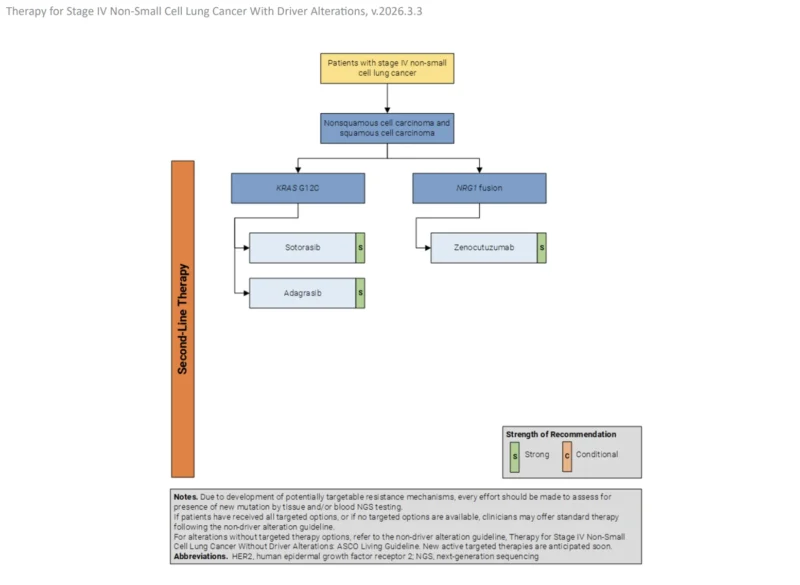
After standard therapy, KRAS G12C disease may be treated with sotorasib or adagrasib, while NRG1 fusion-positive NSCLC may receive zenocutuzumab.
The implication is profound.
A mutation present in only 1%–2% of NSCLC is not clinically unimportant when it can redirect treatment for essentially every patient who carries it.
That is why broad molecular testing is not optional infrastructure around precision oncology. It is what makes precision oncology possible.
The New Problem Is Sequencing
The success of targeted therapy has created a challenge that did not exist when most drivers had only one available drug. There are now situations with multiple effective agents at diagnosis and additional active therapies after resistance.
EGFR offers combination intensification, monotherapy and exon-specific strategies. ALK offers several highly active CNS-penetrant inhibitors. ROS1 has first- and next-generation inhibitors with different resistance profiles. HER2 now includes both ADCs and selective TKIs.
And increasingly, progression does not automatically mean abandoning targeted therapy. Local treatment may be appropriate for oligoprogression.
A next-generation inhibitor may overcome a specific resistance mutation. A different therapeutic modality may remain effective despite prior targeted treatment. This means metastatic driver-positive NSCLC is increasingly becoming a longitudinal sequencing disease.
The first-line treatment decision must therefore consider not only what works today but what resistance patterns and subsequent options it may leave tomorrow.
CNS Activity Is Becoming Central to Drug Selection
Another theme repeatedly visible across the guideline is the importance of the brain. Osimertinib-based intensification improves outcomes in EGFR-mutant patients with CNS disease.
Lorlatinib produces extraordinary long-term CNS protection in ALK-positive NSCLC. Taletrectinib and repotrectinib demonstrate intracranial activity in ROS1-positive disease.
Selpercatinib has strong CNS activity in RET fusion-positive disease. MET, NTRK and emerging HER2 inhibitors also demonstrate intracranial responses. The brain can therefore no longer be treated as a secondary efficacy endpoint.
For many oncogene-driven cancers, CNS penetration is one of the defining characteristics of an optimal systemic therapy. That becomes particularly important as extracranial control improves and patients live long enough for CNS relapse to become a competing clinical problem.
Copyright © 2026 American Society of Clinical Oncology. All rights reserved
Precision Medicine Also Means Choosing Not to Intensify
There is another important message in the guideline that can be overlooked amid increasingly impressive efficacy numbers.
More therapy is not automatically better therapy for every patient. The document repeatedly emphasizes incorporating toxicity, comorbidities, performance status, availability and patient preferences when multiple treatments have comparable recommendation strength.
That is especially relevant in diseases where targeted therapy can continue for years. An additional several months of median PFS may be highly meaningful.
But so are chronic dermatologic toxicity, edema, metabolic effects, cognitive changes, thromboembolism, gastrointestinal toxicity, infusion burden and financial access.
The future of precision oncology therefore cannot be defined only by identifying increasingly potent drugs. It must also identify which patient needs which degree of treatment intensity.
The Bottom Line
The ASCO 2026.3.3 Living Guideline shows that stage IV NSCLC with driver alterations has entered a more mature phase of precision medicine.
The major transition is no longer from chemotherapy to targeted therapy. That transition has already occurred. The current transition is from: finding the target → optimizing the entire targeted-treatment strategy.
Comprehensive molecular profiling should occur before frontline treatment decisions whenever possible. In common EGFR-mutant disease, clinicians must now decide between monotherapy and increasingly effective combination approaches.
EGFR exon 20 insertion disease gains frontline sunvozertinib alongside amivantamab-chemotherapy. Updated CROWN data reinforce the extraordinary long-term systemic and CNS control possible with modern ALK inhibition.
TRUST demonstrates that ROS1-positive disease can also achieve multi-year control with next-generation TKIs. HER2-mutant NSCLC is rapidly moving toward oral targeted therapy, while rare alterations including RET, NTRK and NRG1 increasingly have their own distinct therapeutic pathways.
The result is a new clinical reality: The molecular report no longer simply tells us which drug to prescribe.
It increasingly determines the first therapy, its intensity, how we protect the CNS, how we investigate resistance and what treatment comes next. That is the real message of ASCO 2026.
Precision medicine in metastatic NSCLC is becoming precision sequencing.
Reference
- Wheatley Price P, Ismaila N, Calles Blanco A, Cetnar J, Conneran T, Desai PA, Durm G, Horinouchi H, Khurshid H, Kulkarni S, Marrone KA, Perdrizet K, Bazhenova L. Therapy for Stage IV Non-Small Cell Lung Cancer With Driver Alterations: ASCO Living Guideline. Version 2026.3.3. American Society of Clinical Oncology. Last updated July 24, 2026.