
Assessing treatment response in pleural mesothelioma has long been difficult.
Unlike many solid tumors, pleural mesothelioma does not grow as a rounded mass. Instead, it often spreads along the pleura in a crescent-like pattern around the lung. This morphology makes traditional diameter-based measurements challenging and can limit the consistency of response evaluation in clinical practice and trials.
A new multicentre study published in The Lancet Oncology introduces ARTIMES, an artificial intelligence-assisted volumetric response framework designed specifically for pleural mesothelioma.
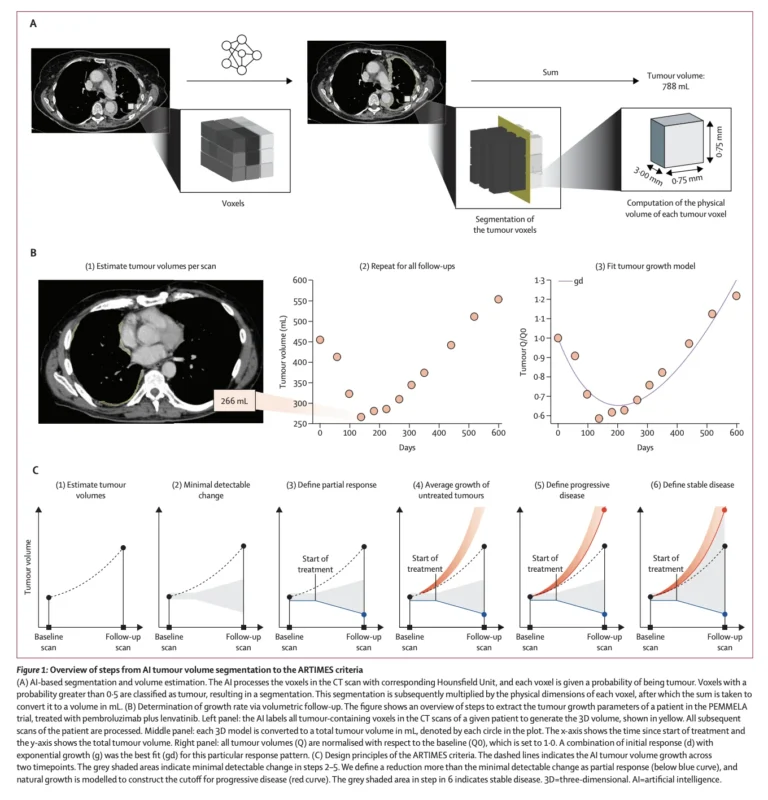
ARTIMES uses automated CT-based tumor segmentation to calculate three-dimensional tumor volume and applies new biologically informed criteria for partial response, progressive disease, and stable disease.
The study found that ARTIMES detected disease progression earlier than modified RECIST and showed stronger associations with overall survival at both patient and trial levels.
Why Mesothelioma Response Assessment Is Challenging
Modified RECIST, or mRECIST, remains the commonly used response assessment framework for pleural mesothelioma.
It estimates tumor burden by measuring up to six representative tumor thicknesses perpendicular to the chest wall or mediastinum. Progressive disease is generally defined as at least a 20% increase in measurements, while partial response requires at least a 30% decrease.
However, this approach has important limitations.
Different radiologists may select different sites for measurement. Tumor thickness may not fully reflect changes across the entire pleural tumor burden. Small changes in measurements can also influence response classification.
These limitations are particularly important in mesothelioma trials, where progression-free survival and response rate are often used to guide development decisions.
What Is ARTIMES?
ARTIMES stands for Artificial Intelligence-Assisted Response Evaluation to Treatment in Mesothelioma.
The framework combines automated deep-learning segmentation of pleural tumors on CT imaging with volumetric response criteria based on two principles:
First, changes within expected inter-reader variability should not be interpreted as true biological progression or response.
Second, tumor growth similar to untreated mesothelioma growth may indicate treatment failure.
The AI model identifies pleural and adjacent tumor tissue on CT scans, calculates total tumor volume, and tracks volumetric changes across follow-up scans.
A medical professional must still review and approve the AI-generated segmentation before ARTIMES response criteria are applied.
Study Design
This retrospective, multicentre study included 10,926 CT scans from 2,080 patients with pleural mesothelioma across 14 cohorts.
The data came from routine-care cohorts and ten phase II or phase III clinical trials, including INITIATE, NivoMes, PEMMELA, LUME-MESO, NVALT19, MiST1, PROMISE-meso, DENIM, NVALT5, and SAKK17/18.
A total of 1,176 CT scans were annotated by 12 radiologists and one pulmonologist to train the deep-learning tumor segmentation model. The dataset was supplemented with 100 CT scans from tumor-free controls.
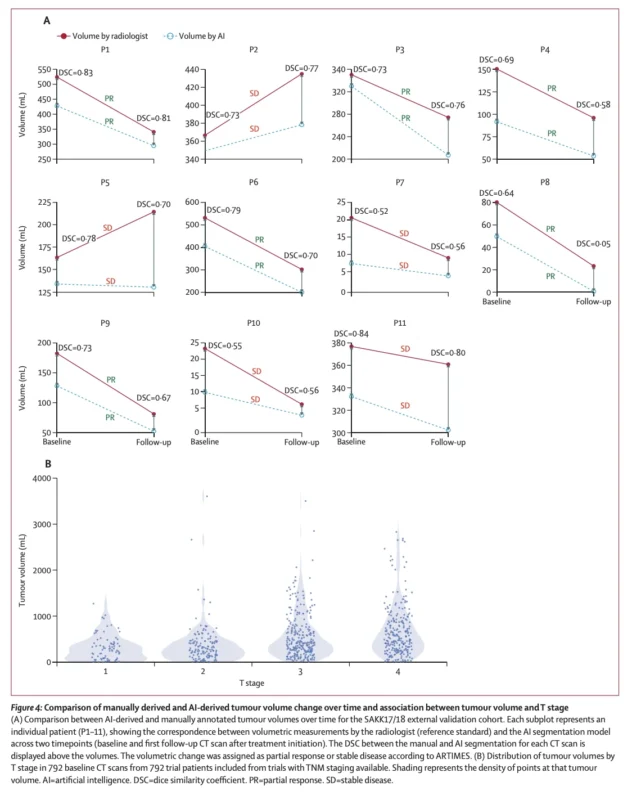
The investigators then validated AI segmentation performance internally and externally using independent datasets, including manual tumor segmentations from the SAKK17/18 trial and the University of Chicago cohort.
ARTIMES was compared with mRECIST in 943 trial participants with 4,674 CT scans and available survival data.
Strong AI Segmentation Performance
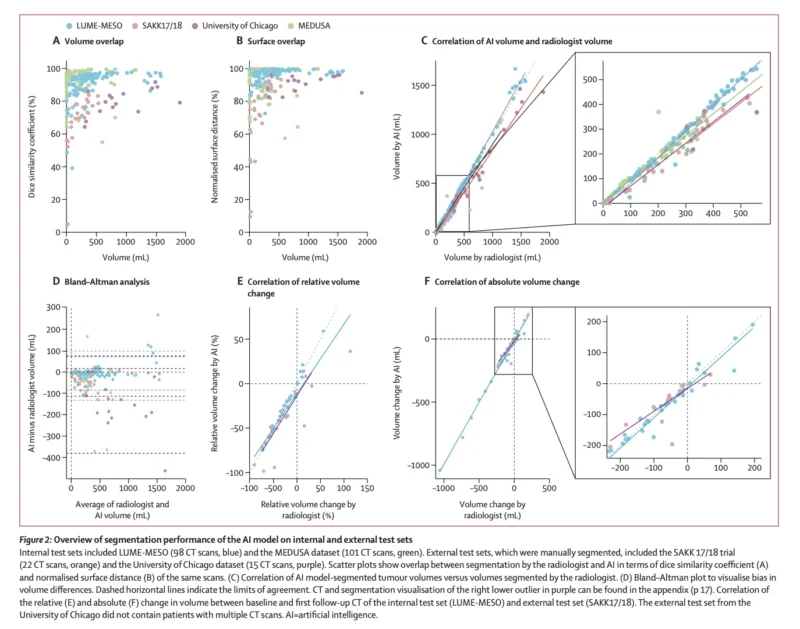
The AI model showed high agreement with radiologist-derived tumor segmentations.
In internal testing, the model achieved a median Dice similarity coefficient of 94% and a normalized surface distance of 98%.
AI-derived tumor volumes strongly correlated with radiologist-derived volumes, with an R² of 99% on individual scans.
The model also maintained performance in challenging imaging settings, including scans with pleural effusion, atelectasis, and thoracic wall invasion.
External datasets showed lower segmentation overlap than internal testing, but volume correlations remained high. This may partly reflect variability between manual segmentations rather than AI error alone.
How ARTIMES Defines Response
The investigators derived thresholds for response from inter-reader variability and untreated tumor growth patterns.
Partial response was defined as either:
A reduction of more than 15% and more than 35 mL compared with the maximum tumor volume during treatment; or
A reduction of more than 75% compared with the maximum tumor volume during treatment.
Progressive disease was defined as either:
A new lesion outside the pleura;
An increase of more than 40% and more than 35 mL compared with the lowest tumor volume since treatment began; or
An increase of more than 70 mL compared with the lowest tumor volume.
Patients who met neither partial response nor progressive disease criteria were classified as having stable disease.
This approach differs from mRECIST because it evaluates the full three-dimensional tumor burden rather than selected tumor thickness measurements.
ARTIMES Detected Progression Earlier
Among 943 trial participants, mRECIST identified progressive disease in 629 patients, while ARTIMES identified progressive disease in 635 patients.
The proportion of patients classified as having progression was therefore similar between methods.
However, ARTIMES identified progression earlier.
Median time to progression was 126 days with ARTIMES compared with 161 days with mRECIST.
Among patients classified as progressing by both methods, ARTIMES detected progression a median of 38 days earlier than mRECIST.
Earlier identification of treatment failure could potentially support more timely treatment adjustments, reduce unnecessary exposure to ineffective therapies, and improve trial efficiency.
However, prospective evaluation is needed before ARTIMES-guided response assessment is used to direct routine treatment decisions.
Better Prognostic Performance Than mRECIST
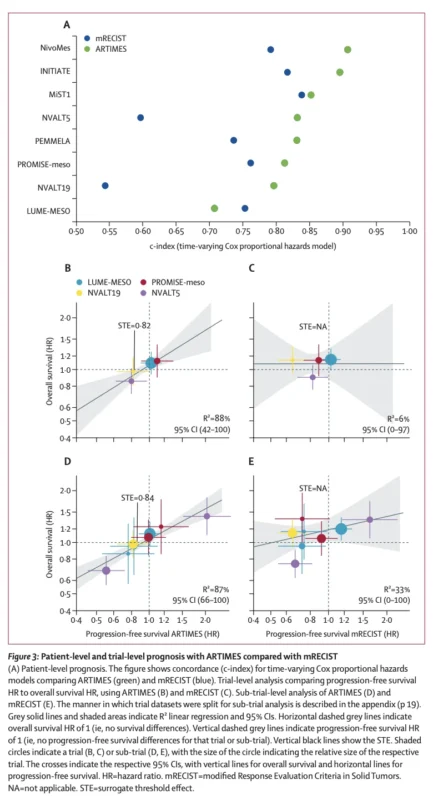
ARTIMES also showed stronger patient-level prognostic performance.
Using time-varying Cox proportional hazards models, ARTIMES achieved a concordance index of 0.83 compared with 0.73 for mRECIST.
ARTIMES had a higher concordance index than mRECIST in seven of eight evaluated trials.
This suggests that volumetric AI-based response assessment may better capture clinically meaningful disease change in pleural mesothelioma than conventional diameter-based criteria.
Stronger Trial-Level Association With Overall Survival
One of the most important findings involved surrogate endpoint performance.
At the trial level, ARTIMES-based progression-free survival showed a strong association with overall survival, with an R² of 88%.
By comparison, mRECIST-based progression-free survival had an R² of 6%.
ARTIMES also demonstrated a surrogate threshold effect.
An ARTIMES progression-free survival hazard ratio below 0.82 predicted a statistically significant overall survival benefit at the trial level.
No surrogate threshold effect was observed for mRECIST.
This finding could be highly relevant for mesothelioma drug development.
If validated prospectively, ARTIMES-based progression-free survival may provide a more reliable early indicator of whether a treatment is likely to improve overall survival.
Baseline AI Tumor Volume Was Prognostic
The study also evaluated the prognostic value of pretreatment AI-derived tumor volume.
Baseline tumor volume independently predicted overall survival.
When AI tumor volume was added to age, sex, histology, treatment line, T stage, and WHO performance status, the prognostic model reached a concordance index of 0.65.
The same model without AI tumor volume had a concordance index of 0.58.
Importantly, baseline AI tumor volume outperformed T stage and WHO performance status as an independent prognostic variable in this analysis.
This finding supports the potential value of volumetric tumor burden as a more informative measure of disease extent in pleural mesothelioma.
Why This Could Matter for Clinical Trials
Mesothelioma trials have often faced challenges when early response signals fail to translate into survival benefits in later-phase studies.
More reproducible and clinically meaningful response criteria may improve the selection of therapies for phase III testing.
ARTIMES could potentially support blinded independent central review in future trials. It may also reduce measurement variability and expand eligibility by removing the requirement for traditionally measurable disease.
The authors suggest that AI-assisted volumetry may allow more accurate drug evaluation while reducing trial costs and unnecessary exposure to ineffective treatments.
Important Limitations
This was a retrospective study.
Treatment discontinuation in the historical datasets was often guided by mRECIST, which may have influenced the ARTIMES analyses. The authors noted that this could introduce bias when evaluating progression-free survival.
There was also variability in non-contrast CT scans, which can make distinction between tumor, pleural effusion, and atelectasis more difficult.
In addition, progression-free survival is based on discrete imaging timepoints and may not fully capture the complexity of longitudinal tumor response patterns.
The study also requires prospective validation before ARTIMES can be recommended for broad clinical use.
A prospective trial comparing ARTIMES and mRECIST is already underway. The COMET trial will assess both criteria in a setting where neither classification alone determines treatment cessation.
Key Takeaway
ARTIMES is a new AI-assisted volumetric response framework developed for pleural mesothelioma.
In a large multicentre retrospective study, ARTIMES accurately quantified tumor volume on CT scans, detected progression earlier than mRECIST, and showed stronger associations between progression-free survival and overall survival.
ARTIMES-based progression-free survival achieved an R² of 88% with overall survival at the trial level, compared with 6% for mRECIST-based progression-free survival.
The findings suggest that AI-assisted volumetric assessment may offer a more reproducible and clinically meaningful way to evaluate treatment response in pleural mesothelioma.
Prospective validation, regulatory clearance, guideline integration, and continued radiologist oversight will be needed before ARTIMES can become part of routine clinical practice.