
A chemotherapy-sparing combination of amivantamab, lazertinib, and bevacizumab has demonstrated promising activity in patients with EGFR-mutant advanced non-small-cell lung cancer (NSCLC) after acquired resistance to a third-generation EGFR tyrosine kinase inhibitor (TKI). Results from the prospective phase II ETOP 18-21 AMAZE-lung trial were published online in The Lancet Respiratory Medicine on October 5, 2026.
The strategy simultaneously targets EGFR, MET, and VEGF-related angiogenesis, pathways that may contribute to resistance after EGFR-directed therapy. Unlike currently established post-osimertinib approaches incorporating chemotherapy, AMAZE-lung evaluated whether these pathways could be targeted without conventional cytotoxic chemotherapy.
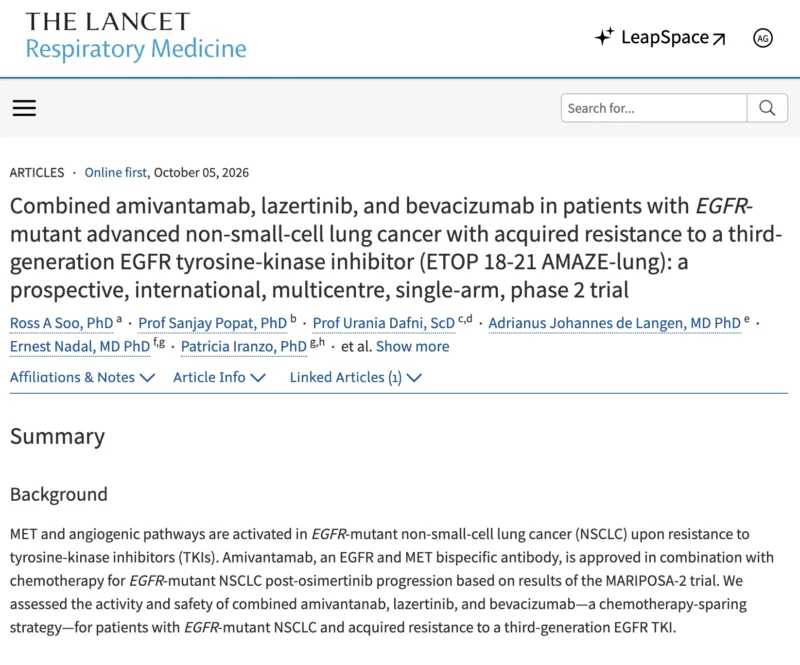
A Triple-Target Strategy After Third-Generation EGFR TKI Failure
AMAZE-lung was an international, multicentre, single-arm phase II trial enrolling adults with advanced nonsquamous NSCLC harboring a sensitizing EGFR exon 19 deletion or exon 21 L858R mutation. Eligible patients had experienced disease progression after a third-generation EGFR TKI, osimertinib or lazertinib, administered in either the first- or second-line setting.
Patients received:
- intravenous amivantamab
- oral lazertinib 240 mg daily
- intravenous bevacizumab 15 mg/kg every 3 weeks
Treatment continued until disease progression or unacceptable toxicity. The primary endpoint was objective response rate at 12 weeks according to RECIST 1.1 in the first 60 enrolled patients. The study was designed to test whether the combination could reject an ORR of 20% or lower in favor of a target rate of 40%.
61 Patients Enrolled Across Europe
Between March 2023 and May 2024, 61 patients from 17 European centers entered the study. Median age was 65 years, 70% were women, 61% had never smoked, and 62% had an ECOG performance status of 1. All tumors were adenocarcinomas, while 30% of patients had asymptomatic brain metastases at baseline.
At the primary analysis, median follow-up was 9 months and 28 patients remained on treatment.
Primary Endpoint Met
Among the first 60 patients, 20 achieved an objective response within 12 weeks, corresponding to an ORR of:
- 33%
- 95.6% CI, 21–47%
The trial therefore successfully rejected an ORR of 20% or less. Across all 61 patients, 24 patients achieved a partial response, producing an overall response rate of:
- 39%
- 95% CI, 27–53%
Of these responses, 22 were subsequently confirmed. These findings provide early evidence that combined EGFR–MET and angiogenic pathway inhibition may retain clinically meaningful antitumor activity after resistance to third-generation EGFR TKIs.
Why Add Bevacizumab?
Acquired resistance to EGFR-directed therapy is biologically heterogeneous. Alongside continued EGFR signaling, MET activation represents an established resistance pathway. Angiogenic signaling may also contribute to tumor persistence and progression following EGFR inhibition.
Amivantamab provides dual EGFR and MET targeting, lazertinib maintains potent EGFR inhibition, while bevacizumab inhibits VEGF-mediated angiogenesis. This provides the biologic rationale for simultaneously attacking three pathways while avoiding traditional chemotherapy.
The strategy is particularly relevant because amivantamab is already established in the post-osimertinib setting in combination with chemotherapy based on MARIPOSA-2. AMAZE-lung instead asks whether effective disease control may be achievable with a chemotherapy-sparing regimen.
Safety: VTE Remains Important
The most common treatment-related adverse events were:
- Infusion-related reactions: 58%
- Acneiform rash: 50%
Grade 3–4 treatment-related adverse events occurred in 43% of patients, while serious treatment-related adverse events occurred in 20%. Venous thromboembolism deserves particular attention.
Treatment-related VTE occurred in:
- 17% of patients at any grade
- 3% at grade 3–4
No treatment-related deaths were reported. The investigators considered the overall safety profile consistent with the known toxicities of the individual agents.
Where Could This Strategy Fit?
The post-osimertinib treatment landscape for EGFR-mutant NSCLC has become increasingly complex. Amivantamab plus chemotherapy has already established a role after osimertinib progression, while multiple other strategies are being studied, including MET-directed combinations, antibody-drug conjugates, continued EGFR inhibition with chemotherapy, and newer approaches targeting several resistance pathways simultaneously.
AMAZE-lung introduces another possibility: maintaining targeted pressure against EGFR while simultaneously addressing MET-mediated resistance and angiogenesis without immediately transitioning to chemotherapy. However, this remains a single-arm phase II study with a relatively small population.
The results therefore cannot establish superiority over chemotherapy-based regimens, and randomized comparisons will be necessary before the approach can redefine standard care.
OncoDaily Takeaway
The AMAZE-lung trial provides proof of concept for a chemotherapy-sparing strategy after third-generation EGFR TKI resistance. The combination of amivantamab + lazertinib + bevacizumab produced a 33% 12-week objective response rate, successfully meeting the study’s primary endpoint, with an overall response rate of 39% across all enrolled patients.
The findings are particularly interesting because they attack three biologically relevant pathways-EGFR, MET, and VEGF, at a point where treatment options are increasingly determined by complex and heterogeneous resistance mechanisms.
For now, AMAZE-lung should be viewed as a promising phase II signal rather than a new standard. But as treatment moves toward increasingly precise post-EGFR TKI strategies, chemotherapy-sparing combinations such as this may become an important area of investigation.
Source
- Soo RA, Popat S, Dafni U, et al. Combined amivantamab, lazertinib, and bevacizumab in patients with EGFR-mutant advanced non-small-cell lung cancer with acquired resistance to a third-generation EGFR tyrosine-kinase inhibitor (ETOP 18-21 AMAZE-lung): a prospective, international, multicentre, single-arm, phase 2 trial. Lancet Respir Med. 2026.