
AcceleRET-Lung is a randomized phase 3 study that confirms the clinical value of pralsetinib as first-line treatment for patients with RET fusion–positive advanced or metastatic non–small cell lung cancer. Presented by Sanjay Popat at the 2026 ASCO Annual Meeting, the trial showed that pralsetinib significantly improved progression-free survival, objective response rate, and duration of response compared with platinum-based standard-of-care therapy (Popat et al., 2026).
The results strengthen the role of selective RET inhibition in a molecularly defined subgroup of NSCLC, while also highlighting an important safety signal: infections occurred more frequently with pralsetinib and require careful monitoring.
Why RET Fusion–Positive NSCLC Needs Targeted First-Line Therapy
RET fusions are actionable oncogenic drivers in NSCLC. For patients with advanced or metastatic disease, targeted therapy offers the possibility of deeper and more durable disease control than broad cytotoxic chemotherapy.
Pralsetinib is an oral tyrosine kinase inhibitor designed to selectively target oncogenic RET fusion and mutation proteins. It is already FDA approved for adults with metastatic RET-altered NSCLC. The phase 3 AcceleRET-Lung study was designed to compare pralsetinib directly with platinum-based standard-of-care therapy in the first-line setting (Popat et al., 2026).
How AcceleRET-Lung Was Designed
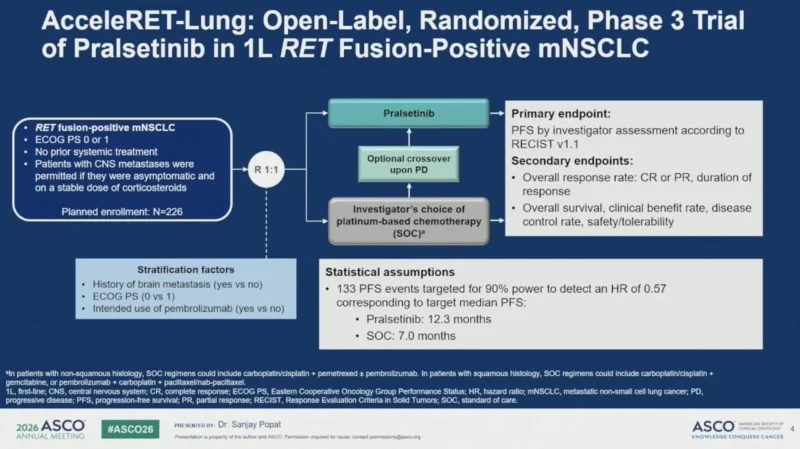
AcceleRET-Lung was a randomized, open-label, phase 3 study conducted across 74 sites in 22 countries. Adults with RET fusion–positive advanced or metastatic NSCLC were randomized to receive either pralsetinib 400 mg once daily or platinum-based standard-of-care therapy.
Crossover to pralsetinib was allowed after disease progression, which is important when interpreting overall survival. The primary endpoint was progression-free survival by RECIST v1.1. Secondary endpoints included objective response rate, overall survival, duration of response, and safety.
A total of 223 patients were included in the intent-to-treat population, with 110 assigned to pralsetinib and 113 assigned to standard of care. Baseline characteristics were generally balanced. Median age was 62 years in the pralsetinib arm and 63 years in the standard-of-care arm. Brain metastases were present in 15% and 16% of patients, respectively. The study was terminated early by sponsor decision on January 27, 2025 (Popat et al., 2026).
Pralsetinib Significantly Improved PFS
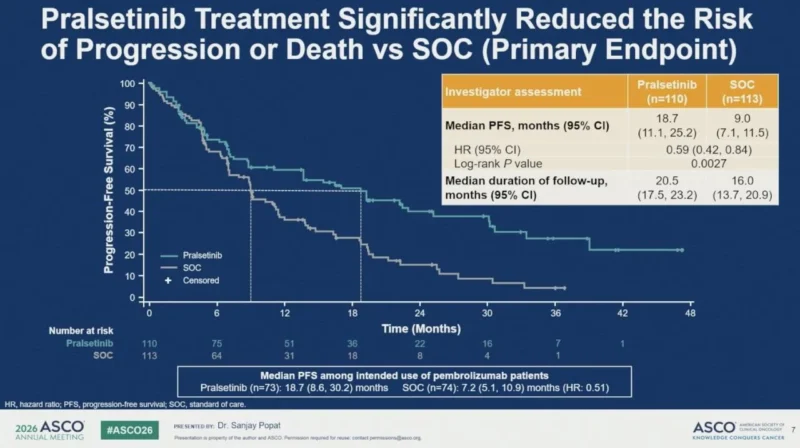
The primary endpoint was met.
Median progression-free survival was 18.7 months with pralsetinib compared with 9.0 months with standard-of-care therapy. This corresponded to a stratified hazard ratio of 0.59 with a 95% confidence interval of 0.42–0.84 and a statistically significant P value of 0.003 (Popat et al., 2026).
This result shows that first-line pralsetinib nearly doubled median PFS compared with platinum-based therapy in patients with RET fusion–positive advanced or metastatic NSCLC.
Higher And More Durable Responses
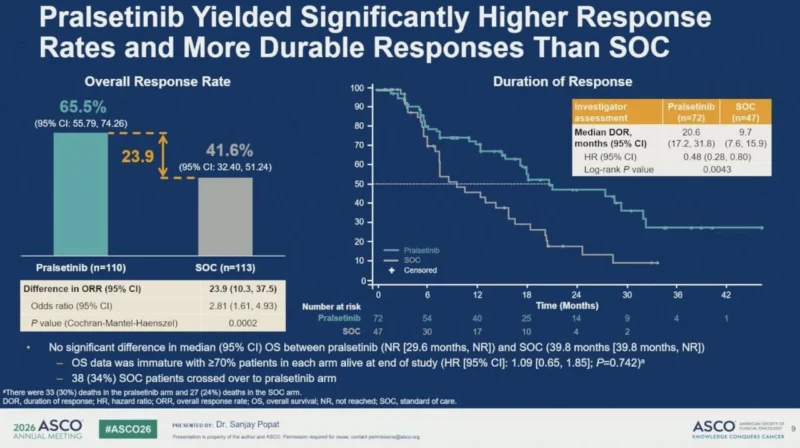
Pralsetinib also produced a significantly higher objective response rate. The ORR was 65.5% with pralsetinib compared with 41.6% with standard of care. The odds ratio was 2.81, with a 95% confidence interval of 1.61–4.93 and a P value of <0.001 (Popat et al., 2026).
Responses were also more durable. Median duration of response was 20.6 months with pralsetinib versus 9.7 months with standard of care. The hazard ratio for duration of response was 0.48, with a 95% confidence interval of 0.28–0.80 and a P value of 0.004.
Together, these efficacy data support pralsetinib as a more active and durable first-line option than platinum-based therapy in this molecularly selected population.
Overall Survival Was Not Improved At This Analysis
Overall survival did not differ significantly between the two treatment arms at the time of analysis. Median OS was not reached in the pralsetinib arm and was 39.8 months in the standard-of-care arm. The hazard ratio was 1.09, with a 95% confidence interval of 0.65–1.85 and a P value of 0.742 (Popat et al., 2026).
This finding should be interpreted cautiously. Optional crossover to pralsetinib after progression may affect overall survival comparisons, and longer follow-up may be needed to better understand the OS signal.
Safety: Efficacy Comes With An Infection Signal
The safety profile was generally consistent with the known pralsetinib profile, but the trial identified a higher infection rate in the pralsetinib arm.
Infections occurred in 71.3% of patients receiving pralsetinib compared with 51.9% receiving standard of care. Pneumonia occurred in 19.4% versus 5.8%, urinary tract infections in 17.6% versus 7.7%, and opportunistic infections in 9.3% versus 1.0%.
There were 32 deaths in the pralsetinib arm and 26 deaths in the standard-of-care arm. Importantly, 8 deaths in the pralsetinib arm were due to infection, compared with none in the standard-of-care group (Popat et al., 2026).
Common grade 3 or higher treatment-related adverse events with pralsetinib versus standard of care included hypertension (11.1% vs 0%), neutropenia (10.2% vs 8.7%), anemia (8.3% vs 10.6%), and decreased neutrophil count (7.4% vs 4.8%).
This safety profile reinforces that infection monitoring, early recognition, and proactive management are essential when using pralsetinib in clinical practice.
Clinical Meaning
AcceleRET-Lung confirms the value of matching first-line therapy to the molecular driver in advanced NSCLC. For patients with RET fusion–positive disease, pralsetinib produced longer PFS, higher response rates, and more durable responses compared with platinum-based standard-of-care therapy.
The trial also reinforces the importance of comprehensive molecular testing at diagnosis. RET fusions must be identified before first-line treatment decisions are made, otherwise patients may miss the opportunity to receive targeted therapy upfront.
At the same time, the infection signal is clinically important. The benefit of pralsetinib is clear, but it must be paired with careful safety surveillance, especially for pneumonia, urinary tract infections, and opportunistic infections.
Key Takeaway
The phase 3 AcceleRET-Lung study showed that first-line pralsetinib significantly improved progression-free survival compared with platinum-based standard-of-care therapy in RET fusion–positive advanced or metastatic NSCLC.
Median PFS was 18.7 months with pralsetinib versus 9.0 months with standard of care. ORR was 65.5% versus 41.6%, and median duration of response was 20.6 versus 9.7 months.
These results support pralsetinib as an effective first-line targeted therapy in RET fusion–positive NSCLC, with infection monitoring remaining a key part of patient management.