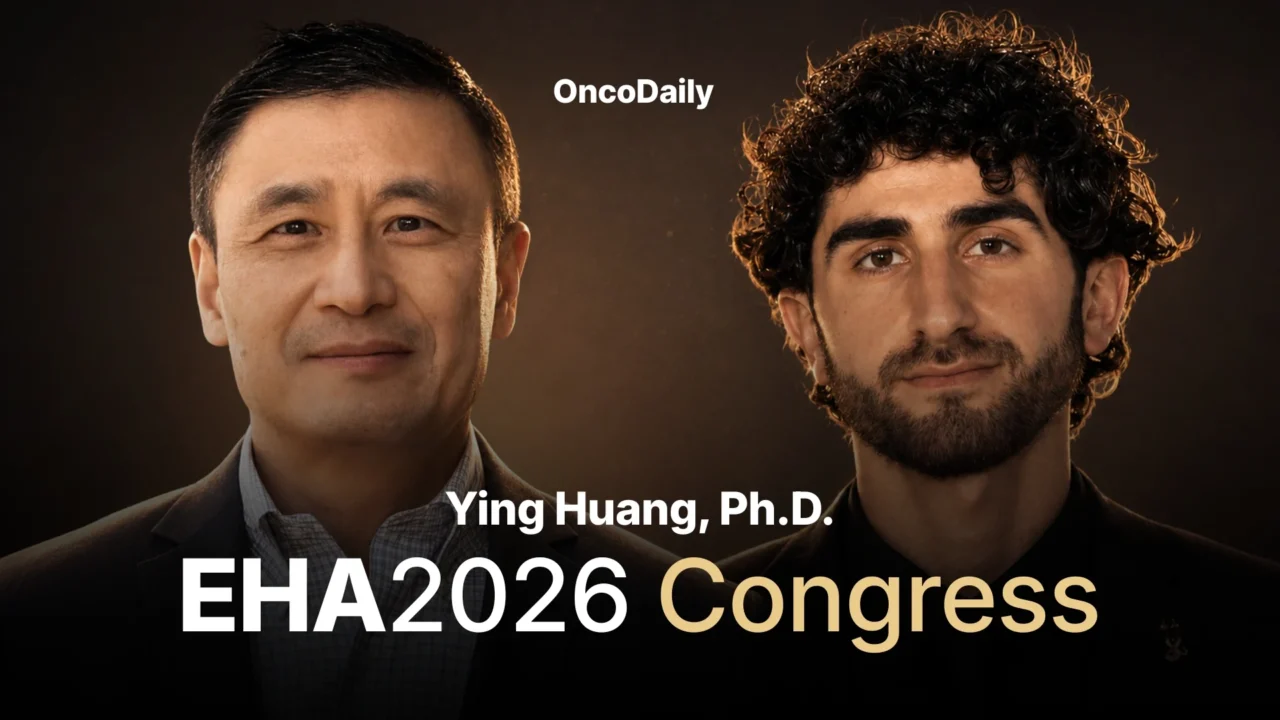
During the European Hematology Association 2026 Congress in Stockholm, Sweden, OncoDaily held a focused conversation with Legend Biotech CEO Dr. Ying Huang on the latest advances in T-cell therapy for hematologic cancers. The discussion centered on LB2501, Legend Biotech’s investigational in vivo CAR T-cell therapy, and the first Phase 1 results presented during the congress.
Dr. Huang introduced Legend Biotech as a leading CAR T-cell therapy company with an established commercial product, Carvykti, which is indicated for multiple myeloma. He noted that Carvykti has become the number one selling CAR T-cell therapy globally, with approximately $2 billion in global sales in 2025. Legend Biotech is partnered with Johnson & Johnson in the promotion, commercialization, and development of Carvykti. According to Dr. Huang, the company’s experience with Carvykti has helped shape its broader strategy in developing next-generation T-cell therapies.
At EHA 2026, Legend Biotech presented early clinical data for LB2501, described in the interview as a CD19 and CD20 dual-targeting in vivo CAR T-cell therapy. The data came from the first phase 1 results, including 12 patients enrolled in the study. Among these patients, 6 were treated at dose level 1, where minimal expansion was observed. Another 6 patients were treated at dose level 2, where consistent expansion was seen.
The most encouraging efficacy signal came from the dose level 2 group. Dr. Huang reported a 100% response rate among the 6 patients treated at this dose level. In addition, 5 of the 6 patients achieved a complete response which means that by PET/CT scan, there was no longer any observable cancer activity on imaging. Although the data are still early, Dr. Huang described these results as very promising and encouraging.
The patient population included individuals with different types of lymphoma, including diffuse large B-cell lymphoma, mantle cell lymphoma, and follicular lymphoma. These were patients with relapsed or refractory disease, a setting where new therapeutic approaches remain highly important. Dr. Huang emphasized that the preliminary data showed both manageable safety and encouraging early efficacy, supporting continued development of LB2501.
A major point of discussion was the scientific rationale behind dual targeting of CD19/CD20. Dr. Huang explained that there are already commercially available CAR T-cell therapies targeting CD19 for the treatment of lymphoma, including Yescarta, Kymriah, and Breyanzi. However, some patients still relapse after CD19-directed CAR T-cell therapy. According to Dr. Huang, one reason for relapse is that cancer cells may escape treatment through loss or downregulation of the CD19 antigen.
This is where the dual-targeting design of LB2501 becomes important. By targeting both CD19/CD20, the therapy is intended to make it less likely that cancer cells can escape through mutation or antigen downregulation. Dr. Huang explained that it would be more difficult for cancer cells to develop resistance to both CD19/CD20 at the same time. The company hopes this approach may eventually demonstrate superior clinical efficacy compared with mono-targeted CD19 therapies.
The interview also highlighted the importance of in vivo CAR T-cell therapy as a potentially important shift in the field. Traditional CAR T-cell approaches usually require cells to be collected from the patient, engineered outside the body, expanded, and then reinfused. In contrast, in vivo CAR T-cell therapy is designed to generate CAR T cells inside the patient’s body. While the interview did not go into technical detail about manufacturing, the conversation framed in vivo CAR T-cell therapy as a strategy with potential implications for treatment delivery and scalability.
Dr. Huang noted that LB2501 was selected as one of the late-breaking abstracts at EHA 2026. He described this recognition as a sign of the early promise of the therapy. The presentation took place in the broader context of many advances being discussed at the congress across lymphoma, leukemia, and multiple myeloma. For Legend Biotech, the LB2501 data represented one of the company’s most exciting updates from the meeting.
Looking ahead, Dr. Huang said Legend Biotech plans to file an investigational new drug application with the U.S. Food and Drug Administration. The goal is to begin a phase 1 study in the United States as soon as possible, once the IND is cleared by the FDA. He stated that the company intends to bring this potential therapy to more patients with lymphoma.
Overall, the interview presented LB2501 as an early but encouraging investigational approach in relapsed or refractory lymphoma. The first phase 1 results showed consistent expansion at dose level 2, a 100% response rate in that group, and complete responses in 5 of 6 patients. While the findings remain preliminary and require further study, the data support continued clinical development of LB2501 and reflect Legend Biotech’s broader effort to advance the next generation of CAR T-cell therapy.