In modern oncology, success is often defined through measurable outcomes: overall survival, progression-free survival, response rates. But do these endpoints reflect what truly matters to patients?
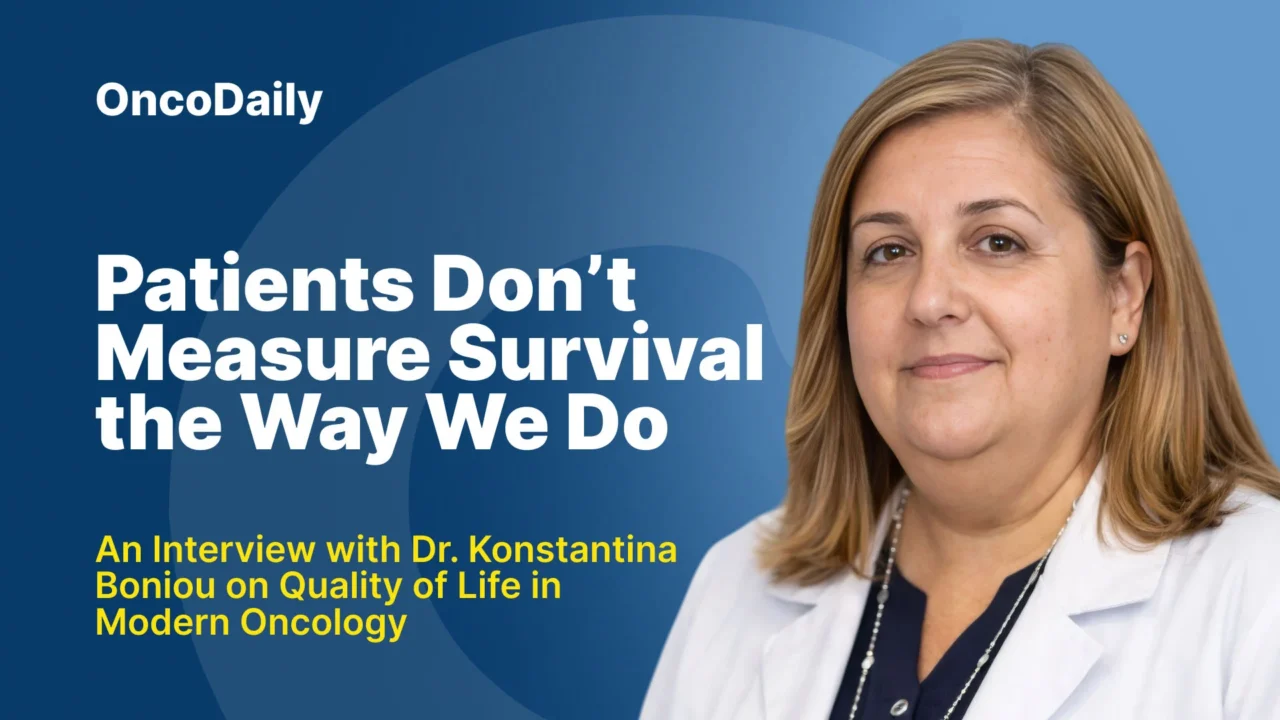
We spoke with Dr. Konstantina Boniou, Director of Radiation Oncology at Theagenio Cancer Hospital, about the gap between clinical metrics and patient experience.
In oncology, we rely heavily on survival metrics. Are these enough to define treatment success?
Survival metrics are essential. They allow us to compare treatments and guide clinical decisions. But they are not sufficient on their own. Patients do not experience survival as numbers. They experience it through their daily lives through their ability to function, think clearly, and maintain independence. So when we talk about, we need to go beyond duration of life and consider its quality.
How important are patient-reported outcomes in modern oncology?
They are becoming increasingly important, and rightly so. Patient-reported outcomes provide direct insight into symptoms and quality of life without clinician interpretation. They help us understand dimensions of treatment that are not captured by imaging or laboratory results.
Importantly, there is growing evidence that these outcomes are not just descriptive—they can also be prognostic.
Can improving symptom monitoring actually impact survival?
Yes, and this is a very interesting development. Studies have shown that systematic symptom monitoring using patient-reported outcomes can improve overall survival. This likely happens because symptoms are identified earlier, managed more effectively, and patients remain in better condition to continue treatment. So, in a way, improving how we listen to patients may also improve outcomes.
Radiotherapy is often described as “well tolerated.” How do patients actually experience it?
From a clinical standpoint, radiotherapy is often well tolerated, especially compared to other treatments. However, tolerance does not necessarily reflect the full patient experience.
Radiotherapy is a daily process. Patients come to the hospital every day, lie still during treatment, and adjust their routines around therapy. Even when side effects are mild, the repetition and the psychological burden can be significant. Patients remember how the process felt not just the side effects.
What do patients remember most after radiotherapy?
They rarely remember the technical aspects. They do not remember dose distributions or planning techniques. They remember how they felt. They remember whether they were reassured, whether things were explained clearly, and whether they felt supported. These aspects leave a lasting impression, often more than the treatment details themselves.
What is the biggest gap between clinicians and patients today?
One of the main gaps is between what we document and what patients experience. We record toxicity in structured ways, but patients live through a much broader experience that includes emotional and functional dimensions. If we do not actively assess these aspects, we risk underestimating their impact.
What does truly patient-centered oncology look like?
It means integrating quality of life into clinical decision-making. Not as an afterthought, but as a core component. We need to consider not only how long patients live, but how they live during that
time. Because ultimately, patients are not only asking for time they are asking for meaningful time.
Modern oncology has achieved extraordinary precision. But precision alone is not enough. As highlighted in this discussion, patient-reported outcomes and quality of life are not secondary considerations. They are central to understanding treatment benefit. Because in the end, patients do not measure survival the way clinicians do.
Written By Eftychia Tataridou, MD