Immune checkpoint inhibitors targeting PD-1 and PD-L1 have fundamentally transformed the treatment landscape of advanced non–small cell lung cancer (NSCLC), producing durable survival benefits in a subset of patients. However, despite these advances, most patients ultimately develop disease progression, creating a major therapeutic challenge in the post-immunotherapy setting.
One increasingly explored strategy has been PD-(L)1 “rechallenge,” where patients previously treated with immunotherapy are re-exposed to another PD-(L)1–containing regimen after progression. The biological rationale is compelling: immune resistance may not always represent complete immune escape, and certain tumors may retain residual immunologic sensitivity that could potentially be reactivated through combination strategies involving chemotherapy, VEGF inhibition, TKIs, or dual immune blockade.
Study Overview and Methodology
This large systematic review and meta-analysis by Daniele Marinelli and colleagues represents the most comprehensive evaluation to date of PD-(L)1 rechallenge strategies in advanced NSCLC previously treated with immunotherapy.
The investigators analyzed:
- 10 randomized controlled trials involving 3,081 patients
- 106 non-randomized interventional studies
The included trials evaluated a broad range of rechallenge approaches, including:
- PD-(L)1 inhibitors plus chemotherapy
- VEGF-targeting combinations
- Tyrosine kinase inhibitor combinations
- Dual immune checkpoint blockade
- Bispecific and investigational immunotherapy regimens
The primary endpoint of the meta-analysis was overall survival, while secondary analyses evaluated progression-free survival, objective response rates, toxicity, and outcomes according to resistance phenotype.
Overall Survival Outcomes
Across the randomized trials, PD-(L)1 rechallenge strategies produced only modest improvements in survival outcomes compared with standard chemotherapy.
Key Overall Survival Findings
- Pooled overall survival hazard ratio was 0.91.
- The reduction in mortality risk was statistically significant but clinically marginal.
- Most individual trials failed to demonstrate clear superiority over standard therapy.
- Heterogeneity across studies was remarkably low, suggesting consistent findings across different rechallenge approaches.
Importantly, although statistical significance was technically achieved, the investigators emphasized that the magnitude of benefit was small and unlikely to justify routine clinical implementation in unselected patients.
Progression-Free Survival and Response Rates
Progression-free survival results mirrored the overall survival findings.
Key PFS Results
- Pooled progression-free survival hazard ratio was 0.89.
- Improvements were numerically modest.
- No individual study demonstrated a dramatic PFS advantage.
- Objective response rates were not meaningfully improved overall.
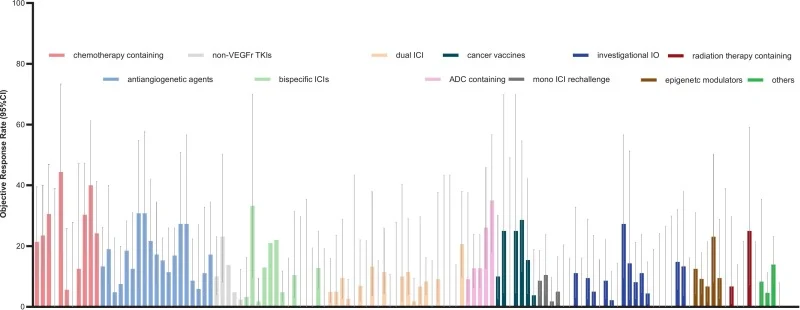
The pooled odds ratio for objective response rate was only 1.12, further supporting the conclusion that rechallenge strategies generally produce limited antitumor activity in unselected populations.
Primary Versus Acquired Resistance
One of the most biologically important contributions of this meta-analysis was the distinction between primary and acquired resistance to prior immunotherapy. The investigators emphasized that resistance to immune checkpoint inhibitors should not be viewed as a single clinical entity, but rather as a spectrum of biologically distinct immune phenotypes.
Primary resistance generally reflects tumors that never meaningfully respond to immunotherapy and are often characterized by immune-cold tumor microenvironments, defective antigen presentation, impaired interferon signaling, and minimal baseline T-cell infiltration. These tumors appear fundamentally resistant to immune activation from the outset of treatment.
By contrast, acquired resistance develops after an initial period of clinical benefit and likely represents adaptive tumor evolution under selective immune pressure rather than complete immune insensitivity. This distinction became highly relevant clinically because the study demonstrated substantially different outcomes between these resistance phenotypes.

Overcoming Primary and Acquired Resistance to Immunotherapy in NSCLC
Acquired Resistance Demonstrated More Favorable Outcomes
The resistance-pattern analyses produced some of the most biologically intriguing findings of the study. While patients with primary resistance derived essentially no meaningful benefit from PD-(L)1 rechallenge strategies, acquired-resistance–like populations consistently demonstrated more encouraging survival signals, suggesting that residual immune responsiveness may still persist in some tumors despite progression.
Key findings included:
- Acquired-resistance populations demonstrated pooled OS hazard ratios of approximately 0.83–0.86.
- Interaction testing approached statistical significance at p=0.07.
- No meaningful survival improvement was observed in primary resistance populations.
Although these findings remain exploratory rather than definitively confirmatory, the consistency of the signal strongly supports the concept that resistance biology profoundly influences retreatment outcomes. The authors proposed that tumors with acquired resistance may retain partially reversible immune biology, potentially making them more amenable to immune reactivation strategies compared with intrinsically immune-refractory tumors.
VEGF and Chemotherapy-Based Combination Strategies
Among the numerous rechallenge strategies evaluated across the analysis, regimens incorporating VEGF-targeting agents or chemotherapy appeared to generate somewhat more encouraging clinical activity compared with many purely immunologic combinations. These findings support the growing understanding that antiangiogenic therapy may partially reverse immunosuppressive tumor microenvironments, improve T-cell trafficking, normalize tumor vasculature, and potentially restore sensitivity to immune checkpoint blockade.
Trials such as CONTACT-01 and Lung-MAP S1800A suggested modest improvements when VEGF inhibition was combined with PD-(L)1 blockade. However, despite biologic rationale and occasional survival signals, most combinations still failed to produce transformative survival breakthroughs. The investigators also cautioned that many encouraging results from earlier single-arm studies were likely influenced by small sample sizes, heterogeneous patient selection, and substantial selection bias.
CONTACT-01 Trial
CONTACT-01 evaluated cabozantinib plus atezolizumab versus docetaxel in previously treated advanced NSCLC after prior immunotherapy exposure. Although the combination demonstrated some progression-free survival improvement, the overall survival benefit remained modest and clinically limited.
Key CONTACT-01 results included:
- Median OS: 10.7 months versus 10.5 months with docetaxel.
- PFS hazard ratio: 0.74.
The trial ultimately reinforced how difficult it remains to meaningfully outperform standard chemotherapy in the post-immunotherapy setting.
Lung-MAP S1800A
Among all randomized studies included in the meta-analysis, Lung-MAP S1800A produced one of the more favorable survival signals. The combination of ramucirumab plus pembrolizumab suggested potential benefit in selected patients previously exposed to immune checkpoint inhibitors.
Key Lung-MAP S1800A findings included:
- Median OS: 14.5 months versus 11.6 months.
- OS hazard ratio: 0.69.
Despite the encouraging overall survival trend, progression-free survival improvements remained limited, underscoring the complexity of interpreting rechallenge efficacy in advanced NSCLC.
LEAP-008
LEAP-008 evaluated lenvatinib plus pembrolizumab but failed to demonstrate a meaningful survival advantage despite some numerical improvements in objective response rates.
Key LEAP-008 findings included:
- Median OS: 11.3 months versus 12.0 months.
- OS hazard ratio: 0.98.
The results illustrated that biologically rational combinations do not necessarily translate into clinically meaningful survival improvements in heavily pretreated immunotherapy-resistant populations.
SAPPHIRE Trial
The SAPPHIRE study evaluated sitravatinib plus nivolumab and demonstrated only modest activity without transformative clinical benefit.
Key SAPPHIRE results included:
- Median OS: 12.2 months versus 10.6 months.
- OS hazard ratio: 0.86.
Although some numerical improvements were observed, the study again highlighted the limited magnitude of benefit achieved by many current rechallenge strategies.
Toxicity Profiles Across Rechallenge Strategies
Safety outcomes varied substantially depending on the therapeutic backbone used alongside PD-(L)1 rechallenge. Chemotherapy-free combinations generally demonstrated more manageable toxicity profiles, whereas multitarget tyrosine kinase inhibitor–containing regimens frequently produced substantially higher rates of grade 3–5 adverse events, treatment discontinuation, and treatment-related toxicity.
Importantly, the overall toxicity burden often appeared to reflect the partner therapy more than the immune checkpoint rechallenge itself. This finding is clinically important because many intensification strategies may increase toxicity without clearly improving long-term survival outcomes.
Biological Interpretation of Resistance
The findings reinforce the growing understanding that immunotherapy resistance is highly heterogeneous and mechanistically complex. The investigators proposed that simply reintroducing PD-(L)1 blockade is unlikely to overcome deeply established immune escape mechanisms in intrinsically resistant tumors.
However, in acquired resistance settings where partial immune responsiveness may still persist, rationally selected combination strategies could potentially restore antitumor immunity. The study discusses several biologic pathways implicated in resistance and possible re-sensitization, including VEGF-mediated immunosuppression, T-cell exhaustion, TIGIT and TIM-3 signaling, TGF-β pathway activation, and adaptive remodeling of the tumor microenvironment. Importantly, these mechanisms likely differ substantially between primary and acquired resistance phenotypes.
Why Docetaxel Still Matters
One of the most practically important conclusions of the meta-analysis was the continued relevance of standard chemotherapy in the post-immunotherapy setting. Across multiple randomized studies, docetaxel-based control arms consistently performed better than historically expected, raising the threshold required for novel rechallenge strategies to demonstrate clinically meaningful superiority.
Several important observations emerged:
- Overall survival in docetaxel control arms frequently exceeded historical benchmarks.
- Many rechallenge strategies failed to clearly outperform chemotherapy.
- Docetaxel ± ramucirumab remained highly competitive across multiple studies.
As a result, docetaxel, with or without ramucirumab, continues to represent the recommended second-line standard for most patients with advanced NSCLC without oncogenic driver alterations.
Future Directions
Rather than supporting broad “all-comer” PD-(L)1 rechallenge strategies, the study strongly argues for a more biologically refined and precision-based approach moving forward. Future progress will likely depend on improved classification of resistance phenotypes, harmonized definitions of primary versus acquired resistance, biomarker-enriched trial designs, and dynamic biomarker strategies capable of identifying tumors that retain residual immune sensitivity after prior immunotherapy exposure.
The investigators specifically emphasized the importance of future studies focused on biologically selected patient populations rather than unselected retreatment approaches.
Clinical Implications
Overall, this landmark meta-analysis delivers a highly important but somewhat sobering message for modern immuno-oncology. PD-(L)1 rechallenge after prior immunotherapy progression does not currently support routine use in unselected advanced NSCLC populations.
At the same time, the consistent signal observed among acquired-resistance–like populations strongly suggests that resistance biology profoundly influences retreatment outcomes and that carefully selected subsets of patients may still derive meaningful benefit from immune reactivation strategies.
Rather than validating rechallenge as a broadly effective approach, the study reframes the field toward precision immunotherapy resistance modeling, biomarker-guided retreatment strategies, and biologically individualized approaches to overcoming immune escape.
Read Full Article Here