





The introduction of consolidation immunotherapy after concurrent chemoradiotherapy has transformed the treatment landscape for patients with unresectable stage III non-small cell lung cancer (NSCLC). The landmark PACIFIC trial established durvalumab as the standard of care, significantly improving progression-free and overall survival and offering many patients the possibility of long-term disease control.
Despite these advances, responses to immunotherapy remain highly variable, and reliable biomarkers that can predict treatment benefit are still limited. While research has largely focused on tumor-related factors such as PD-L1 expression, increasing evidence suggests that host-related factors including the gut microbiome and commonly prescribed concomitant medications may also influence the effectiveness of immune checkpoint inhibitors.
Proton pump inhibitors (PPIs) and antibiotics are among the most frequently prescribed medications in oncology practice. Both have been shown to alter the gut microbiome, raising important questions about whether they could inadvertently affect the immune response required for successful immunotherapy. A recent post-hoc analysis of the PACIFIC trial explored this hypothesis, evaluating the impact of these medications on clinical outcomes with durvalumab while also investigating microbiome-related signatures that may help explain the observed associations.
To better understand the rationale behind the study, its key findings, and what they mean for everyday clinical practice, OncoDaily spoke with Dr. Leonardo Brunetti, whose team conducted this important analysis examining the relationship between concomitant medications, the gut microbiome, and the efficacy of consolidation durvalumab in patients with unresectable stage III NSCLC.
Trial Design and Methods
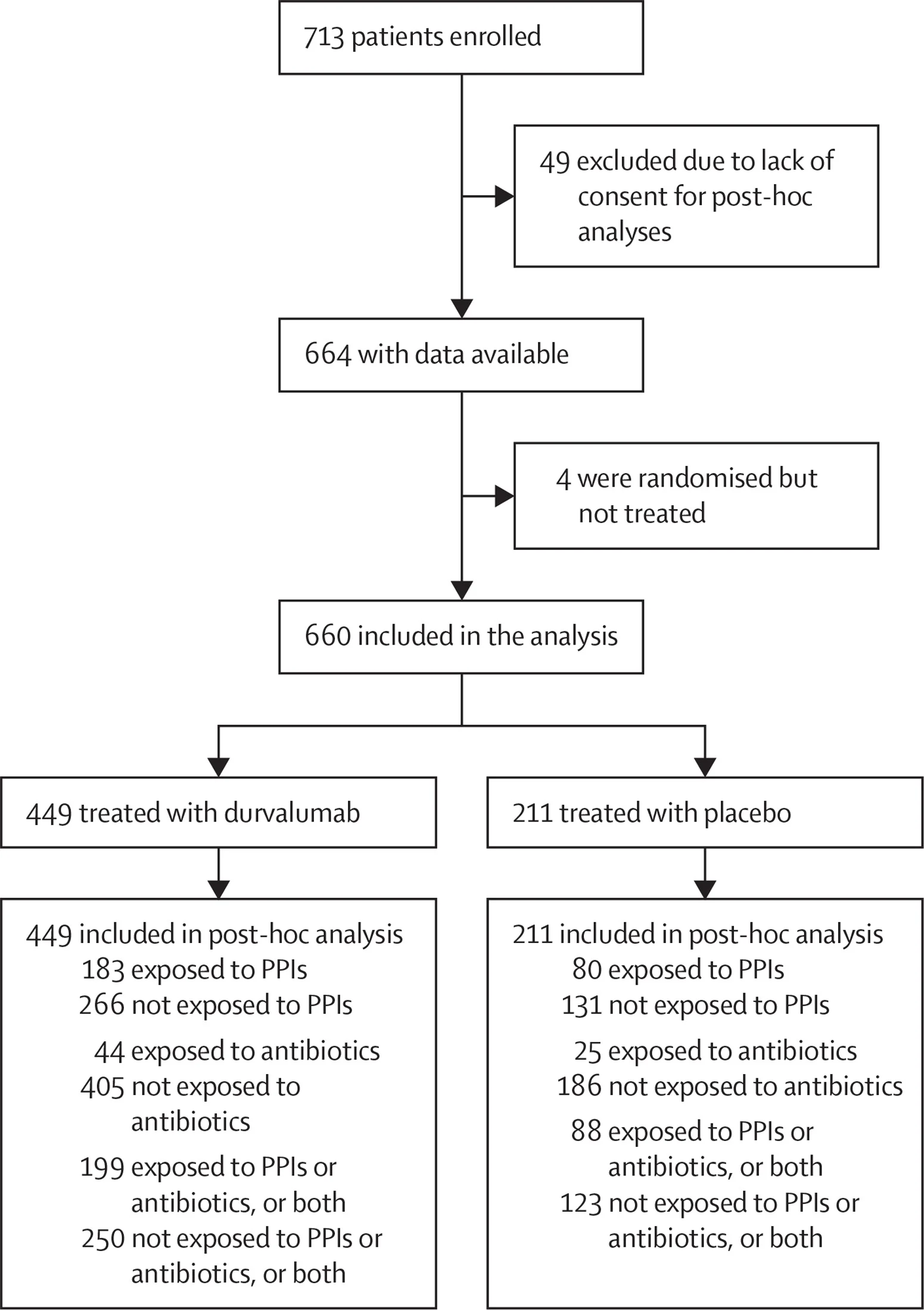
The analysis presented by Dr. Leonardo Brunetti was a post-hoc investigation of the landmark PACIFIC trial, which established consolidation durvalumab as the standard of care for patients with unresectable stage III non-small cell lung cancer (NSCLC) who had not experienced disease progression following concurrent platinum-based chemoradiotherapy.
The study evaluated whether concomitant use of proton pump inhibitors (PPIs) and antibiotics around the initiation of durvalumab influenced clinical outcomes. Investigators also explored the biological relationship between these medications and the gut microbiome using Toposcore, a microbiome-based analytical platform developed to characterize microbial signatures associated with immunotherapy response.
Study Design
- Study: Post-hoc analysis of the randomized Phase III PACIFIC trial
- Population: Patients with unresectable stage III NSCLC without disease progression after concurrent chemoradiotherapy
- Intervention: Consolidation durvalumab versus placebo
- Exposure of interest: Concomitant proton pump inhibitor and antibiotic use
- Primary analyses: Progression-free survival (PFS) and overall survival (OS) according to medication exposure
- Exploratory analyses: Microbiome-related signatures using Toposcore to investigate potential biological mechanisms linking concomitant medications and immunotherapy efficacy.
Understanding How Common Medications May Influence Immunotherapy
The PACIFIC post-hoc analysis was driven by a growing interest in host-related factors that may influence the effectiveness of immune checkpoint inhibitors. While tumor biomarkers have traditionally been the primary focus, accumulating evidence suggests that concomitant medications and the gut microbiome may also play an important role in determining treatment response.
When asked what inspired the study, Dr. Leonardo Brunetti explained that his research group has long been interested in understanding how host-related factors shape outcomes with immunotherapy.
“As a research group, we have long been interested in understanding how host-related factors shape outcomes with immune-checkpoint inhibitors. Unresectable stage III NSCLC remains an area where clinically useful biomarkers are still limited, and the potential impact of concomitant medications had not been fully explored in this setting. This motivated us to investigate whether commonly prescribed drugs such as proton pump inhibitors and antibiotics could influence the efficacy of consolidation durvalumab.”
A Practical Finding That Could Influence Everyday Oncology Care
Among the study’s findings, one observation stands out for its immediate clinical relevance. The association between proton pump inhibitors, antibiotics, and poorer clinical outcomes appeared to be limited to patients receiving durvalumab, suggesting that these medications may specifically interfere with immunotherapy rather than reflecting a generally poorer prognosis.
Dr. Leonardo Brunetti believes this finding has important implications for routine practice.
“I believe the most practice-relevant finding is that the detrimental association between concomitant PPI or antibiotic use and clinical outcomes appeared to be context-dependent: it was observed in the durvalumab arm, but not in the placebo arm. This is important because improving the appropriateness of prescriptions for drugs that are often used too liberally comes at virtually no cost, making this message highly applicable in everyday clinical practice.”
The Gut Microbiome: One Piece of a More Complex Puzzle
The observation that these associations were confined to the durvalumab arm further strengthens interest in the biological mechanisms underlying immunotherapy response. While disruption of the gut microbiome is a leading hypothesis, the interaction between concomitant medications and immune checkpoint inhibitors is likely multifactorial.
Dr. Leonardo Brunetti emphasized that the microbiome represents only one component of this complex relationship.
“The activity of immune-checkpoint inhibitors is influenced by a wide range of host-related factors…”
Medication Stewardship Rather Than Medication Avoidance
One of the most important messages from the study is that clinicians should not discontinue necessary medications solely because a patient is receiving immunotherapy. Instead, the findings highlight the importance of prescribing these agents only when there is a clear clinical indication.
Dr. Leonardo Brunetti emphasized that the study should not be interpreted as a recommendation to universally avoid proton pump inhibitors or antibiotics in patients treated with durvalumab.
“Our goal is absolutely not to suggest that PPIs or antibiotics should be avoided in all patients receiving immunotherapy, especially in the absence of definitive prospective data. However, overprescription is common, particularly in patients with multiple comorbidities. Our recommendation is careful medication stewardship: clinicians should avoid unnecessary prescriptions that may potentially interfere with anticancer treatment efficacy. In my view, this is also a form of precision and personalized medicine.”
Can the Microbiome Become a Clinical Biomarker?
The investigators also explored microbiome signatures using Toposcore, adding to the growing body of evidence supporting the gut microbiome as a determinant of immunotherapy response. While microbiome-based biomarkers remain largely confined to research settings, Dr. Brunetti believes the field is steadily moving toward clinical translation.
“The gut microbiome is a validated and highly relevant component of the immune response to cancer therapy. However, we are still much closer to the research setting than to routine clinical implementation, probably because of barriers related to sample collection, standardization, and data analysis. That said, the evidence is becoming increasingly mature and robust, and we should now make a stronger effort to translate microbiome signatures into biomarkers that can ultimately be integrated into daily oncology practice.”
Interpreting the Results With Appropriate Caution
Although the findings are compelling, Dr. Brunetti stressed that they should be interpreted within the context of the study’s retrospective design. As with any post-hoc analysis, the results are hypothesis-generating and require prospective confirmation before they can directly influence clinical guidelines.
“Although our analysis was based on data from a randomized clinical trial, it was retrospective in nature and therefore carries the inherent limitations of a post-hoc study. We cannot fully exclude selection bias, residual confounding, or other associative biases. In addition, the microbiome data came from a separate cohort rather than from the PACIFIC trial population, so they should be interpreted as supportive and hypothesis-generating rather than as definitive mechanistic proof.”
The Next Generation of Research
The findings raise important questions that extend beyond whether proton pump inhibitors and antibiotics influence immunotherapy outcomes. Future studies will need to determine which specific drugs, exposure durations, and treatment windows are most relevant, while also uncovering the biological mechanisms underlying these associations.
“These findings now need to be validated in prospective studies with both clinical and translational endpoints. Future research should clarify how, and to what extent, PPIs and antibiotics impair immunotherapy outcomes. Importantly, we need to move beyond broad drug classes and investigate whether specific agents, subclasses, durations of exposure, or timing windows are more strongly associated with this effect. These were key questions that the PACIFIC dataset was not statistically powered to fully address.”
Looking Ahead: Can We Modulate the Microbiome?
Beyond avoiding unnecessary medications, researchers are increasingly investigating whether actively modifying the gut microbiome could enhance responses to immunotherapy. Although several strategies including dietary interventions, probiotics, and fecal microbiota transplantation are being explored, Dr. Brunetti believes considerable work remains before these approaches become part of routine oncology care.
“Microbiome modulation is an area of great interest, also supported by evidence from other disciplines. However, it remains highly complex. Longitudinal changes, as well as changes in specific taxa, can be either highly relevant or biologically negligible depending on the context. Still, the potential is considerable. I believe that both behavioral interventions and dedicated therapeutic strategies targeting the microbiome represent an important direction for future immuno-oncology care.”
A Final Message for Oncologists
Dr. Leonardo Brunetti concluded with a practical message that reflects the central theme of the study: thoughtful prescribing rather than indiscriminate medication avoidance. The goal is not to withhold medications that patients genuinely need, but to encourage clinicians to carefully evaluate whether every prescription is truly necessary.
“Do not deprive patients of medications that are genuinely needed for day-to-day symptom control in the hope of improving cancer treatment efficacy. That is not our message. Rather, our message is to raise awareness around conscious, rational prescribing. We should minimize or avoid unnecessary medications that provide no real symptomatic benefit and may, at the same time, compromise the efficacy of anticancer treatments.”

Could Proton Pump Inhibitors Affect Durvalumab Outcomes After Chemoradiotherapy in Stage III NSCLC?