
Durvalumab after concurrent chemoradiotherapy remains a central treatment approach for patients with unresectable stage III non-small-cell lung cancer.
However, not every factor that influences immunotherapy outcomes is part of the cancer treatment regimen itself.
A post-hoc analysis of the PACIFIC trial has examined whether baseline exposure to proton pump inhibitors and systemic antibiotics was associated with outcomes in patients receiving durvalumab after chemoradiotherapy.
The study reported that proton pump inhibitor exposure within 30 days before randomisation was associated with shorter progression-free survival and overall survival in the durvalumab group. Antibiotic exposure was associated with shorter progression-free survival, but not with a statistically significant difference in overall survival.
The findings add to growing interest in the relationship between the gut microbiome, concomitant medications, and immune checkpoint inhibitor activity. They do not establish that proton pump inhibitors or antibiotics directly reduce the efficacy of durvalumab.
Why Could Supportive Medications Matter During Immunotherapy?
Proton pump inhibitors and antibiotics are frequently used in patients receiving chemoradiotherapy.
Proton pump inhibitors may be prescribed for reflux disease, dyspepsia, gastritis, corticosteroid-related gastrointestinal protection, or treatment-related oesophageal symptoms. Antibiotics may be required for respiratory infections, hospital-acquired infections, treatment complications, or other clinically important indications.
Both drug classes can alter the gut microbiome.
This has raised concerns that microbiome disruption might affect antitumour immune activity and reduce the benefit of immune checkpoint blockade. Previous evidence has largely come from retrospective studies in metastatic cancer, where patients receiving antibiotics or proton pump inhibitors often had poorer outcomes with immunotherapy.
Whether the same pattern applies in potentially curative stage III NSCLC had remained unclear.
What Did the PACIFIC Analysis Include?
The analysis used data from the PACIFIC trial, a randomised, double-blind phase 3 study of durvalumab or placebo after concurrent platinum-based chemoradiotherapy in unresectable stage III NSCLC.
Of the 713 patients randomly assigned in PACIFIC, 660 were included in this post-hoc analysis:
- 449 patients received durvalumab
- 211 patients received placebo
Baseline proton pump inhibitor exposure was defined as oral or intravenous use within 30 days before randomisation. Baseline antibiotic exposure was defined using the same 30-day window.
Overall:
- 263 patients, or 40%, had baseline proton pump inhibitor exposure
- 69 patients, or 10%, had baseline antibiotic exposure
The median follow-up in the overall population was 62.4 months.
Proton Pump Inhibitor Exposure Was Associated With Shorter PFS and OS With Durvalumab
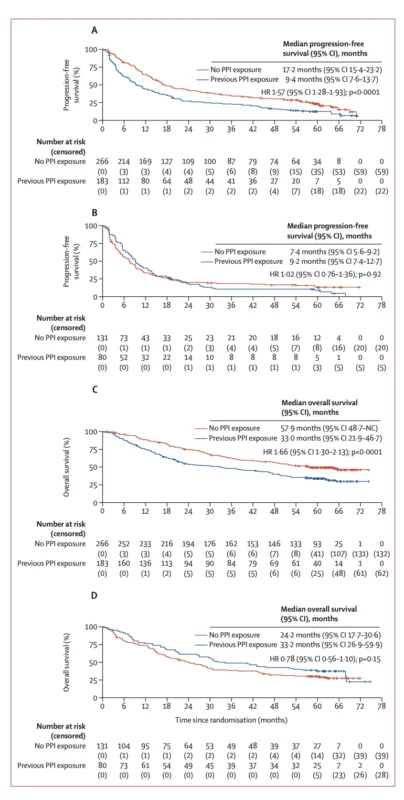
Among patients treated with durvalumab, baseline proton pump inhibitor exposure was associated with shorter progression-free survival.
Median PFS was:
- 9.4 months with proton pump inhibitor exposure
- 17.2 months without proton pump inhibitor exposure
The hazard ratio for progression or death was 1.57 (95% CI, 1.28–1.93; p<0.0001).
The difference was also observed for overall survival.
Median OS was:
- 33.0 months with proton pump inhibitor exposure
- 57.9 months without proton pump inhibitor exposure
The hazard ratio for death was 1.66 (95% CI, 1.30–2.13; p<0.0001).
After adjustment for baseline clinical and pathological variables, proton pump inhibitor exposure remained associated with increased risk of progression and death in durvalumab-treated patients.
Importantly, the same pattern was not observed in the placebo group.
The treatment-by-proton pump inhibitor interaction was statistically significant for both PFS and OS. This suggests that the association may be more relevant in the context of durvalumab than as a general marker of poorer prognosis.
Antibiotics Were Associated With Shorter PFS, but the Signal Was Less Consistent
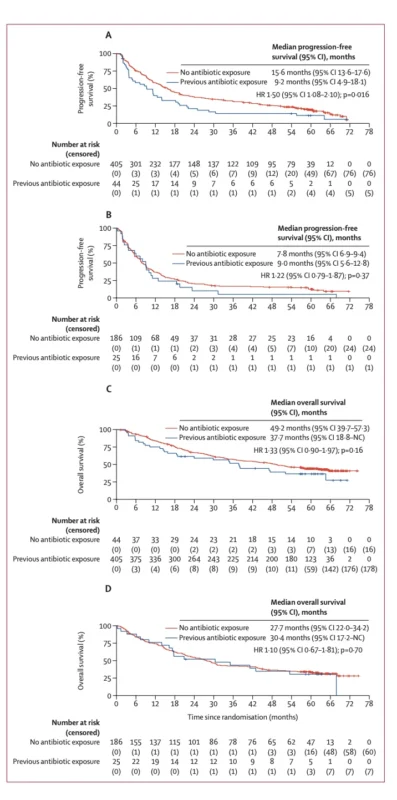
Baseline antibiotic exposure was also associated with shorter PFS in the durvalumab group.
Median PFS was:
- 9.2 months with antibiotic exposure
- 15.6 months without antibiotic exposure
The hazard ratio for progression or death was 1.50 (95% CI, 1.08–2.10; p=0.016).
However, antibiotic exposure was not associated with a statistically significant difference in overall survival.
Median OS was 37.7 months in patients exposed to antibiotics and 49.2 months in those without antibiotic exposure. The hazard ratio was 1.33 (95% CI, 0.90–1.97; p=0.16).
In adjusted analyses, antibiotic exposure remained associated with shorter PFS in the primary multivariable model. However, this association was no longer statistically significant in a sensitivity analysis that included additional variables with substantial missing data.
Unlike proton pump inhibitors, antibiotic exposure did not show a statistically significant treatment interaction. This means the analysis did not establish that the association was specifically related to durvalumab treatment.
What Did the Microbiome Analysis Show?
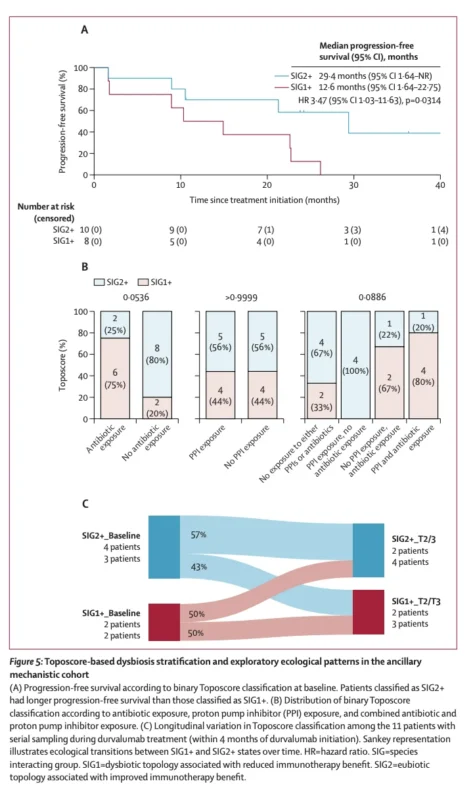
The researchers also examined an ancillary cohort of 18 patients with stage III NSCLC treated with chemoradiotherapy followed by durvalumab in routine practice.
Stool samples were analysed using a microbiome-based dysbiosis classification called Toposcore.
Patients with a eubiotic microbiome profile, classified as SIG2-positive, had longer progression-free survival than patients with a dysbiotic SIG1-positive profile.
The reported hazard ratio was 3.47 (95% CI, 1.03–11.63; p=0.0314).
Antibiotic exposure was numerically associated with a greater proportion of dysbiotic microbiome profiles. Proton pump inhibitor exposure alone did not show a clear association with dysbiosis in this small cohort.
These findings provide biological context for the clinical results, but they remain exploratory. The microbiome cohort was small, and the analysis was not designed to prove that medication-associated microbiome changes caused differences in durvalumab benefit.
Why the Results Need Careful Interpretation
This was a post-hoc analysis, not a study designed prospectively to test whether proton pump inhibitors or antibiotics reduce durvalumab efficacy.
The reasons why patients received these medications were not available. This is important because medication use may reflect underlying clinical circumstances.
For example, proton pump inhibitor use could reflect reflux disease, oesophagitis after chemoradiotherapy, or other gastrointestinal symptoms. Antibiotic use could reflect infection, hospital admission, treatment complications, or inflammatory conditions.
These factors may themselves be associated with outcomes.
The investigators adjusted for multiple baseline characteristics and used the placebo group as a comparator. This reduces, but does not eliminate, the possibility of confounding.
The data should therefore be interpreted as treatment-dependent associations, not proof that proton pump inhibitors or antibiotics directly impair durvalumab activity.
What Should Change in Clinical Practice?
The findings do not support stopping proton pump inhibitors or withholding antibiotics when they are clinically indicated.
Patients receiving chemoradiotherapy and durvalumab may require these medications for important medical reasons. Avoiding appropriate treatment for infection, gastrointestinal bleeding risk, reflux, or severe oesophageal symptoms could cause harm.
However, the study supports careful medication review.
Clinicians may consider whether long-term proton pump inhibitor therapy remains necessary, whether the indication is still present, and whether the lowest effective dose is being used. Antibiotic stewardship remains important, particularly when antibiotics are prescribed without a clear indication.
These decisions should be individualised. They should not be based on an assumption that every patient receiving a proton pump inhibitor or antibiotic will have reduced benefit from durvalumab.
Why This Matters for Stage III NSCLC
The PACIFIC setting differs from metastatic NSCLC.
Patients with unresectable stage III disease are treated with curative intent. Even a modest reduction in the benefit of consolidation durvalumab could be clinically important.
The study also reinforces a broader point in immuno-oncology: treatment outcomes may be influenced by factors beyond tumour biomarkers and drug selection.
The gut microbiome, medications, diet, comorbidities, infection, corticosteroid exposure, and treatment-related complications may all shape the immune environment in ways that are not yet fully understood.
Prospective studies with standardised medication-exposure definitions and integrated microbiome profiling will be needed before medication use can be incorporated into routine immunotherapy decision-making.
The Bottom Line
In this post-hoc analysis of the PACIFIC trial, baseline proton pump inhibitor exposure was associated with shorter progression-free survival and overall survival in patients receiving durvalumab after chemoradiotherapy for unresectable stage III NSCLC.
Baseline antibiotic exposure was associated with shorter progression-free survival, but the effect on overall survival was not statistically significant and the treatment interaction was not significant.
The findings raise an important hypothesis about microbiome disruption and durvalumab benefit. They do not prove causality and should not lead to withholding clinically necessary proton pump inhibitors or antibiotics.
The practical message is careful medication review, appropriate antibiotic stewardship, and prospective validation before treatment recommendations change.
References
- Brunetti L, Santo V, Pinato DJ, et al. Differential impact of proton pump inhibitors and antibiotics on immunotherapy efficacy after chemoradiotherapy in locally advanced non-small-cell lung cancer: a post-hoc analysis of the PACIFIC trial. The Lancet Oncology. 2026. doi:10.1016/S1470-2045(26)00191-9.
- Antonia SJ, Villegas A, Daniel D, et al. Durvalumab after chemoradiotherapy in stage III non-small-cell lung cancer. New England Journal of Medicine. 2017;377:1919–1929.
- Spigel DR, Faivre-Finn C, Gray JE, et al. Five-year survival outcomes from the PACIFIC trial: durvalumab after chemoradiotherapy in stage III non-small-cell lung cancer. Journal of Clinical Oncology. 2022;40:1301–1311.
- Derosa L, Iebba V, Silva CAC, et al. Custom scoring based on ecological topology of gut microbiota associated with cancer immunotherapy outcome. Cell. 2024;187:3373–3389.