
An exploratory circulating tumor DNA (ctDNA) analysis of the phase III KEYNOTE-B15/EV-304 trial found higher neoadjuvant ctDNA clearance with enfortumab vedotin plus pembrolizumab than with gemcitabine–cisplatin in cisplatin-eligible patients with muscle-invasive bladder cancer (MIBC). ctDNA clearance was associated with more favorable event-free survival (EFS), while presurgical ctDNA negativity was associated with higher pathological complete response (pCR) rates.
Jonathan A. Chatzkel presented the analysis at ESMO 2026 (abstract 4734O).
Background
KEYNOTE-B15/EV-304 previously demonstrated significant improvements in EFS, overall survival, and pCR with perioperative enfortumab vedotin plus pembrolizumab compared with neoadjuvant gemcitabine–cisplatin, with both treatment strategies incorporating radical cystectomy and pelvic lymph node dissection.
This exploratory analysis evaluated associations between ctDNA status, clearance during neoadjuvant treatment, and clinical outcomes.
Methods and Study Design
KEYNOTE-B15/EV-304 randomized 808 cisplatin-eligible patients with T2–T4aN0M0 or T1–T4aN1M0 MIBC to:
- Enfortumab vedotin plus pembrolizumab (n = 405): Neoadjuvant combination treatment followed by radical cystectomy and pelvic lymph node dissection, then adjuvant combination treatment.
- Chemotherapy (n = 403): Neoadjuvant gemcitabine–cisplatin followed by radical cystectomy and pelvic lymph node dissection.
ctDNA was assessed using the Natera Signatera assay before neoadjuvant treatment, before surgery after neoadjuvant treatment, after surgery before adjuvant treatment, and during the adjuvant phase.
Clearance was defined as conversion from detectable ctDNA at baseline to undetectable ctDNA before surgery among patients with evaluable samples at both timepoints. EFS and pCR were examined according to ctDNA status and changes during neoadjuvant treatment.
Results
- ctDNA positivity: Before neoadjuvant treatment, ctDNA positivity was 52.4% with enfortumab vedotin plus pembrolizumab versus 56.8% with chemotherapy. Corresponding rates were 13.0% versus 19.7% before surgery and 4.8% versus 13.5% after surgery. Samples from 490, 436, and 432 patients were analyzed at these respective timepoints.
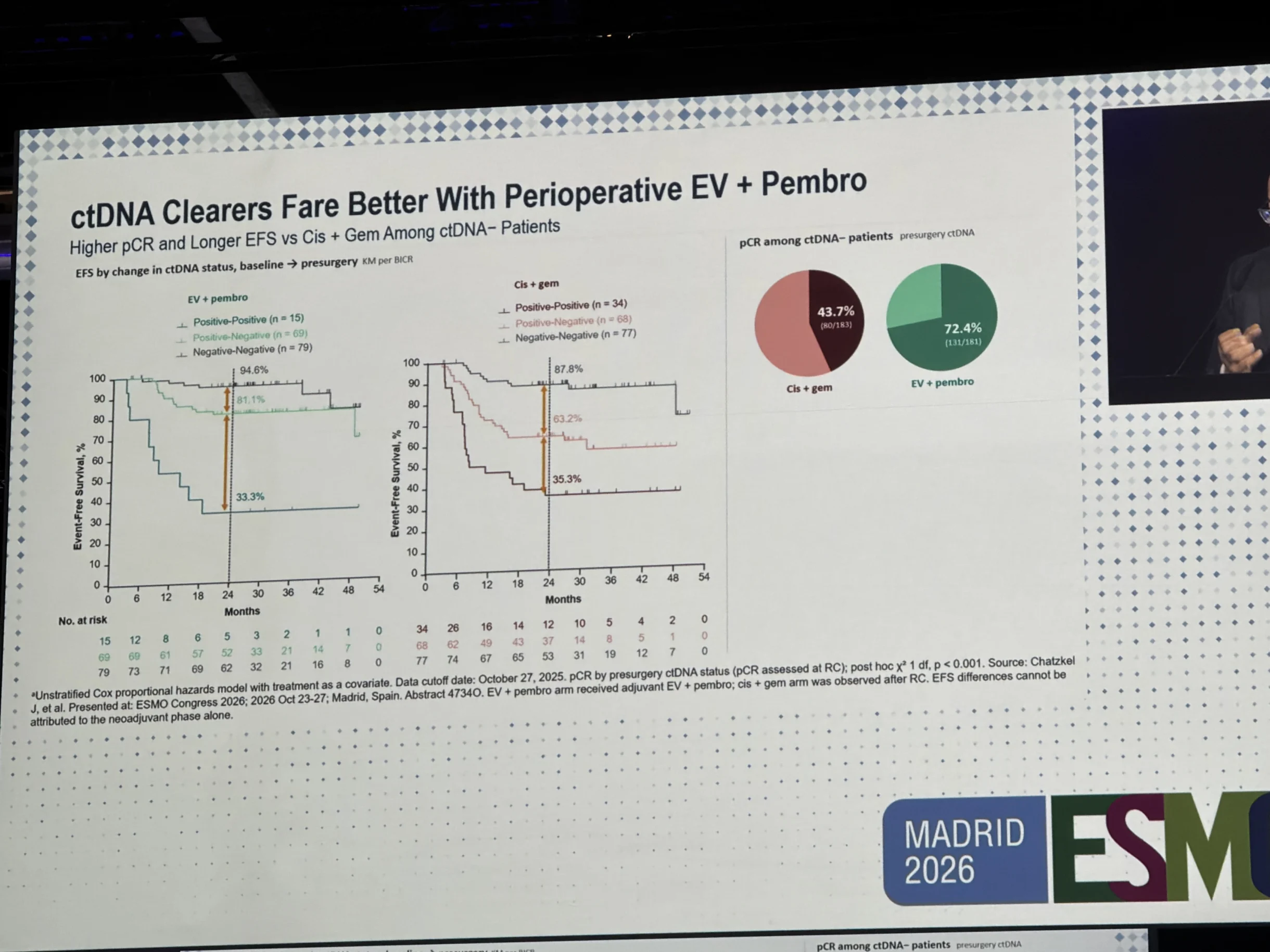
- Neoadjuvant ctDNA clearance: Among baseline ctDNA-positive patients with evaluable presurgical samples, clearance occurred in 82.1% (69/84) receiving enfortumab vedotin plus pembrolizumab versus 66.7% (68/102) receiving chemotherapy—a numerical difference of 15.4 percentage points.
- EFS according to ctDNA trajectory: Among patients achieving clearance, estimated 24-month EFS was 81.1% with enfortumab vedotin plus pembrolizumab versus 63.2% with chemotherapy. Corresponding estimates were 33.3% versus 35.3% among patients who remained ctDNA-positive and 94.6% versus 87.8% among those who remained ctDNA-negative from baseline to the presurgical assessment.
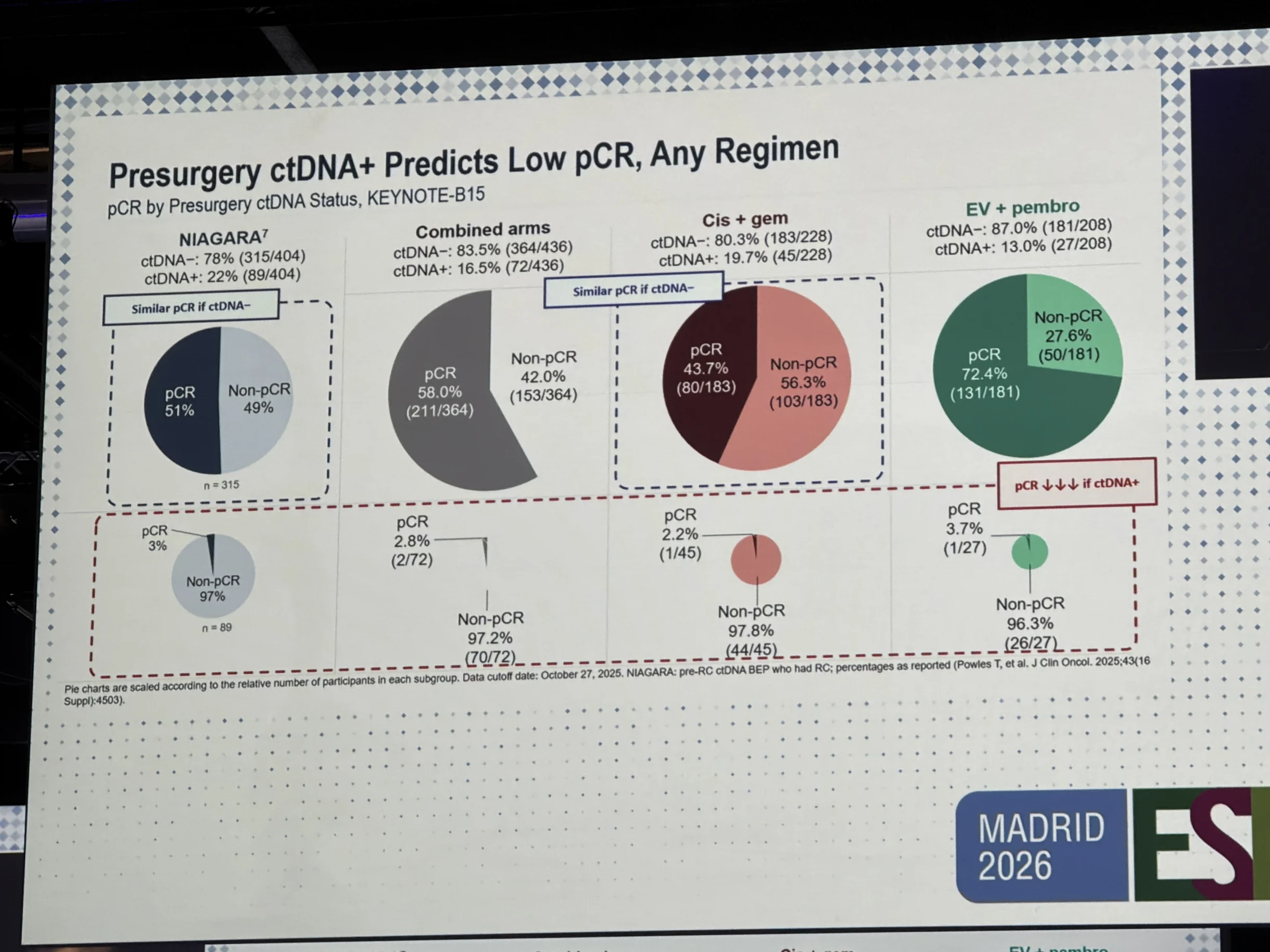
- Presurgical ctDNA status and pCR: Among presurgical ctDNA-negative patients, pCR occurred in 72.4% (131/181) with enfortumab vedotin plus pembrolizumab versus 43.7% (80/183) with chemotherapy. Among presurgical ctDNA-positive patients, pCR rates were 3.7% (1/27) versus 2.2% (1/45), respectively. The presurgical ctDNA-negative groups included both patients who achieved clearance and those who were already negative at baseline.
- EFS by baseline ctDNA status: Treatment HR point estimates favored enfortumab vedotin plus pembrolizumab in both baseline ctDNA-positive patients (HR 0.54; 95% CI 0.37–0.80) and ctDNA-negative patients (HR 0.68; 95% CI 0.37–1.26).
- EFS by postoperative ctDNA status: HR point estimates also favored the combination in postoperative ctDNA-positive patients (HR 0.63; 95% CI 0.30–1.35) and ctDNA-negative patients (HR 0.48; 95% CI 0.29–0.81). Confidence intervals crossed 1 in the baseline ctDNA-negative and postoperative ctDNA-positive subgroups.
Interpretation
ctDNA clearance and persistent negativity were associated with more favorable EFS, whereas persistent ctDNA detection identified patients with poorer outcomes. Presurgical ctDNA negativity was also associated with higher pCR rates, although a negative result did not reliably indicate the absence of residual cancer.
These analyses were exploratory and involved subsets of the randomized population with available samples. Comparisons within groups defined by treatment response, such as ctDNA clearance, should be interpreted cautiously because these groups were determined after randomization.
EFS outcomes reflect the complete treatment strategies, including adjuvant enfortumab vedotin plus pembrolizumab in the experimental arm. Differences therefore cannot be attributed to neoadjuvant treatment alone.
Conclusion
In this exploratory KEYNOTE-B15/EV-304 analysis, neoadjuvant enfortumab vedotin plus pembrolizumab was associated with higher ctDNA clearance than gemcitabine–cisplatin. Clearance was associated with more favorable EFS, and presurgical ctDNA negativity was associated with higher pCR rates.
The findings support the prognostic relevance of ctDNA assessment but do not establish ctDNA as a predictive biomarker for treatment selection. They also do not validate omission of radical cystectomy or adjuvant treatment based on ctDNA negativity alone.