At the 2026 ASCO Annual Meeting, Martin Wermke and colleagues presented first-in-human results from the phase 1 IMA401-101 study evaluating IMA401, a MAGEA4/8-targeted T-cell receptor–based bispecific T-cell engager (TCER), in patients with recurrent or refractory solid tumors.
IMA401 is a next-generation bispecific TCR-based T-cell engager designed to redirect T cells toward antigen-positive cancer cells. The molecule combines a high-affinity and highly specific TCR domain targeting an HLA-A*02:01-presented peptide shared by the cancer-testis antigens MAGEA4 and MAGEA8 with a low-affinity T-cell–recruiting domain intended to improve tolerability and biodistribution. An Fc component was incorporated for half-life extension.
The phase 1a/b IMA401-101 basket study evaluated the safety, tolerability, and preliminary antitumor activity of IMA401 in heavily pretreated patients with advanced solid tumors.
Study Design and Methods
Eligible patients were:
- ≥18 years old
- HLA-A*02:01 positive
- MAGEA4 and/or MAGEA8 positive
- Diagnosed with recurrent or refractory solid tumors
- Required to have measurable disease per RECIST 1.1
- ECOG performance status 0–2
- Have exhausted standard-of-care treatment options
- Dose escalation used an adaptive Bayesian logistic regression model (BLRM) design with cohorts of 1–6 patients.
Bi-Specific T Cell Engagers in Cancer Therapy: Mechanisms, Advances, and Clinical Impact
Patients received:
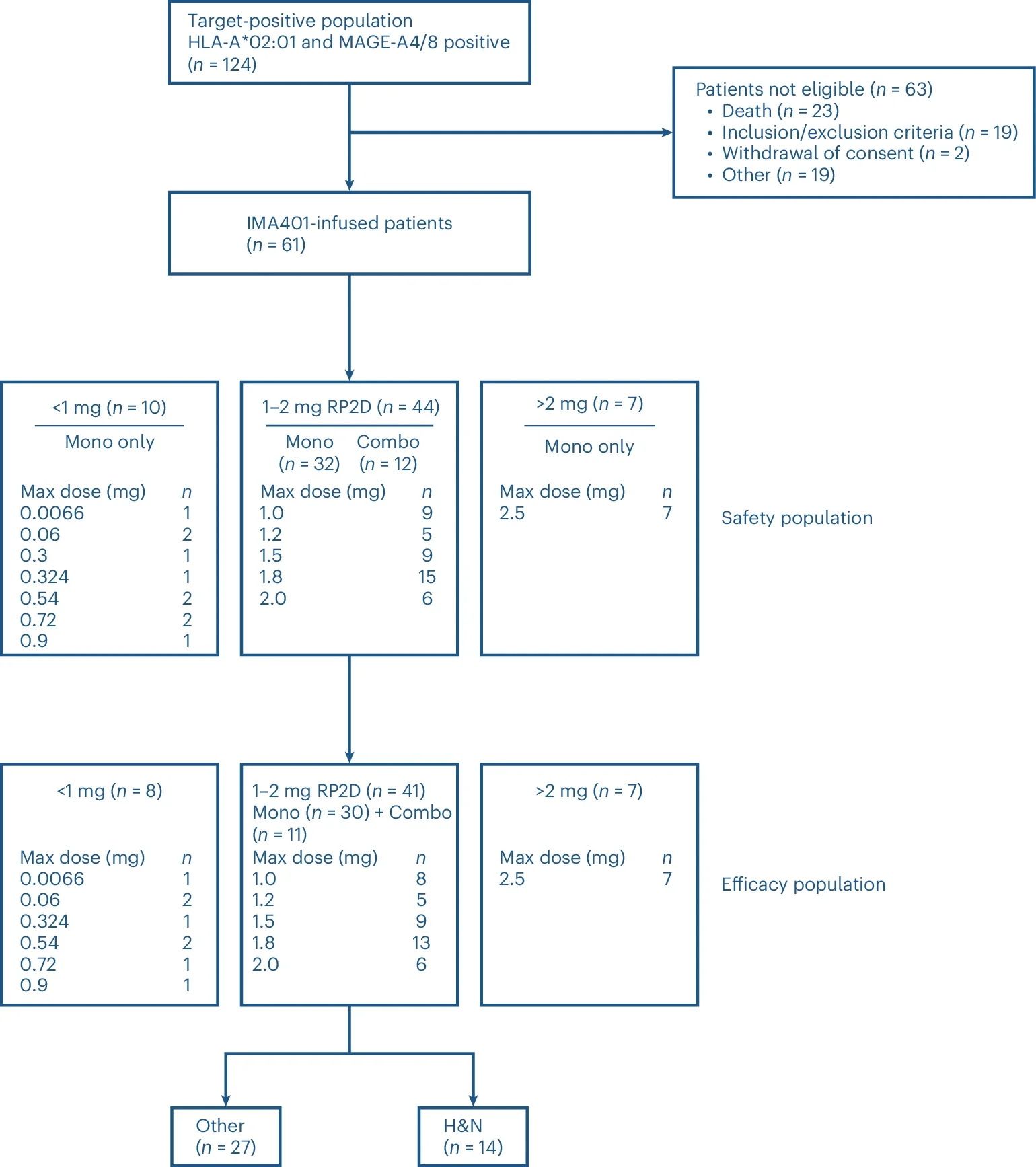
- IMA401 at doses ranging from 0.0066 mg to 2.5 mg every 2 weeks
- With or without pembrolizumab every 6 weeks
Combination therapy with pembrolizumab was evaluated at:
- 1.0 mg IMA401
- 1.5 mg IMA401
Weekly step dosing of IMA401 was implemented during the first 2–3 doses at dose levels ≥1 mg.
Primary endpoints included:
- Maximum tolerated dose (MTD)
- Recommended phase 2 dose (RP2D)
Secondary endpoints included:
- Safety
- Confirmed objective response rate (cORR)
- Disease control rate (DCR)
Results
As of September 26, 2025, 55 heavily pretreated patients across more than 15 tumor types had received IMA401 with or without pembrolizumab.
Patients had received a median of 4 prior lines of therapy (range 1–9).
The most frequent treatment-related adverse events included:
Low-grade cytokine release syndrome (CRS)
- Grade 1: 24%
- Grade 2: 11%
- No grade ≥3 CRS observed
Transient lymphopenia
- Any grade: 29%
- Grade ≥3: 24%
Reversible neutropenia
- Any grade: 29%
- Grade ≥3: 18%
- No ICANS was reported.
Investigators noted that tolerability of IMA401 combined with pembrolizumab (n=9) was consistent with the monotherapy safety profile.
The formal maximum tolerated dose was not reached, although 3 dose-limiting toxicities occurred at 2.5 mg IMA401.
The recommended phase 2 dose range was determined to be:
- 1–2 mg IMA401
Antitumor Activity
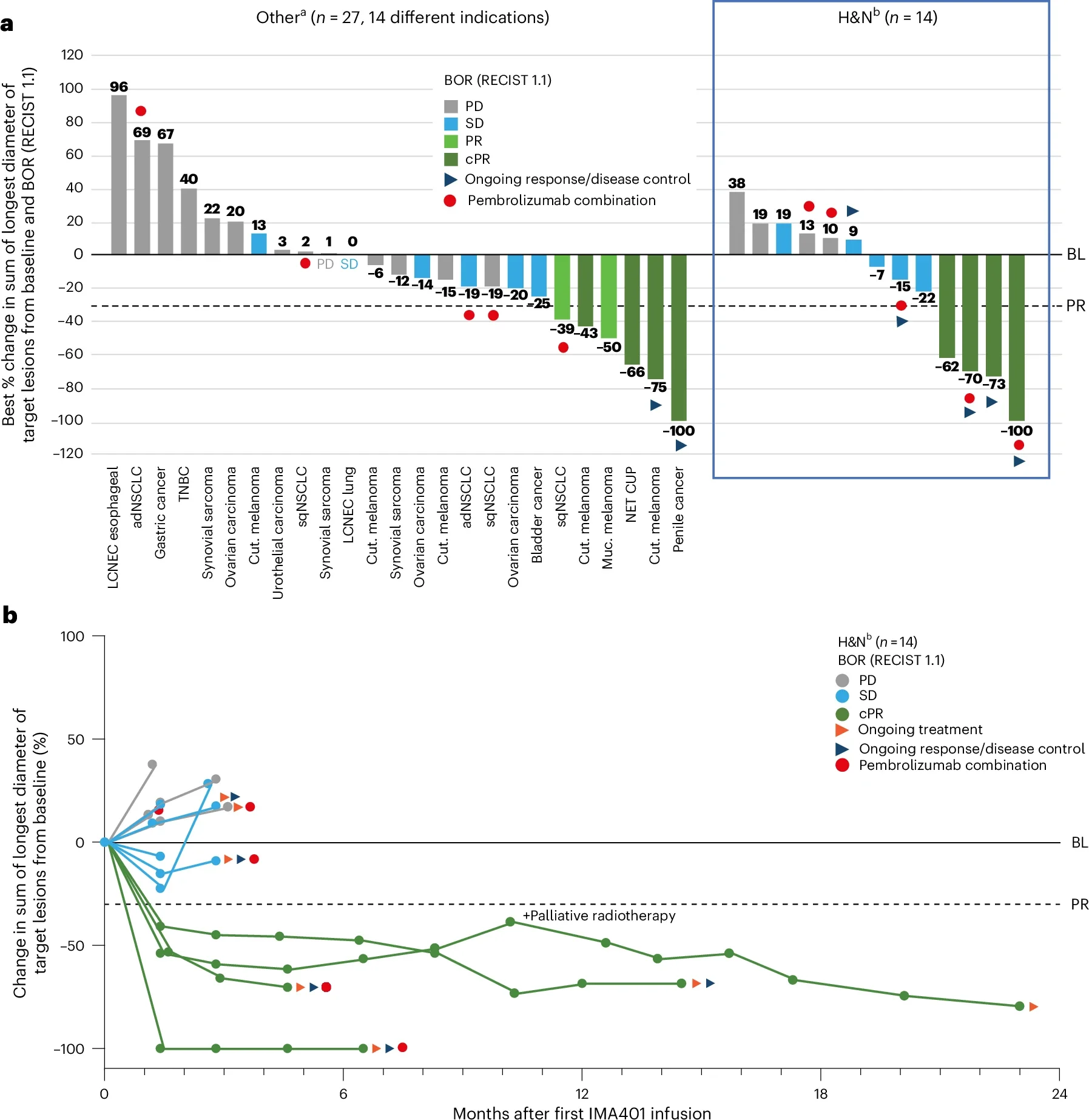
Efficacy was evaluable in 38 patients receiving target doses of at least 1 mg IMA401.
Promising clinical activity was observed in:
- Head and neck cancercORR: 25% (2/8)
- DCR: 63% (5/8)
- MelanomacORR: 29% (2/7)
- DCR: 57% (4/7)
All confirmed responses remained ongoing beyond 6 months postinfusion.
In squamous non–small cell lung cancer (sqNSCLC):
- One patient achieved partial response with reduction in all target lesions
- One patient achieved stable disease with overall survival of approximately 16 months
- One patient had progressive disease but demonstrated reduction in all liver target lesions
After the data cutoff, investigators observed two additional confirmed partial responses in head and neck cancer, increasing the confirmed ORR to:
- 33% (4/12)
Conclusion
The first-in-human IMA401 study demonstrated favorable tolerability and encouraging early antitumor activity in heavily pretreated patients with recurrent or refractory solid tumors.
Clinical activity was particularly notable in:
- Head and neck cancer
- Melanoma
- Squamous NSCLC
The study did not reach a formal maximum tolerated dose, and the RP2D range was established at 1–2 mg IMA401.
Based on these findings and supporting preclinical data, further development strategies are being explored, including combination approaches with the PRAME-directed bispecific molecule IMA402 in squamous NSCLC and other solid tumors.