
At the 2026 ASCO Annual Meeting, Zhenzhen Liu and colleagues presented results from the phase III HELEN-Trio 011 trial evaluating the addition of camrelizumab to neoadjuvant docetaxel and carboplatin in patients with stage II–III triple-negative breast cancer (TNBC).
The study builds on prior evidence from KEYNOTE-522 and the phase III CamRelief trial, both of which demonstrated improved pathological complete response (pCR) rates with PD-1 blockade in early TNBC. However, many currently used regimens rely on anthracyclines and are associated with substantial toxicity. HELEN-Trio 011 explored whether an anthracycline-free chemoimmunotherapy approach could maintain efficacy while offering a manageable safety profile.

KEYNOTE-522 Final Analysis: Pembrolizumab Plus Chemotherapy in High-Risk Early-Stage TNBC
Study Design and Treatment Strategy
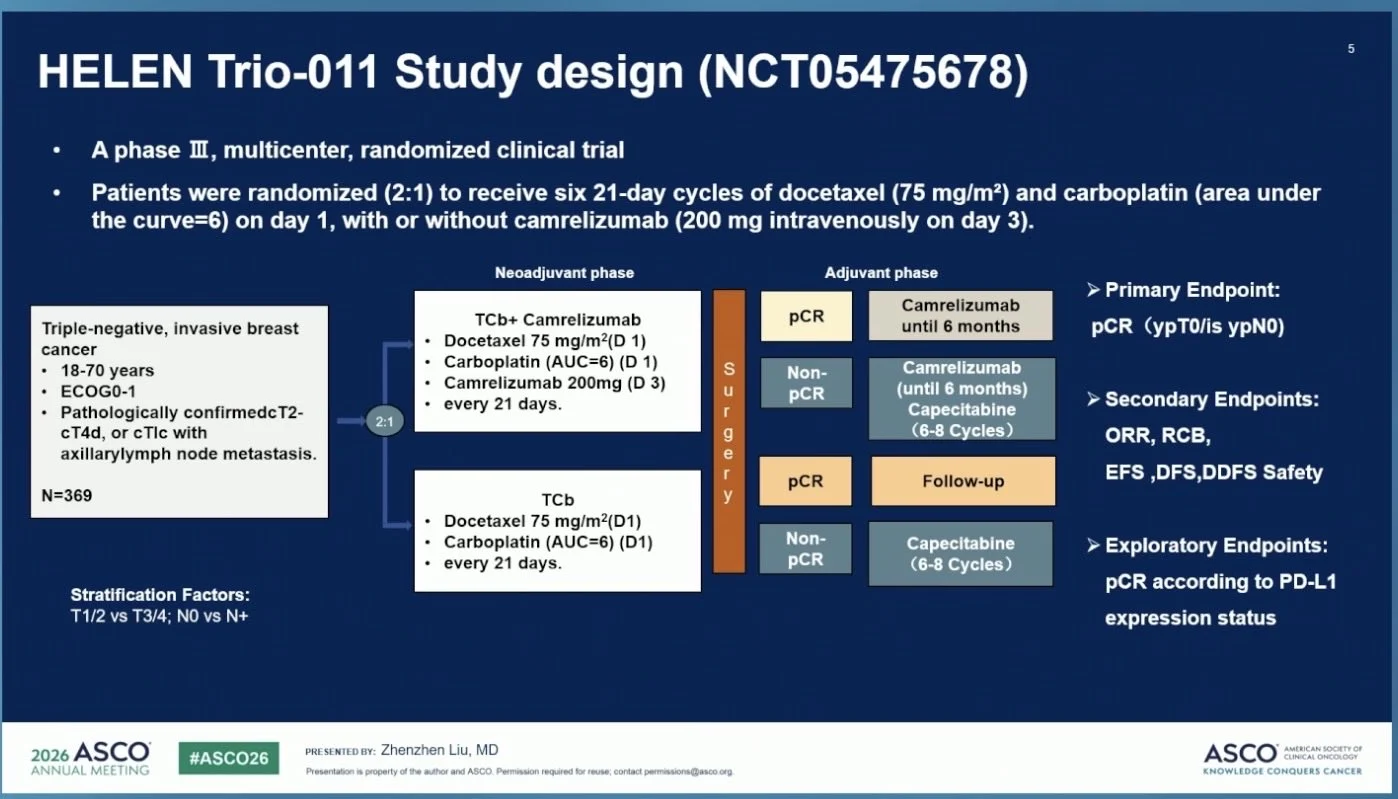
HELEN-Trio 011 was a multicenter, randomized, open-label phase III trial (NCT05475678) conducted across 14 hospitals in China.
Eligible patients included women aged 18–70 years with previously untreated stage II–III TNBC. Patients were randomized 2:1 to receive:
- Docetaxel plus carboplatin alone
- Or the same regimen combined with camrelizumab
Treatment consisted of six 21-day neoadjuvant cycles:
- Docetaxel 75 mg/m² day 1
- Carboplatin AUC 6 day 1
- Camrelizumab 200 mg IV day 3
The primary endpoint was pathological complete response defined as ypT0/Tis ypN0 in the modified intention-to-treat population.
Pathological Complete Response Outcomes
Between December 2022 and June 2025, a total of 369 patients were randomized, and 352 patients were included in the modified intention-to-treat population.
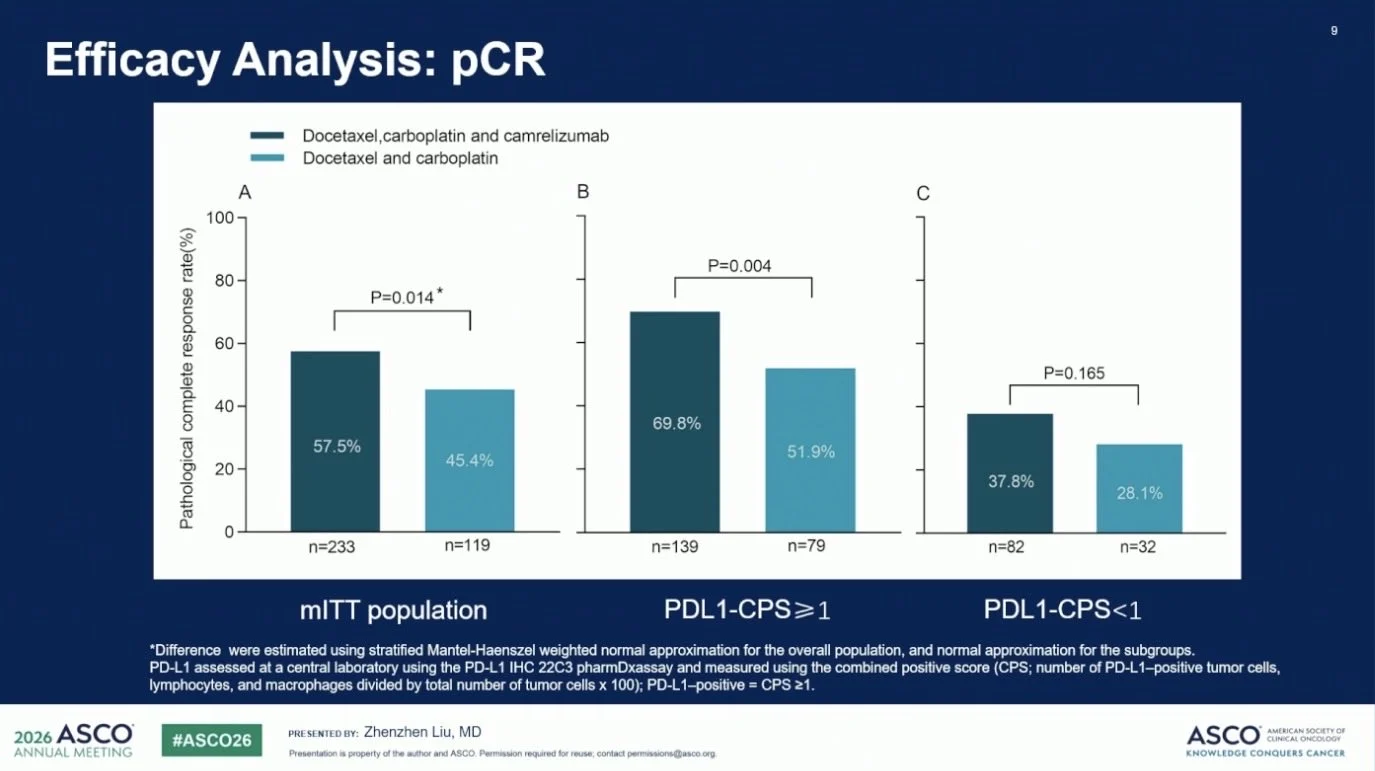
The addition of camrelizumab to neoadjuvant docetaxel and carboplatin resulted in a significant improvement in pathological complete response compared with chemotherapy alone. pCR was achieved in 57.5% of patients treated with camrelizumab plus chemotherapy, compared with 45.4% in the chemotherapy-alone arm, corresponding to an absolute improvement of 12.2 percentage points (95% CI, 1.4–22.9; P = 0.014).
The benefit appeared more pronounced in patients with PD-L1–positive disease (CPS ≥1). In this subgroup, pCR rates reached 69.8% with camrelizumab plus chemotherapy versus 51.9% with chemotherapy alone, representing an absolute improvement of 17.9 percentage points (P = 0.004).
Among patients with PD-L1–negative tumors (CPS <1), pCR rates were 37.8% with camrelizumab plus chemotherapy and 28.1% with chemotherapy alone. Although a numerical improvement was observed, the difference did not reach statistical significance (P = 0.165).
Subgroup analyses demonstrated a generally consistent benefit with camrelizumab across multiple clinical subgroups. The largest absolute improvements in pCR were observed in patients with stage III disease (+23.0 percentage points) and in those with PD-L1 CPS ≥1 tumors (+17.9 percentage points).
Clinical Implications
The HELEN-Trio 011 trial suggests that camrelizumab combined with docetaxel and carboplatin may represent a promising anthracycline-free neoadjuvant option for early-stage TNBC.
Several aspects make the study clinically relevant:
- meaningful improvement in pCR
- particularly strong activity in PD-L1–positive tumors
- manageable toxicity profile
- avoidance of anthracycline exposure
As neoadjuvant immunotherapy continues to evolve in TNBC, these results support further exploration of chemotherapy de-escalation strategies that preserve efficacy while potentially reducing long-term treatment burden.