
At the 2026 ASCO Annual Meeting, Peter Schmid and colleagues presented the final analysis of the phase 3 KEYNOTE-522 trial evaluating neoadjuvant pembrolizumab plus chemotherapy followed by adjuvant pembrolizumab in patients with high-risk early-stage triple-negative breast cancer (TNBC).
Previous analyses from KEYNOTE-522 demonstrated statistically significant and clinically meaningful improvements in pathologic complete response (pCR), event-free survival (EFS), and overall survival (OS) with the addition of pembrolizumab to chemotherapy. The final analysis provides long-term follow-up data after a median follow-up approaching 8 years.

Triple-Negative Breast Cancer in 2026: A Step-by-Step Clinical Approach From Diagnosis to Treatment
Study Design and Treatment
KEYNOTE-522 enrolled patients with previously untreated, non-metastatic, centrally confirmed TNBC with stage T1c N1-2 or T2-4 N0-2 disease.
Patients were randomized 2:1 to receive neoadjuvant pembrolizumab or placebo in combination with paclitaxel plus carboplatin followed by doxorubicin or epirubicin plus cyclophosphamide. Following definitive surgery, patients continued pembrolizumab or placebo for up to 9 adjuvant cycles or until recurrence or unacceptable toxicity.
The dual primary endpoints were pathologic complete response and event-free survival. Overall survival was a key secondary endpoint.
Patient Population
A total of 1,174 patients were randomized, including 784 patients in the pembrolizumab arm and 390 patients in the placebo arm.
At the October 14, 2025 data cutoff, the median follow-up was 93.8 months.
Event-Free Survival
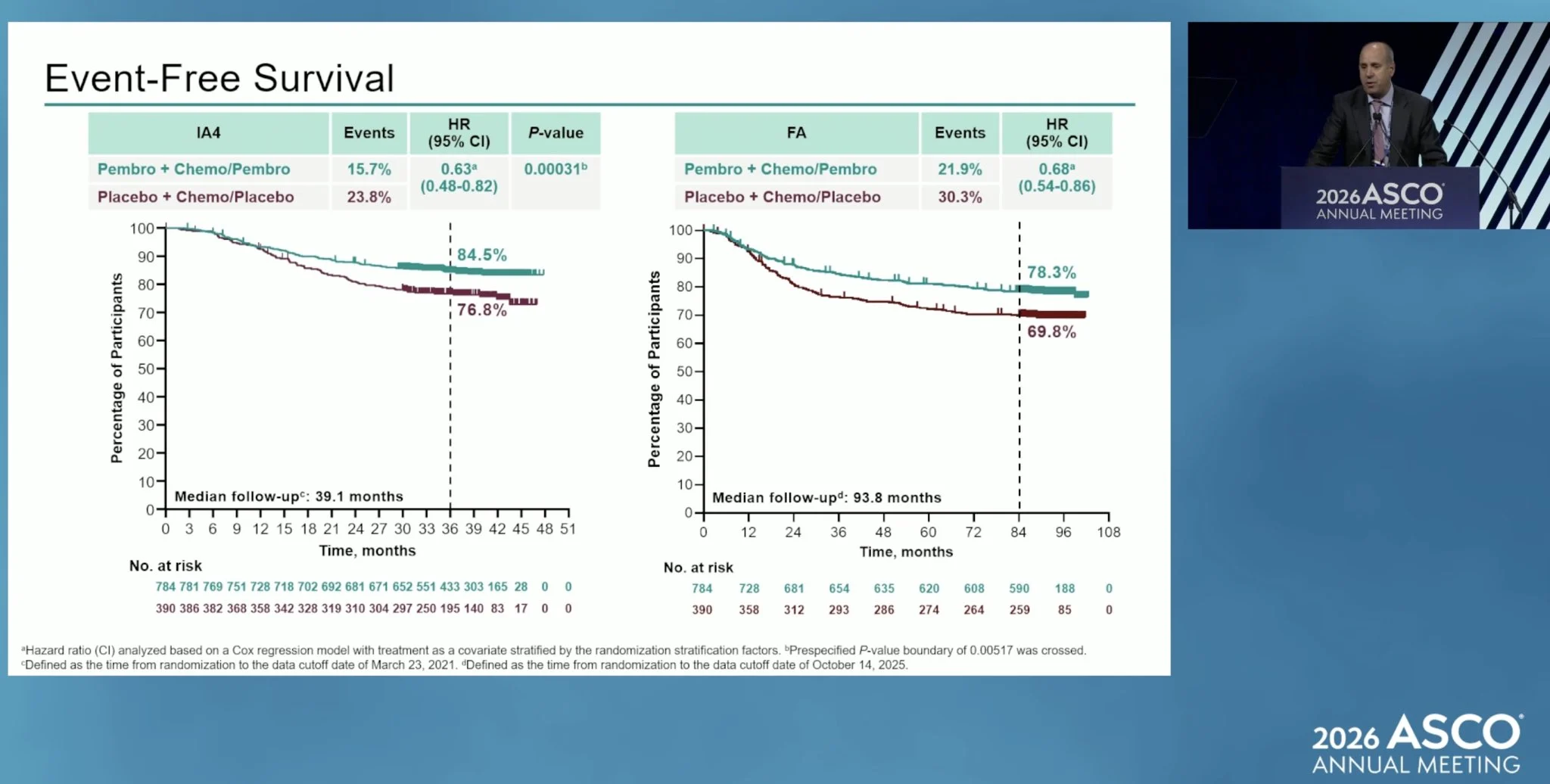
The final analysis demonstrated durable long-term improvement in event-free survival with pembrolizumab-based therapy.
At the final analysis, EFS events had occurred in 21.9% of patients treated with pembrolizumab compared with 30.3% of patients receiving placebo.
The 7-year EFS rate was 78.3% in the pembrolizumab group compared with 69.8% in the placebo group, corresponding to a hazard ratio of 0.68 (95% CI, 0.54–0.86).
The benefit was generally consistent across prespecified subgroups, including PD-L1 status, nodal status, and tumor size.
Importantly, the EFS benefit was observed regardless of pathologic complete response status. Among patients who achieved pCR, the 7-year EFS rate was 90.4% with pembrolizumab versus 85.9% with placebo (HR, 0.68; 95% CI, 0.44–1.07). Among patients without pCR, the corresponding rates were 57.6% and 49.7%, respectively (HR, 0.78; 95% CI, 0.59–1.03). These analyses were exploratory and should be interpreted with caution because pCR is a post-treatment outcome.
In addition, pembrolizumab reduced distant recurrence rates, an established predictor of favorable long-term outcomes.
Overall Survival
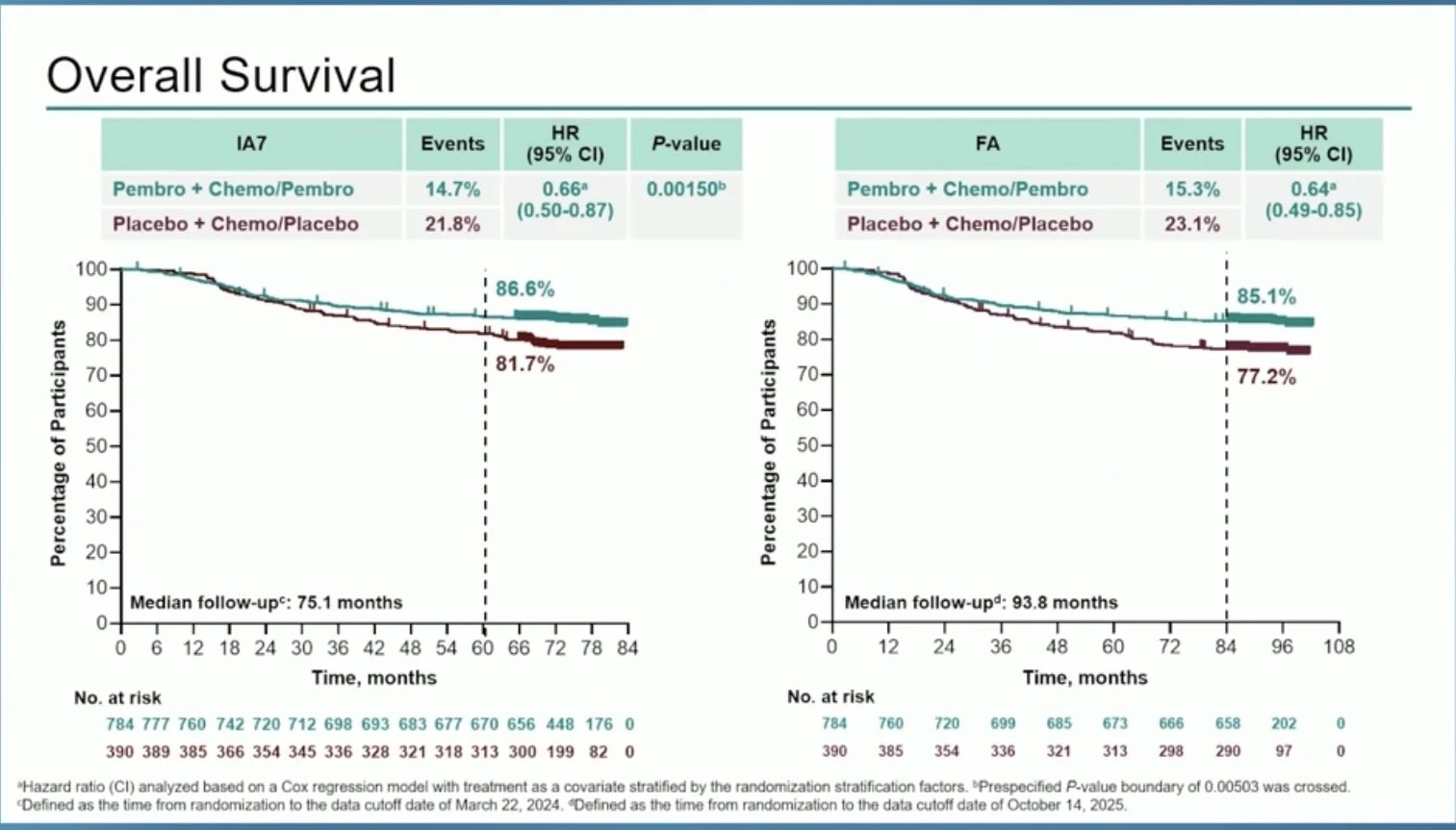
Pembrolizumab also continued to demonstrate a significant overall survival advantage.
At the final analysis, OS events had occurred in 15.3% of patients receiving pembrolizumab compared with 23.1% of patients receiving placebo.
The 7-year OS rate was 85.1% in the pembrolizumab arm compared with 77.2% in the placebo arm, corresponding to a hazard ratio of 0.64 (95% CI, 0.49–0.85). These findings were consistent with the earlier interim analysis, which demonstrated a hazard ratio of 0.66 (95% CI, 0.50–0.87).
The survival benefit was generally consistent across prespecified patient subgroups.
Safety
The safety profile remained consistent with previous analyses and with the known safety profiles of pembrolizumab and chemotherapy. No new safety signals were identified with longer follow-up.
Conclusion
After a median follow-up of approximately 8 years, the protocol-specified final analysis of KEYNOTE-522 demonstrated that the addition of pembrolizumab to platinum-containing neoadjuvant chemotherapy followed by adjuvant pembrolizumab continued to provide substantial and clinically meaningful survival benefits in patients with high-risk early-stage TNBC.
The survival benefit was generally consistent across prespecified subgroups, including PD-L1 status, nodal status, and tumor size, and was observed regardless of pCR status. Pembrolizumab reduced distant recurrence rates and produced durable improvements in both event-free survival and overall survival without the emergence of new safety signals.
These long-term findings further support neoadjuvant pembrolizumab plus platinum-containing chemotherapy followed by adjuvant pembrolizumab as a standard-of-care treatment option for patients with high-risk early-stage TNBC.