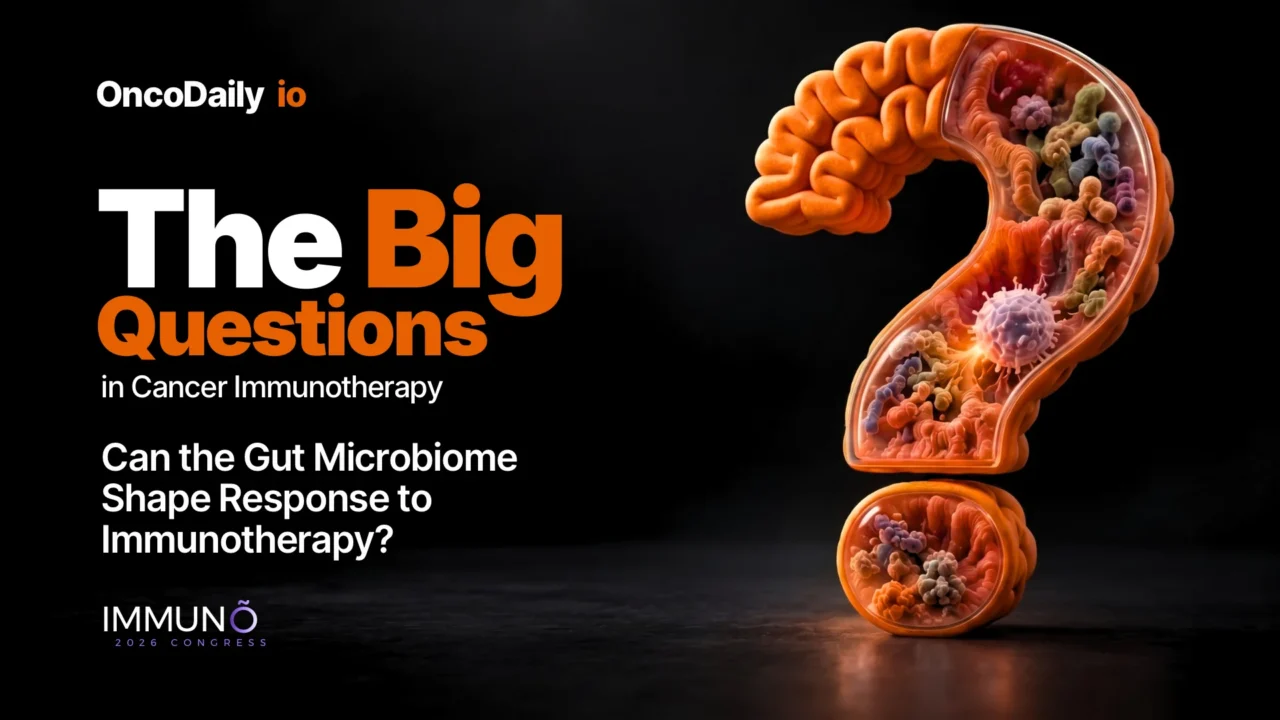
The immune system does not develop or function in isolation. Throughout life, it interacts continuously with trillions of microorganisms inhabiting the gastrointestinal tract, and these microbial communities contribute to immune maturation, epithelial integrity, inflammatory signaling and host metabolism. This creates an intriguing possibility for cancer immunotherapy: two patients receiving the same checkpoint inhibitor may enter treatment with different systemic immune states partly shaped by their gut microbiota.
A decade ago, the idea that intestinal bacteria could influence the efficacy of PD-1 blockade against a distant tumor seemed provocative. Today, the evidence extends from mouse models and observational cohorts to fecal microbiota transplantation (FMT), prospective interventional studies and randomized clinical trials.
The central question has therefore evolved. We are no longer asking only whether microbiome composition correlates with immunotherapy response. We are asking whether the gut microbiome represents a causal, measurable and therapeutically modifiable component of antitumor immunity.
The Studies That Put the Microbiome on the Immunotherapy Map
Some of the most influential evidence emerged from two Science studies published in 2018.
In “Gut Microbiome Modulates Response to Anti-PD-1 Immunotherapy in Melanoma Patients,” Vancheswaran Gopalakrishnan, Jennifer Wargo and colleagues analyzed the oral and gut microbiomes of patients with melanoma receiving anti-PD-1 therapy. Responders showed differences in gut microbial composition and, within the analyzed cohort, greater alpha diversity and enrichment of bacteria from the Ruminococcaceae family. These microbial features were accompanied by evidence of more favorable systemic and intratumoral immune activity.
The study became particularly influential because it went beyond clinical association. Fecal microbiota from responding and nonresponding patients were transferred into germ-free mice. Animals receiving responder-derived microbiota demonstrated enhanced antitumor immunity and improved responses to PD-1 blockade compared with animals receiving microbiota from nonresponders.
A second Science paper published in the same issue, “Gut Microbiome Influences Efficacy of PD-1-Based Immunotherapy Against Epithelial Tumors,” by Bertrand Routy, Laurence Zitvogel, Guido Kroemer and colleagues reached a complementary conclusion. The investigators reported an association between antibiotic exposure and reduced benefit from checkpoint inhibition and identified Akkermansia muciniphila as one of the organisms associated with favorable outcomes in the studied patients. Transfer of microbiota from responding patients improved the activity of PD-1 blockade in mice, whereas microbiota from nonresponders did not. In experimental models, supplementation with A. muciniphila could restore sensitivity to PD-1 blockade under specific conditions through an IL-12-dependent immune mechanism.
These studies established something considerably more interesting than a stool biomarker. They suggested that characteristics associated with checkpoint sensitivity could, at least in experimental systems, be transferred through the microbiome.

Can Diet and the Gut Microbiome Improve Immunotherapy Response?
How Could Bacteria in the Gut Influence a Tumor Somewhere Else?
The biological connection between intestinal microorganisms and a distant tumor does not require bacteria themselves to reach the tumor. The gut microbiota constantly interacts with epithelial cells, dendritic cells, macrophages and lymphocyte populations, while microbial metabolites and molecular products can enter the systemic circulation and influence immune function at distant sites.
Several mechanisms are likely involved simultaneously. Microbial signals can affect dendritic-cell maturation and antigen presentation, T-cell differentiation and activation, regulatory immune populations, inflammatory cytokine production and epithelial barrier function. The microbiome can also alter the availability of metabolites capable of influencing immune-cell metabolism.
Short-chain fatty acids such as acetate, propionate and butyrate are among the best-known examples, but they represent only part of a much broader metabolomic network. Inosine, bile-acid derivatives, tryptophan metabolites and other microbially derived molecules have all been investigated as potential mediators of host immunity.
The emerging picture is therefore less about bacteria directly attacking cancer and more about the microbiome acting as an immune and metabolic interface capable of influencing the physiological environment in which antitumor immunity develops.
The Search for a “Good Microbiome” Quickly Became More Complicated
Early studies naturally generated enthusiasm around individual bacterial species. Akkermansia muciniphila, Faecalibacterium, members of the Ruminococcaceae family, Bifidobacterium species and several other organisms were associated with favorable immunotherapy outcomes in different cohorts.
However, as larger datasets became available, the microbial signatures did not reproduce consistently across populations.
The 2022 Nature Medicine study “Cross-Cohort Gut Microbiome Associations with Immune Checkpoint Inhibitor Response in Advanced Melanoma” addressed this directly. Karla Lee and colleagues analyzed pretreatment stool samples from 165 patients with advanced melanoma across five observational cohorts and integrated these data with 147 samples from previously published studies.
The investigators confirmed that gut microbiome composition was associated with response and progression-free survival during checkpoint therapy. At the same time, microbiome signatures showed substantial cohort dependence. Species including Bifidobacterium pseudocatenulatum, Roseburia species and Akkermansia muciniphila were associated with response in parts of the dataset, but no single species emerged as a consistently reliable biomarker across all cohorts.
This inconsistency is biologically plausible. Microbial ecosystems are influenced by geography, habitual diet, antibiotic exposure, proton pump inhibitors and other medications, age, host genetics, previous cancer treatment and numerous environmental factors. Two individuals can also harbor taxonomically different microbial communities that perform overlapping metabolic functions.
For immuno-oncology, this suggests that the clinically relevant signal may reside less in the presence of one particular organism and more in microbial communities, ecological relationships and functional metabolic programs.
A Baseline Stool Sample May Capture Only Part of the Story
The microbiome is also dynamic. Its composition can evolve during cancer treatment as a consequence of dietary changes, antibiotic and other medication exposure, treatment-related effects, disease progression and broader changes in host physiology. This means that a single pretreatment stool specimen may not fully represent the microbial state that influences immunity throughout therapy.
Longitudinal studies are therefore becoming increasingly important. Rather than treating the microbiome as a fixed baseline characteristic, investigators are beginning to examine whether changes in microbial composition, function and metabolite production during treatment correlate with changes in antitumor immunity.
This has an important conceptual implication. If the microbiome changes during therapy, it may function not only as a predictive biomarker but also as a dynamic biological compartment that interacts with treatment over time.
Antibiotics Became an Important Clinical Clue
The association between antibiotic exposure and checkpoint inhibitor outcomes has been reported repeatedly across observational studies. Broad-spectrum antibiotics can substantially alter microbial ecosystems, making the finding biologically credible. The Routy study was among the early influential reports linking antibiotic exposure with reduced clinical benefit from PD-1-based immunotherapy.
However, antibiotic studies are particularly vulnerable to confounding. Patients receiving antibiotics may have infections, hospitalization, poorer performance status, corticosteroid exposure or other clinical characteristics that independently influence outcomes. Observational associations therefore cannot establish that antibiotic-induced microbiome disruption is responsible for every observed difference in survival.
This distinction is clinically important. Necessary antimicrobial treatment should not be withheld because a patient is receiving immunotherapy. A more useful research question is whether clinically significant microbiome disruption can be prevented, characterized or restored without compromising appropriate infection management.
Diet Introduced a Modifiable Variable
Diet is one of the most accessible environmental factors capable of influencing gut microbial ecology, which made it an obvious candidate for investigation.
In the Science study “Dietary Fiber and Probiotics Influence the Gut Microbiome and Melanoma Immunotherapy Response,” Christine Spencer, Jennifer McQuade, Jennifer Wargo and colleagues evaluated dietary habits, probiotic use and microbiome characteristics in patients with melanoma receiving checkpoint blockade.
Among 128 patients with available dietary data, higher dietary fiber intake was associated with improved progression-free survival. The strongest association was observed among patients reporting sufficient dietary fiber intake without probiotic supplementation. Parallel experiments in mouse models supported the biological relevance of these observations, with low-fiber diets and probiotic exposure associated with impaired anti-PD-1 activity and lower frequencies of IFN-γ-positive cytotoxic T cells within tumors.
The probiotic observation was particularly interesting because it challenged the widespread assumption that adding commercially available bacterial strains necessarily creates a more favorable microbiome. A complex microbial ecosystem cannot be reduced to the presence of a few organisms sold as supplements, and increasing selected bacteria does not necessarily reproduce the ecological functions associated with immunotherapy response.
These findings do not establish that prescribing additional dietary fiber improves ICI efficacy, nor do they demonstrate that all probiotics are detrimental during immunotherapy. They do, however, provide a strong rationale for prospective dietary intervention studies rather than assuming that all forms of microbiome manipulation are biologically equivalent.
Gut Microbiome as a Predictor of Dual Checkpoint Inhibition Benefit in Non–Small Cell Lung Cancer
Fecal Microbiota Transplantation Changed the Question
Observational associations can suggest that the microbiome matters, but interventional studies provide a more direct test of causality. Fecal microbiota transplantation therefore represented a critical step for the field.
In 2021, two pioneering Science studies investigated FMT in patients with melanoma who had developed resistance to anti-PD-1 therapy.
In “Fecal Microbiota Transplant Overcomes Resistance to Anti-PD-1 Therapy in Melanoma Patients,” Diwakar Davar, Hassane Zarour, Giorgio Trinchieri and colleagues treated 15 patients with PD-1-refractory melanoma using responder-derived FMT followed by anti-PD-1 therapy. Clinical benefit was observed in six patients. Responding patients demonstrated changes in microbiome composition accompanied by increased CD8+ T-cell activation and reduced frequencies of IL-8-expressing myeloid cells, together with distinct proteomic and metabolomic changes.
The biological importance of this study was not simply that some patients responded. Patients whose tumors had already demonstrated resistance to PD-1 blockade underwent manipulation of their intestinal microbiota and were subsequently rechallenged with the same therapeutic class, with evidence of both microbial and immune remodeling.
In the companion Science study “Fecal Microbiota Transplant Promotes Response in Immunotherapy-Refractory Melanoma Patients,” Erez Baruch and colleagues evaluated FMT followed by anti-PD-1 reinduction in ten patients with refractory metastatic melanoma. Three patients achieved objective responses, including one complete response.
Both studies were small and exploratory, and neither established FMT as standard treatment. Their significance was conceptual: the microbiome had moved from an observational biomarker into the realm of therapeutic intervention.
Could Microbiome Manipulation Work Before Resistance Develops?
Once FMT demonstrated activity in the refractory setting, investigators began exploring whether microbiome modulation could be incorporated earlier in treatment.
A multicenter phase I trial published in Nature Medicine in 2023 evaluated healthy-donor FMT combined with nivolumab or pembrolizumab in 20 previously untreated patients with advanced melanoma. The objective response rate was 65%, including four complete responses. Donor microbial strains engrafted in all treated patients, while stronger donor-recipient microbial similarity over time was observed particularly among responders.
The study also identified microbial and metabolic changes associated with treatment response, reinforcing the possibility that successful microbiome modulation involves more than simply increasing overall bacterial diversity.
Without a randomized control arm, the contribution of FMT could not be separated from the expected activity of anti-PD-1 therapy. The study nevertheless provided the rationale for controlled trials capable of testing whether microbiome intervention actually adds to established immunotherapy.
Randomized Evidence Arrived in 2026
The randomized phase II TACITO trial, published in Nature Medicine in January 2026, represents one of the most important developments in the clinical microbiome field.
The trial enrolled treatment-naive patients with metastatic renal cell carcinoma receiving pembrolizumab plus axitinib and randomized them to receive donor FMT derived from patients who had achieved complete responses to immune checkpoint therapy or placebo FMT.
Forty-five patients underwent randomization. The prespecified primary endpoint of 12-month progression-free survival was 70% in the donor-FMT group and 41% in the placebo group, with a P value of 0.053. The study therefore did not meet its primary endpoint according to the prespecified statistical threshold.
The secondary progression-free survival analysis was nevertheless notable. Median PFS was 24.0 months with donor FMT compared with 9.0 months with placebo, corresponding to a hazard ratio of 0.50.
These findings require careful interpretation. TACITO was a relatively small phase II study, and its primary endpoint was not statistically met. It should therefore not be presented as definitive evidence that FMT improves checkpoint inhibitor efficacy in metastatic RCC. At the same time, the randomized design and the magnitude of the secondary PFS signal provide substantially stronger clinical evidence than the observational associations that originally launched the field.
The Field Is Moving Beyond Melanoma
Another 2026 Nature Medicine study, FMT-LUMINate, extended microbiome intervention into first-line immunotherapy across different tumor types.
The phase II trial evaluated healthy-donor FMT together with checkpoint inhibition in separate cohorts of patients with non-small cell lung cancer and melanoma. Patients with NSCLC received FMT in combination with anti-PD-1 therapy, while patients with melanoma received FMT alongside combined PD-1 and CTLA-4 blockade.
The importance of studies such as FMT-LUMINate lies not only in response rates. Modern microbiome trials increasingly incorporate donor engraftment, metagenomic profiling, circulating metabolites and immune parameters, allowing investigators to study whether clinical activity is associated with specific biological changes.
This transition is essential. If microbiome therapy is eventually going to become reproducible, investigators need to understand why one microbial intervention succeeds while another fails.
Engraftment May Be More Important Than Simply Increasing Diversity
Early microbiome studies frequently associated greater microbial diversity with favorable outcomes, leading to the intuitive assumption that higher diversity is inherently better.
More recent analyses suggest that this may be too simplistic.
The therapeutic effect of FMT is likely to depend on whether relevant donor organisms successfully establish themselves within the recipient ecosystem and whether that ecological change persists long enough to alter microbial function and host immunity.
This shifts attention from diversity alone toward engraftment, community structure and functional integration. Two patients may both experience increased diversity after FMT while acquiring very different organisms and metabolic capabilities.
For future microbiome therapeutics, the clinically relevant endpoint may therefore not be how many microbial species are present after treatment. It may be whether the intervention successfully establishes the microbial functions required to support productive antitumor immunity.
The Microbiome May Also Influence Immune-Related Toxicity
The relationship between the microbiome and checkpoint therapy may extend beyond efficacy. Increasing evidence suggests that gut microbial composition may also influence susceptibility to immune-related adverse events, particularly ICI-associated gastrointestinal toxicity.
This creates a more complicated therapeutic objective. An ideal microbiome intervention would enhance antitumor immune activity without simultaneously increasing immune-mediated damage to healthy tissues.
That balance may become particularly important as microbiome therapeutics move into combination regimens. A microbial community associated with stronger systemic immune activation is not automatically the community that provides the most favorable overall therapeutic index.
Future studies will therefore need to examine efficacy and toxicity together rather than treating them as independent consequences of microbiome modulation.
FMT May Be the Beginning Rather Than the Final Therapy
FMT is a powerful experimental strategy because it transfers an entire microbial ecosystem. The same complexity that makes it scientifically valuable also makes it difficult to standardize as a cancer therapeutic.
Several unresolved questions remain:
- Which organisms or microbial functions are necessary for therapeutic benefit?
- Should donors be healthy individuals or exceptional responders to immunotherapy?
- Does the optimal microbial community differ between melanoma, lung cancer, renal cell carcinoma and other malignancies?
- How much donor engraftment is necessary, and how long must it persist?
- Which microbial metabolites mediate the relevant immune effects?
- Can defined bacterial consortia reproduce the activity of FMT more safely and consistently?
- Could microbial metabolites, engineered bacteria, targeted prebiotics or dietary interventions eventually replace whole-community transplantation?
Answering these questions may move the field from empirical microbiome transplantation toward precision microbial therapeutics.
The eventual intervention might not resemble conventional FMT at all. It could consist of defined bacterial communities selected for particular metabolic functions, engineered microorganisms capable of delivering immunomodulatory molecules, or interventions designed around specific microbial metabolites.
The Microbiome Is Unlikely to Become Another PD-L1
There is an understandable temptation to convert microbiome science into a conventional biomarker strategy: analyze a stool sample, identify favorable organisms and predict whether a patient will respond to immunotherapy.
Current evidence argues against such simplicity.
Cross-cohort studies have demonstrated substantial variation in response-associated taxa. Geography, diet, medications, sequencing methods, sample processing and host characteristics can all influence microbiome measurements. Even organisms repeatedly associated with favorable outcomes, such as Akkermansia muciniphila, cannot currently be treated as universal binary biomarkers.
The relevant biology may instead reside in microbial networks and the functions they perform. Metagenomics can identify functional genetic potential, while metabolomics can reveal molecules actually being produced and interacting with the host. Integrating these data with circulating immune profiles and tumor biology may eventually prove more informative than taxonomic classification alone.
The microbiome may therefore require a different biomarker philosophy. Rather than searching for a single organism analogous to a genomic alteration, the field may need to characterize an ecological and functional immune state.