Immune checkpoint inhibitors (ICIs) have transformed modern oncology, yet their cost remains one of the greatest barriers to global access. Although drugs such as nivolumab produce durable responses across multiple tumor types, standard dosing strategies were largely developed using conventional maximum tolerated dose paradigms rather than precise immune receptor occupancy models. Increasing pharmacodynamic evidence suggests that much lower doses may still achieve substantial PD-1 receptor saturation and meaningful immune activation.
The DELII phase III trial explored one of the most provocative questions in contemporary immuno-oncology: can ultra-low-dose nivolumab retain clinical efficacy while dramatically improving affordability and reducing toxicity?
Biological Rationale for Ultra-Low-Dose Nivolumab
Unlike cytotoxic chemotherapy, immune checkpoint inhibitors function primarily through immune modulation rather than direct dose-dependent tumor killing. Early pharmacokinetic studies demonstrated that PD-1 receptor occupancy reaches biologically active levels even at doses far below currently approved regimens.
The approved nivolumab dose is typically 240 mg every two weeks or 3 mg/kg. However, phase I receptor occupancy analyses showed that doses as low as 0.1 mg/kg already achieved approximately 64–70% PD-1 receptor occupancy, with minimal additional biological gain at higher exposures.
Importantly, the serum concentration required for clinical efficacy is estimated around 1.2 μg/mL, while standard approved dosing generates concentrations approaching 33.7 μg/mL — nearly 30-fold higher than theoretically necessary for immune activation.
These observations formed the biological foundation for testing nivolumab at only 20 mg intravenously every two weeks, representing approximately one-twelfth of the conventional dose.
DELII Trial Design
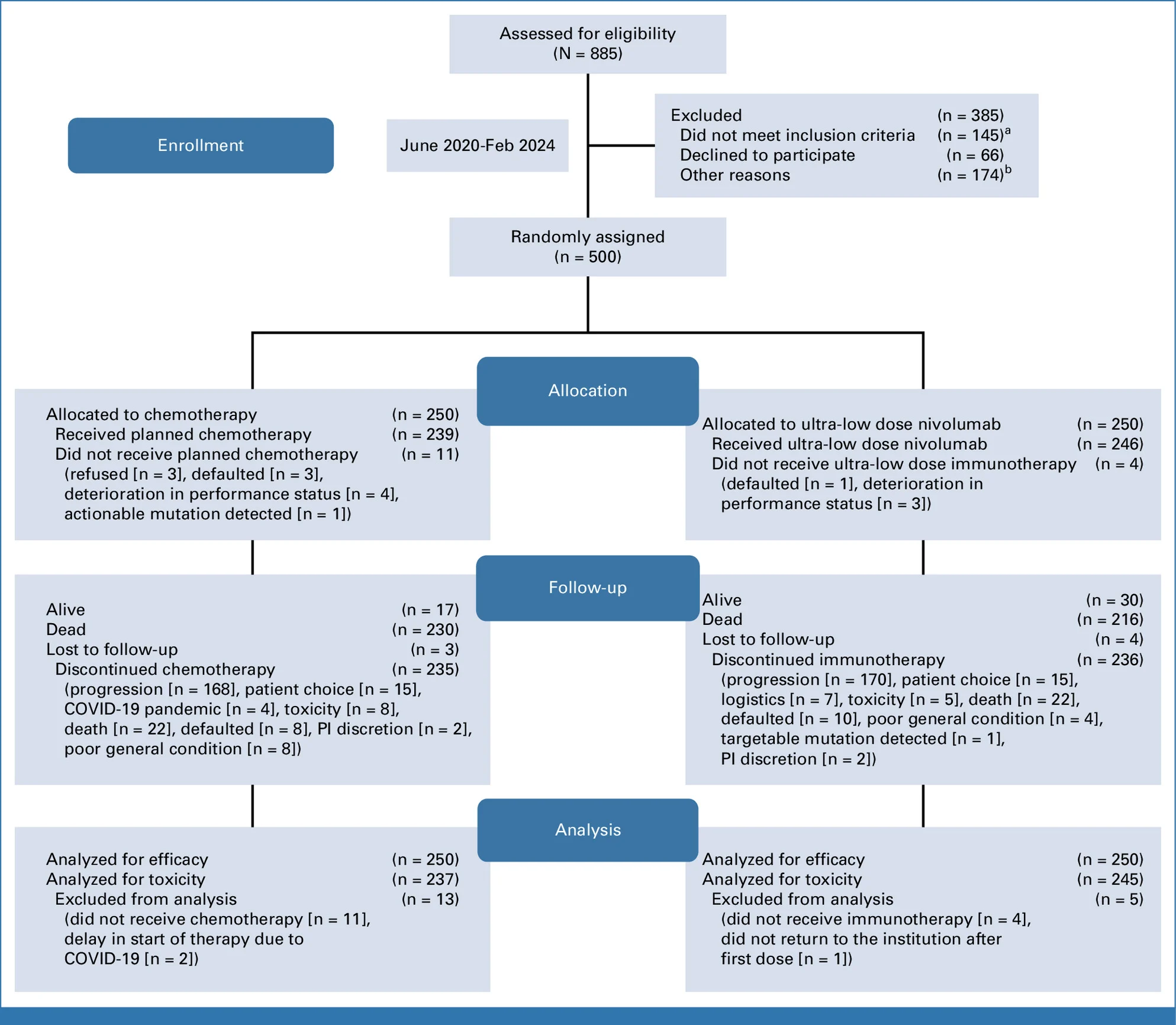
The Development of Low-Dose Immunotherapy in India (DELII) study was an open-label randomized phase III superiority trial conducted at Tata Memorial Hospital in Mumbai between 2020 and 2024.
The study enrolled heavily pretreated patients with relapsed refractory solid tumors after at least one prior systemic therapy line. Major tumor types included head and neck cancer, non–small cell lung cancer, esophageal cancer, urothelial carcinoma, and MSI-high tumors.
Patients were randomized to receive either:
- Ultra-low-dose nivolumab 20 mg IV every 2 weeks
or - Standard chemotherapy with docetaxel or paclitaxel according to tumor type.
The primary endpoint was overall survival, while secondary endpoints included progression-free survival, objective response rate, toxicity, and quality of life.
Patient Population and Baseline Characteristics
The study enrolled 500 patients, with 250 patients in each treatment arm. The cohort represented a particularly challenging real-world population with advanced, heavily pretreated disease.
Approximately 52% of patients had head and neck cancers, while 36% had lung cancer. Nearly one-third had already received two or more prior therapy lines, and over half presented with metastatic disease at enrollment.
Importantly, many patients came from resource-constrained settings where standard-dose immunotherapy remains financially inaccessible. The investigators emphasized that only a very small proportion of eligible patients in many low- and middle-income countries are currently able to receive checkpoint inhibitors because of cost limitations.
Overall Survival Benefit
The most important finding of the DELII study was the statistically significant improvement in overall survival with ultra-low-dose nivolumab compared with chemotherapy.
Key Survival Results
- Median overall survival reached 5.88 months with ultra-low-dose nivolumab versus 4.70 months with chemotherapy.
- Hazard ratio for death was 0.80.
- One-year overall survival was 27.3% with ultra-low-dose nivolumab versus 16.9% with chemotherapy.
- Survival benefit remained consistent across multiple clinical subgroups.
- Remarkably, the benefit was observed despite using only approximately 8% of the conventional nivolumab dose.
The subgroup analyses suggested that ultra-low-dose immunotherapy retained activity regardless of age, smoking status, tumor histology, PD-L1 expression, or prior therapy burden.
Progression-Free Survival and Response Rates
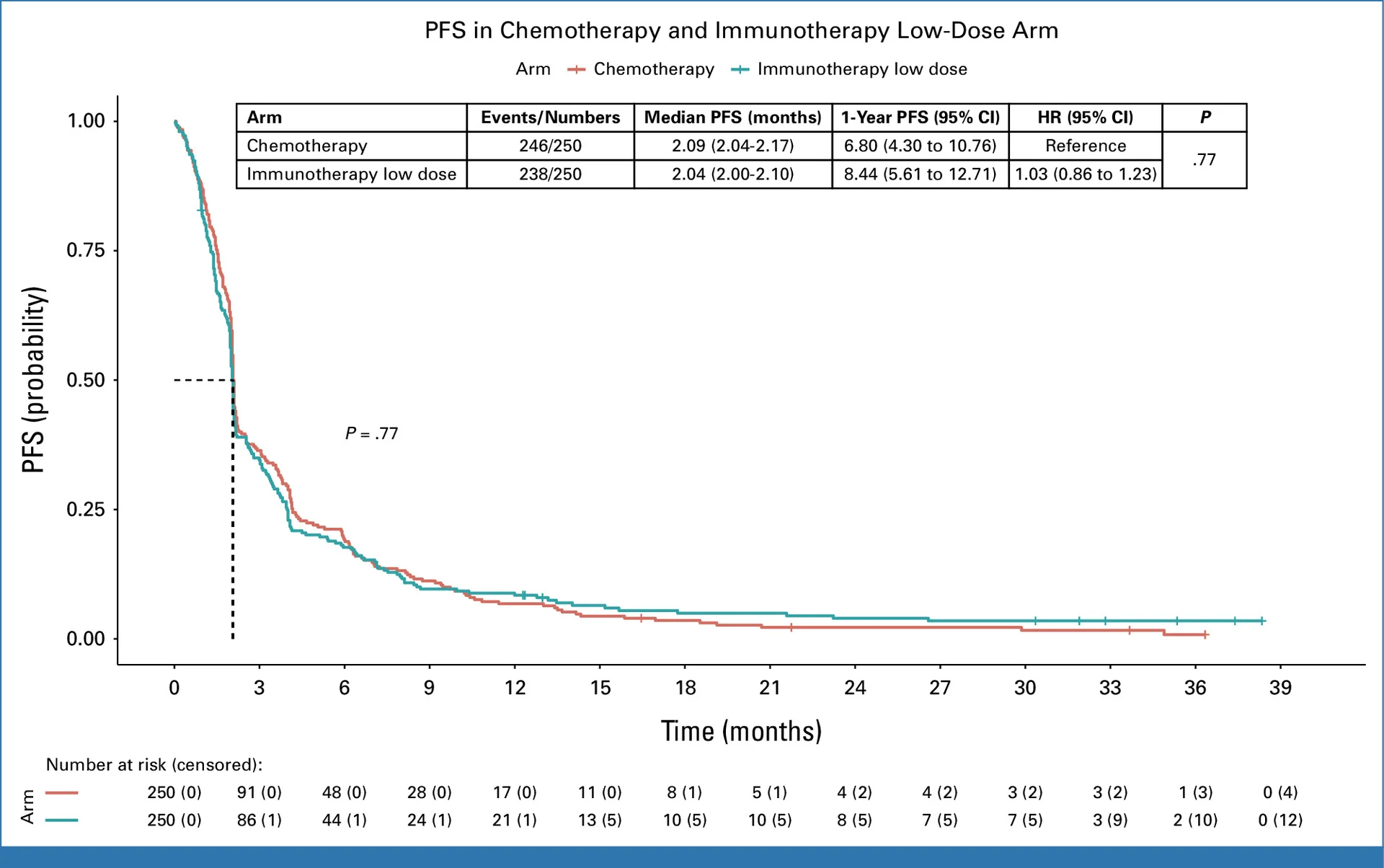
Interestingly, progression-free survival did not significantly differ between the two treatment groups. Median PFS remained approximately two months in both arms.
Similarly, objective response rates were relatively low and nearly identical:
- ORR was 7.1% with ultra-low-dose nivolumab.
- ORR was 8.1% with chemotherapy.
- Disease control rates were approximately 38–39% in both groups.
However, duration of response appeared longer with ultra-low-dose nivolumab, reaching 8.28 months versus 4.93 months with chemotherapy.
This apparent disconnect between modest response rates and improved overall survival mirrors patterns previously observed in landmark immunotherapy trials such as KEYNOTE-048, KEYNOTE-010, and CheckMate-057.
The investigators proposed that delayed immune-mediated antitumor activity may explain why survival curves initially overlapped before separating several months later.
Toxicity and Safety Advantages
One of the most clinically meaningful findings of the DELII study was the substantially improved safety profile of ultra-low-dose nivolumab.
Major Toxicity Findings
- Grade ≥3 toxicities occurred in 42.0% with ultra-low-dose nivolumab versus 60.3% with chemotherapy.
- Hospitalization for toxicity occurred in 8.6% versus 21.1%.
- Severe neutropenia was dramatically lower with nivolumab.
- Serious infections were significantly less frequent in the immunotherapy arm.
Importantly, severe pneumonitis rates remained very low in both groups.
The reduced toxicity burden is particularly relevant in relapsed refractory populations where preserving quality of life often becomes as important as prolonging survival.
Quality of Life Improvements
Quality-of-life analyses demonstrated consistently better patient-reported outcomes with ultra-low-dose nivolumab compared with chemotherapy.
Longitudinal analyses showed more favorable symptom trajectories in the immunotherapy arm, particularly regarding swallowing function, dry mouth symptoms, fatigue, and alopecia.
The investigators emphasized that patients with relapsed refractory disease frequently have limited survival expectations, making toxicity reduction and maintenance of functional quality of life critically important therapeutic goals.
Global Access and Affordability Implications
Perhaps the most impactful aspect of the DELII study lies in its implications for global cancer equity.
The authors highlighted the enormous economic disparity surrounding immunotherapy access worldwide. In India, the monthly cost of standard-dose nivolumab approaches approximately $5,000, while the average monthly income may be only $175–233.
By contrast, the 20 mg ultra-low-dose regimen reduced treatment cost dramatically while still preserving clinically meaningful activity.
Economic Impact Highlights
- Standard-dose nivolumab costs approximately ₹446,754 per month.
- Ultra-low-dose nivolumab costs approximately ₹18,700.
- Dose reduction decreases drug cost by nearly 90%.
- The strategy may substantially expand immunotherapy access in low- and middle-income countries.
The study therefore challenges one of the central assumptions in modern oncology drug development: that higher dosing necessarily translates into greater efficacy.
Mechanistic Explanations for Durable Benefit
The investigators proposed several potential explanations for why ultra-low-dose nivolumab retained efficacy despite dramatic dose reduction.
Immune checkpoint inhibitors may require only limited receptor occupancy to sustain T-cell activation once antitumor immune responses are initiated. Unlike chemotherapy, efficacy may not correlate linearly with systemic drug exposure.
Additionally, immune-mediated tumor control often develops gradually over time, which may explain the delayed separation of survival curves and the observation that some patients continued benefiting despite radiologic progression.
Approximately 20% of patients receiving ultra-low-dose nivolumab continued treatment beyond progression because investigators believed ongoing clinical benefit persisted despite imaging changes.
Limitations of the DELII Trial
Despite its highly provocative findings, the study has several important limitations.
The trial was conducted at a single institution and enrolled a heterogeneous mixture of tumor types. It also did not directly compare ultra-low-dose nivolumab against standard-dose immunotherapy, leaving unanswered whether lower dosing is truly equivalent to conventional regimens.
Furthermore, pharmacokinetic and biomarker analyses were not incorporated, limiting mechanistic interpretation.
Nevertheless, the consistency of survival benefit across multiple subgroups strengthens the overall biological plausibility of the findings.
Future Directions
The DELII trial may represent one of the most important contemporary studies in rational immunotherapy dosing. Its implications extend beyond cost reduction alone and raise fundamental questions regarding how checkpoint inhibitors should be developed, prescribed, and globally distributed.
Future studies will likely explore:
- Ultra-low-dose immunotherapy in earlier treatment settings.
- Combination strategies with short-course chemotherapy.
- Biomarker-guided low-dose approaches.
- Curative-intent applications.
- Direct comparisons versus standard-dose ICIs.
Ultimately, this work supports a broader shift toward pharmacodynamically optimized immunotherapy dosing strategies rather than empiric maximal exposure approaches.
If validated internationally, ultra-low-dose checkpoint blockade could substantially reshape global immuno-oncology practice by improving affordability, accessibility, and treatment sustainability while preserving meaningful clinical benefit.
Read Full Article Here
Low-Dose Immunotherapy: India’s Challenge to Conventional PD-1 Dosing