CD20 × CD3 bispecific antibodies now represent a core option for relapsed/refractory B-cell lymphomas, providing off-the-shelf T-cell redirection across multiple subtypes without the manufacturing lag of CAR T-cell therapy. Pivotal trials showed high response rates alongside a manageable toxicity profile. As use expands, the open questions are different: how do these agents perform in patients who never would have met trial criteria, how much hospital care do they actually require, and which toxicities create the real burden in routine practice?
A nationwide study from the Spanish GELTAMO network is one of the largest European real-world analyses of CD20 × CD3 bispecific antibodies outside clinical trials. Besides efficacy and toxicity, the investigators also looked at hospitalization and healthcare use across tertiary and regional hospitals.
CD20 × CD3 Bispecifics in Routine Practice
Bispecific antibody treatment typically starts with step-up dosing to limit the risk and severity of cytokine release syndrome (CRS). In practice, this has usually meant planned hospital admission during the early weeks, so patients can be monitored closely for CRS and neurotoxicity. It’s a controlled way to start therapy, but repeated inpatient stays add up in cost and burden.
Severe immune-mediated toxicity is uncommon, and bispecifics are moving well beyond academic centers. At the same time, real-world patients often carry comorbidities, cytopenias, poor performance status, or heavy prior treatment – the kind of profile that would have excluded them from the pivotal trials. Real-world evidence is needed both to understand outcomes in the broader population and to figure out how these drugs can be delivered more efficiently without compromising safety.
Methods
The investigators ran a nationwide retrospective study through the GELTAMO Spanish lymphoma network, inviting affiliated centers to enroll consecutive adults with relapsed/refractory B-cell lymphoma who received commercial bispecific antibodies between November 2023 and March 2025.
38 centers took part: 21 high-volume tertiary hospitals and 17 smaller regional ones. Sixteen were CAR T-accredited, meaning treatment wasn’t restricted to institutions with cellular therapy programs.
Patients received subcutaneous epcoritamab or intravenous glofitamab or mosunetuzumab, with availability shaped by Spain’s reimbursement rules and early-access programs. Baseline characteristics, toxicity, treatment management, resource use, and efficacy were all collected from routine clinical care. The primary objective was characterizing real-world safety, toxicity management, and resource utilization, efficacy was a secondary, descriptive endpoint.
Study Design and Patient Population
The cohort totaled 168 patients, median age 64. Large B-cell lymphoma (LBCL) made up 58%, follicular lymphoma (FL) the remaining 42%. Patients had a median of 3 prior treatment lines.
This was a population that reflected real-world messiness: 29% would not have met eligibility criteria for the pivotal trials (35% of LBCL patients, 20% of FL patients), mostly due to comorbidities (67% of ineligibility) and cytopenias.
Trial eligibility carried different weight by subtype. In LBCL, patients who wouldn’t have qualified for the pivotal studies had significantly worse progression-free survival. In FL, there was no significant difference, though there weren’t enough events for formal interaction testing.
High-risk disease was common throughout. Among LBCL patients, 59% had primary refractory disease and 54% had already failed CAR T-cell therapy. In FL, 52% had progressed within 24 months (POD24). Worth keeping in mind when reading the LBCL response rates, this was a heavily pretreated, high-risk group.
Hospitalization Remained Common During Step-Up Dosing
Hospital-based monitoring was still the default during initial treatment: 86% of patients had a scheduled admission for step-up dosing. Of those, 61% stayed hospitalized through the entire step-up phase, while 39% were admitted only for the full-dose administration.
Unplanned hospitalization is a separate consideration. It occurred in 32% of patients, at a median of 25.5 days after starting treatment, mostly because of infection (50% of urgent admissions) and disease-related complications, with CRS or neurotoxicity accounting for only 17%. Risk factors included:
- LBCL or high-grade histology
- poorer performance status
- shorter bendamustine washout
- greater extranodal disease burden
Inpatient treatment was nearly universal in LBCL (98%). Outpatient administration was more common with mosunetuzumab in FL, though the inpatient use was high even there. 8% of patients overall required ICU admission.
CRS Was Frequent but Predominantly Low Grade
CRS occurred in 42% of patients, almost entirely during Cycle 1 (97% of events). Grade ≥3 CRS occurred in just 2%.
Tocilizumab was used in 31% of patients, a median of one dose, with no one needing more than that. Corticosteroids beyond routine premedication were used in 37%, for a median of three days. No CRS was reported after Cycle 3, apart from a single event.
Neurotoxicity was rarer still. ICANS occurred in 4% of patients, almost all Grade 1. No Grade 4-5 ICANS or Grade 5 CRS occurred.
Infections and Cytopenias Were the More Important Ongoing Toxicities
Beyond the step-up window, cytopenias and infections were the bigger persistent problem. Cytopenias occurred in roughly 40% of patients (Grade ≥3 in 30%), infections in 27% (Grade ≥3 in 10%).
Timing mattered: 74% of infections occurred in Cycles 1-2, with respiratory infections predominating. Thirteen patients needed ICU admission. Non-relapse mortality was 5.9%, and infections accounted for 80% of those deaths.
So there are really two distinct risk windows here: early treatment demands preparation for CRS and occasional neurotoxicity, but the broader burden – infection prevention, vaccination, immunoglobulin monitoring and replacement, cytopenia management, extends well past that.
Bispecific Antibodies Retained Activity After CAR T-Cell Therapy in LBCL
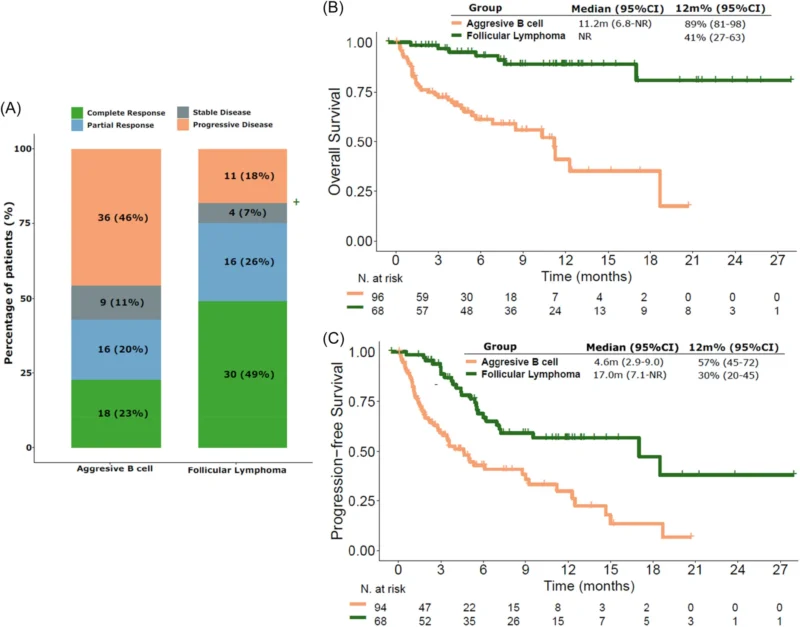
In LBCL, the overall response rate was 43%, with a 23% complete response rate – lower than pivotal-trial numbers, but unsurprising given how high-risk this cohort was.
Among the 52 LBCL patients previously treated with CAR T cells, ORR was 45% and CR was 22%. So bispecifics held up even after another T-cell-directed therapy had already failed.
Median time from CAR T-cell therapy to starting a bispecific was 6.67 months. Patients who waited longer than that median had a numerically higher CR rate (30% vs. 13%), though not statistically significant.
The authors frame it around prior evidence that early CAR T failure marks a particularly poor-risk group, patients who progress quickly after CAR T may need more aggressive strategies and clinical trial enrollment.
Responses Were Stronger and More Durable in Follicular Lymphoma
FL responses were considerably better: 75% ORR, 49% CR. In the small subgroup previously exposed to CAR T-cell therapy, ORR and CR were 67% and 50%.
After a median follow-up of 8.8 months, median PFS was 17 months in FL vs 4 months in LBCL. Median overall survival wasn’t reached in FL and was 11 months in LBCL, a real gap in durability of disease control.
One notable wrinkle: POD24 didn’t seem to hurt outcomes. More than half the FL cohort had POD24, yet it wasn’t associated with worse results, raising the possibility that T-cell redirection retains activity even in conventionally high-risk FL, though this needs confirmation in larger datasets.
Extranodal Disease May Identify a Higher-Risk FL Population
Extranodal involvement, on the other hand, did predict worse outcomes in FL, in both univariable and multivariable analysis. Patients with two or more extranodal sites had a median PFS of 6 months, patients with zero or one site hadn’t reached median PFS.
The subgroup is small and this analysis was exploratory, so it’s hypothesis-generating. But it’s an interesting split: POD24 didn’t move the needle in this setting, while extranodal burden did.
Prior Bendamustine Did Not Appear to Reduce Bispecific Antibody Efficacy
Prior bendamustine exposure didn’t significantly affect outcomes in either LBCL or FL, notable because bendamustine exposure has been linked to worse CAR T-cell efficacy.
Most bendamustine-exposed LBCL patients had received it fairly recently (75% within nine months), yet no effect on outcomes turned up. It’s a hint that prior therapies may affect T-cell fitness differently ahead of bispecifics than they do ahead of CAR T.
What Does This Study Add Beyond Clinical Trials?
Nearly a third of patients treated in routine practice wouldn’t have qualified for the pivotal trials, and treatment still proved feasible across that broader group, delivered across 38 institutions, including regional centers without CAR T accreditation. That’s a reasonable case for these therapies scaling beyond specialized cellular-therapy programs.
It also puts a number on the healthcare burden: planned hospitalization was extremely common, but severe CRS and neurotoxicity were not. That’s the distinction health systems need as they decide which parts of bispecific treatment genuinely require an inpatient bed and which don’t.
And it puts efficacy in context. The modest PFS in LBCL reflects a population enriched for primary refractory disease and prior CAR T failure, while FL showed deeper, more durable responses despite heavy POD24 representation, a reminder to read real-world response rates against the population treated, not against pivotal-trial numbers directly.
Discussion: Can More Bispecific Antibody Therapy Move Into the Outpatient Setting?
As centers gain experience, carefully selected patients could likely be managed through outpatient pathways with close monitoring, rapid access to assessment, early-intervention protocols, and clear criteria for when to escalate to admission.
That doesn’t mean less surveillance overall, it means redirecting it. CRS and ICANS are largely predictable around step-up dosing, but infections drove half of urgent hospitalizations and 80% of non-relapse deaths. Moving step-up dosing outpatient would still need to pair with early, solid infection prevention.
This becomes more relevant as bispecifics move earlier in treatment sequencing and into more centers. GELTAMO suggests these drugs don’t need to stay confined to large tertiary hospitals, but scaling further will require reproducible supportive-care pathways and clear criteria for who can safely start treatment outside the hospital.
Study Limitations
The retrospective design means adverse events, especially lower-grade ones, were likely under-reported, and response assessments were done locally without centralized radiologic review.
The investigators could not verify adherence to infection-prevention measures, an important limitation given the impact of infections on hospitalization and mortality. Subgroup analyses were exploratory and based on small numbers, so findings on extranodal disease, CAR T-cell timing, and bendamustine require further validation.
You can also read about