
The introduction of T-cell-engaging bispecific antibodies has broadened the therapeutic possibilities of cancer immunotherapy, but it has also brought a practical challenge to the forefront: how can these agents be delivered safely without routine hospitalization?
Their antitumor activity depends on rapid immune activation, making treatment initiation the period of greatest risk for cytokine release syndrome (CRS) and, less frequently, immune effector cell-associated neurotoxicity syndrome (ICANS). As a result, early clinical development relied heavily on inpatient monitoring while clinicians gained experience managing these toxicities.
That approach is changing. Product-specific step-up dosing schedules, standardized toxicity management, and growing clinical experience have made outpatient initiation feasible for carefully selected patients. Which patients? What infrastructure is required to support them? How can outpatient treatment be delivered without compromising patient safety?
These questions are particularly relevant to community oncology practice, where most patients receive long-term cancer care. They will be discussed at the OncoDaily Community Oncology Global Congress 2026, taking place virtually on August 28-30.
Why Treatment Begins with Step-Up Dosing
Unlike conventional monoclonal antibodies, CD3-engaging bispecific antibodies physically bridge cytotoxic T lymphocytes with malignant cells by simultaneously binding CD3 on T cells and a tumor-associated antigen. This interaction forms an immunologic synapse, triggering T-cell activation, proliferation, and the release of cytotoxic granules that induce tumor cell apoptosis. At the same time, activated T cells and innate immune cells release inflammatory cytokines which amplify the immune response and systemic inflammation.
The first treatment cycle is biologically distinct from subsequent doses. Initial exposure brings large numbers of previously unengaged T cells into contact with abundant target cells, producing the greatest cytokine surge and the highest risk of cytokine release syndrome (CRS). As tumor burden decreases and immune activation becomes less intense, CRS occurs less frequently.
Step-up dosing was developed to modify this early immune response. Instead of administering the full treatment dose immediately, patients receive one or more lower priming doses before reaching the target dose. Importantly, step-up dosing is not a conventional dose-escalation strategy designed to determine an individual’s tolerated dose, it is a standardized risk-mitigation strategy.
An analysis of 19 US practices across 13 states found that 74% administered step-up dosing exclusively in the inpatient setting, with 86% doing so during a single continuous hospitalization. Correspondingly, US claims data showed that patients treated with teclistamab who received inpatient step-up dosing spent a mean of 10.9 days in the hospital, with 88% requiring hospitalization.
Clinicians are increasingly interested in moving bispecific antibody step-up dosing to the outpatient setting to reduce healthcare resource utilization, improve the patient experience, and expand treatment access for patients living in underserved areas. In fact, there is growing evidence that clinical practices in the US are using hybrid or OP administration models for BsAb therapy and that some patients are receiving these therapies in a rural setting.
Cytokine Release Syndrome: A Barrier to Outpatient Administration
Step-up dosing reduces the intensity of the initial immune response but does not eliminate it. Most CRS events associated with currently approved T-cell-engaging bispecific antibodies are low grade and present with fever and constitutional symptoms that respond to supportive care or cytokine-directed therapy. In the outpatient setting, fever requires prompt evaluation because CRS, infection, and other causes often present similarly.
Severe CRS requiring intensive care has become relatively uncommon but may develop rapidly, leading to capillary leak, vasodilation, hypotension, hypoxia, and organ dysfunction. Current American Society for Transplantation and Cellular Therapy (ASTCT) consensus criteria grade CRS primarily according to the presence and severity of hypotension and hypoxia rather than fever alone, providing a standardized framework for clinical assessment and treatment decisions.
Whether CRS can be anticipated, recognized promptly, and managed safely outside the hospital, depends not only on the characteristics of the individual drug but also on the systems supporting its administration, including standardized monitoring protocols, rapid access to emergency evaluation, and multidisciplinary teams familiar with immune-mediated toxicities.
ICANS: Neurologic Monitoring Beyond the Clinic
Immune effector cell-associated neurotoxicity syndrome (ICANS) occurs less frequently than CRS with currently approved bispecific antibodies, particularly in multiple myeloma, but early neurologic changes may be subtle and more difficult to recognize in the outpatient setting.
The mechanisms underlying ICANS remain incompletely understood. Current evidence implicates systemic inflammation, endothelial activation, and disruption of the blood-brain barrier. Neurologic dysfunction may develop without structural abnormalities on routine neuroimaging, making clinical assessment the primary diagnostic tool.
Early manifestations include impaired attention, slowed thinking, word-finding difficulty, changes in handwriting, tremor, and confusion. These symptoms may precede aphasia, seizures, reduced consciousness, or, rarely, cerebral edema. Structured neurologic assessment is recommended before treatment and during the step-up period.
The Immune Effector Cell-Associated Encephalopathy (ICE) score provides a standardized assessment of orientation, attention, language, handwriting, and consciousness to detect early neurologic changes. Caregivers are equally important, as subtle behavioral or cognitive changes often become apparent at home before the next clinic visit.
Practical Considerations for Safe Outpatient Bispecific Antibody Programs
Careful patient selection remains the first step in minimizing risk. Although eligibility criteria vary among institutions and individual products, outpatient initiation is generally reserved for clinically stable patients with adequate performance status (ECOG PS of ≤1), well-controlled comorbidities, no active infection, reliable transportation, prompt access to emergency medical care, and the ability to comply with scheduled monitoring.
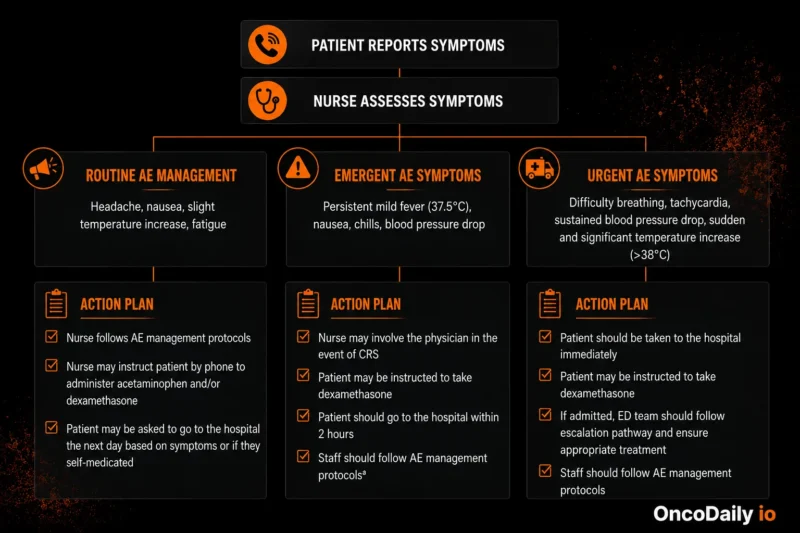
Example Outpatient Workflow
The presence of a caregiver who can recognize early symptoms of CRS or neurologic toxicity is strongly encouraged, particularly during step-up dosing. Patients and caregivers should receive written instructions, emergency contact information, and clear guidance on when urgent medical evaluation is required.
Standardized institutional protocols are equally important. Product-specific step-up dosing schedules, premedication requirements, observation periods, and recommendations for treatment interruption differ among approved bispecific antibodies and should be incorporated into local clinical pathways.
Nursing staff, pharmacists, advanced practice providers, and physicians should be familiar with standardized grading systems for CRS and ICANS, predefined escalation algorithms, and the appropriate use of supportive measures, including cytokine-directed therapy and corticosteroids when clinically indicated.
It also requires administrative and financial preparation. Precertification and reimbursement processes should cover both the bispecific antibody and supportive medications, including tocilizumab. Many centers also incorporate take-home (“pocket”) dexamethasone into product-specific CRS management protocols.
Finally, outpatient administration requires seamless communication beyond the oncology clinic. Emergency physicians, hospitalists, intensive care teams, and neurologists may all become involved. In this respect, successful outpatient programs rely on coordinated systems, transforming immune toxicity management into a structured component of routine cancer care.
Why Outpatient Bispecific Antibody Therapy Is Becoming a Major Topic in Community Oncology
Hospital admission increases healthcare utilization, costs, and the burden on patients, particularly those who live far from tertiary referral centers. Outpatient treatment should not be viewed simply as a strategy to reduce hospitalization. It redistributes clinical responsibility. Monitoring that previously occurred on an inpatient ward must instead be coordinated across outpatient infusion units, nursing teams, caregivers, emergency departments, and inpatient services.
These changes have particular relevance for community oncology. Clinical development of bispecific antibodies began largely in academic centers with extensive experience in cellular immunotherapy, but most patients receive long-term cancer care closer to home.
As indications continue to expand, treatment delivery cannot remain confined to specialized institutions. Standardized outpatient pathways that can be implemented across diverse practice settings will be essential to maintain access while preserving patient safety.
Join the Discussion at the OncoDaily Community Oncology Global Congress
Safe and effective administration of BsAbs in outpatient and community settings appears feasible with appropriate planning, process development, and close coordination between academic and community oncology centers.
Not all institutions currently have the staffing, resources, or infrastructure required to establish outpatient bispecific antibody programs, and implementation will likely vary across healthcare settings, but broadening access while maintaining patient safety remains a shared priority.
These practical aspects will be discussed at the OncoDaily Community Oncology Global Congress 2026, held virtually on August 28-30. Register now to join international experts for discussions on patient selection, multidisciplinary care, and expanding access across community oncology settings.
Predicting Immunotherapy Response Beyond PD-L1 and Tumor Mutational Burden