Despite the transformative impact of immune checkpoint inhibitors (ICIs) in advanced melanoma, a substantial proportion of patients fail to achieve durable benefit. Current treatment selection primarily relies on clinical variables such as performance status, LDH levels, and metastatic burden, while established biomarkers including PD-L1 expression and tumor mutational burden provide only modest predictive value.
In this multicenter Dutch study, Schuiveling and colleagues evaluated whether artificial intelligence (AI)-based analysis of routine H&E-stained pathology slides could predict immunotherapy response and identify histological patterns associated with treatment sensitivity and resistance. The investigators analyzed over 1,100 pre-treatment metastatic melanoma samples from patients treated with first-line anti–PD-1 therapy with or without anti–CTLA-4 blockade.
Study Design and Methods
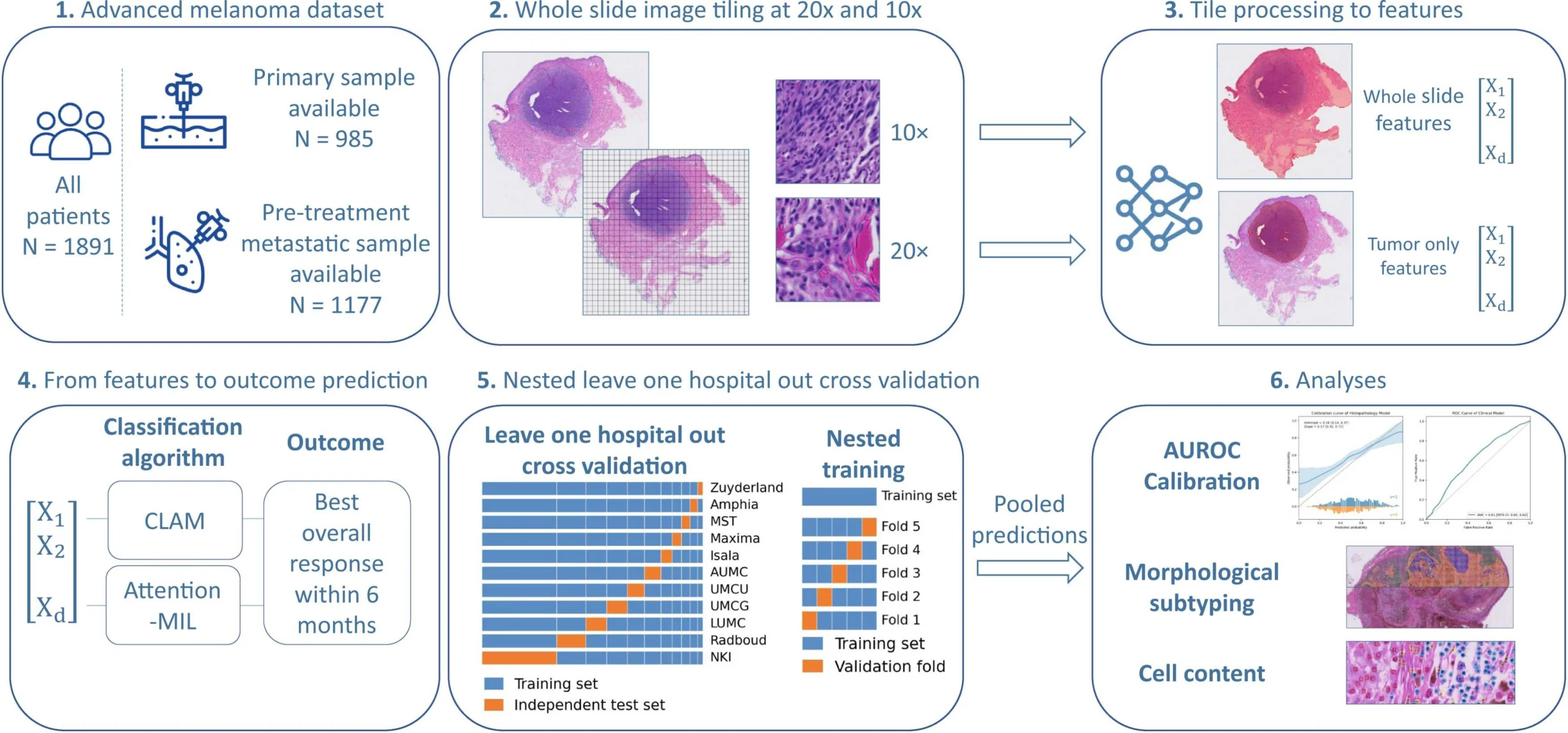
The study included 1,177 patients with available pre-treatment metastatic tumor samples and 985 patients with primary melanoma specimens collected across 11 melanoma centers in the Netherlands. Patients received first-line anti–PD-1 monotherapy or anti–PD-1 plus anti–CTLA-4 combination therapy between 2016 and 2023.
Using multiple deep-learning foundation models and advanced machine-learning architectures, the investigators analyzed digitized H&E slides to predict objective response to immunotherapy. AI-generated predictions were subsequently integrated with clinical variables including performance status, LDH, liver metastases, AJCC stage, and treatment type to determine whether multimodal models could improve predictive performance.
Patient Characteristics and Clinical Outcomes
The cohort reflected a real-world advanced melanoma population. Most patients were older than 65 years, approximately one-third received combination immunotherapy, and liver or brain metastases were present in a substantial subset of patients. The overall response rate across the metastatic cohort was 56.7%, with a median progression-free survival of 8.8 months and a median overall survival of 35.9 months.
Key Clinical Outcomes
- Objective response rate (ORR): 56.7%
- Median progression-free survival (PFS): 8.8 months
- Median overall survival (OS): 35.9 months
- Combination anti–PD-1 + anti–CTLA-4 therapy used in 35.3% of patients
AI Successfully Predicted Immunotherapy Response
The most effective AI model was generated using the UNI2 foundation model combined with clustering-constrained multiple-instance learning (CLAM). This model demonstrated a meaningful ability to distinguish responders from non-responders using routine pathology slides alone.
Importantly, predictive performance remained consistent across both biopsy and resection specimens and across patients treated with either monotherapy or combination immunotherapy. These findings suggest that routinely collected diagnostic tissue contains clinically relevant biological information regarding treatment sensitivity.
AI Model Performance
- Best AI model AUROC: 0.63 (95% CI 0.60–0.66)
- Biopsy specimens AUROC: 0.65
- Resection specimens AUROC: 0.60
- Anti–PD-1 monotherapy AUROC: 0.61
- Anti–PD-1 + anti–CTLA-4 AUROC: 0.66
Combining AI and Clinical Data Improved Prediction
While the AI model alone demonstrated moderate predictive ability, the most important finding emerged when histopathology-derived predictions were combined with clinical variables.
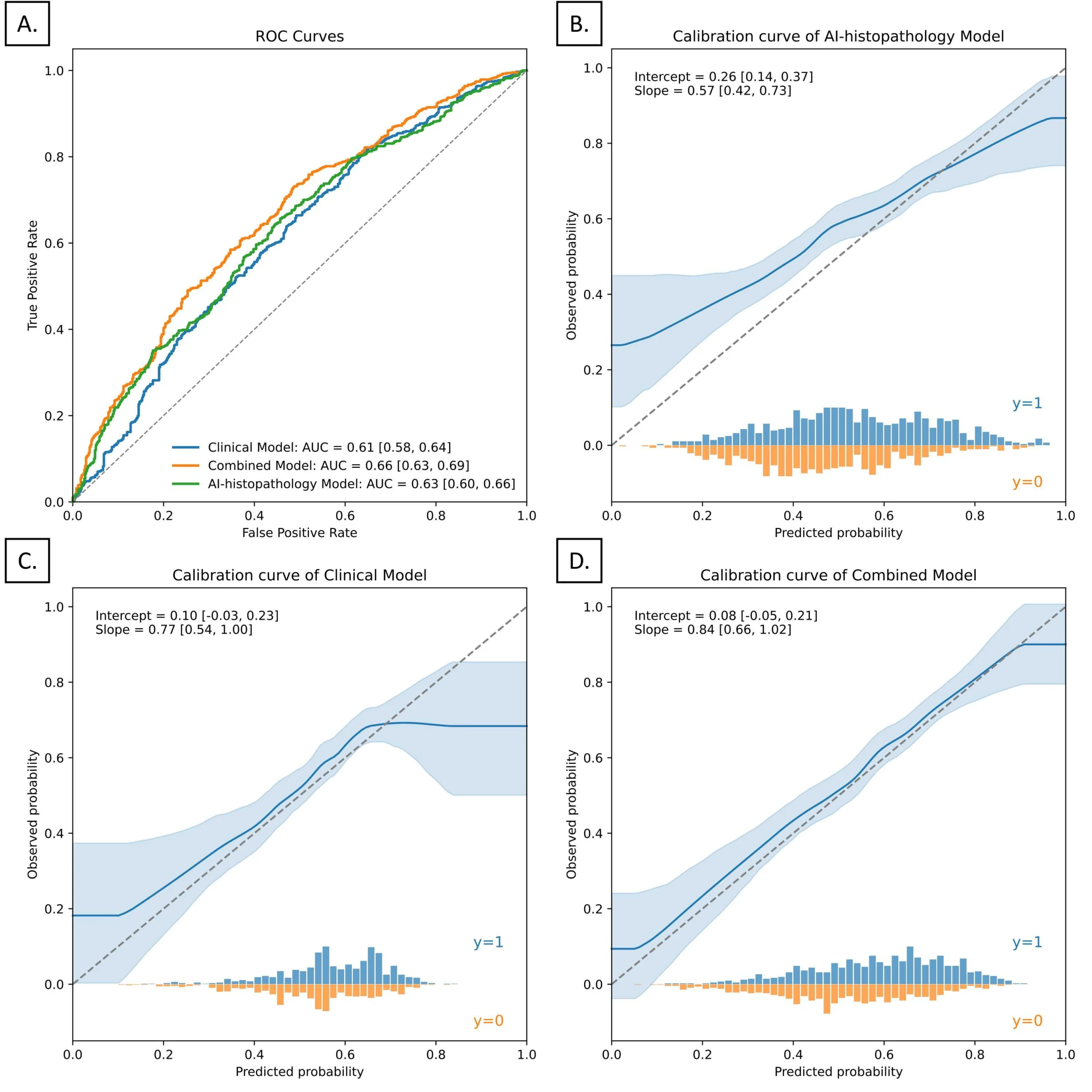
The clinical model alone achieved an AUROC of 0.61. After incorporating AI-based pathology analysis, predictive accuracy improved significantly, reaching an AUROC of 0.66. The combined model also demonstrated superior calibration and a broader separation between low- and high-probability responders.
Combined Model Results
- Clinical model AUROC: 0.61
- AI model AUROC: 0.63
- Combined model AUROC: 0.66
- Improvement statistically significant (P < 0.001)
Predicted Response Strongly Correlated With Survival
The investigators further evaluated whether model predictions translated into meaningful clinical outcomes. Patients were stratified into tertiles according to predicted response probability.
The combined AI-clinical model produced striking separation of survival curves. Patients classified within the highest predicted-response group experienced substantially longer progression-free and overall survival compared with those in the lowest tertile.
Survival According to Combined Model Predictions
- ORR increased from 39.7% in the lowest tertile to 72.2% in the highest tertile
- Median PFS improved from 4.0 months to 17.4 months
- Median OS improved from 14.4 months to 58.4 months
These results suggest that AI-assisted pathology analysis captures biologically meaningful information associated not only with radiographic response but also with long-term patient outcomes.
Histological Features Driving Response and Resistance
One of the most compelling aspects of this study was its ability to move beyond simple outcome prediction and provide biological insight into the histological features associated with immunotherapy response. Using explainable AI approaches, the investigators were able to identify specific tissue patterns that contributed to treatment predictions, transforming the model from a “black box” into an interpretable tool capable of revealing meaningful tumor biology.
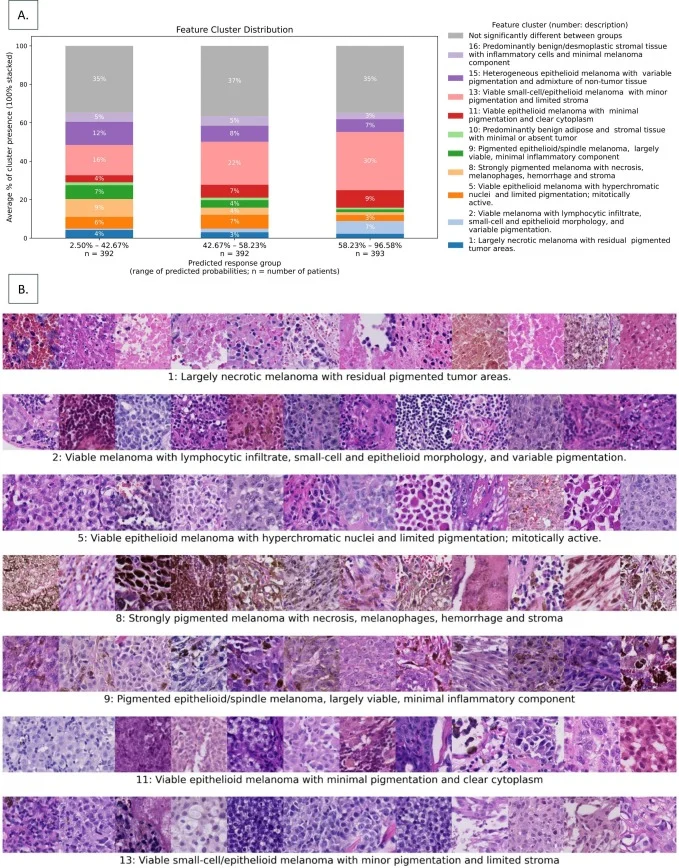
Tumors predicted to respond favorably to immune checkpoint inhibitors were characterized by prominent immune infiltration and epithelioid melanoma morphology. In particular, regions enriched with tumor-infiltrating lymphocytes appeared to play a central role in driving positive predictions. Conversely, tumors predicted to be resistant frequently demonstrated spindle-cell morphology, extensive necrosis, hemorrhagic changes, and limited immune-cell infiltration. These features consistently clustered within samples associated with poor clinical outcomes.
Importantly, the cluster most strongly associated with response was also the only cluster in which lymphocytes outnumbered tumor cells, further emphasizing the critical role of pre-existing antitumor immunity in determining the effectiveness of checkpoint blockade. These findings reinforce the concept that the immune contexture of the tumor microenvironment remains one of the strongest determinants of immunotherapy success.
Influence of Metastatic Site on Histological Patterns
The study also revealed a notable relationship between metastatic location and the histological features identified by the AI model. Metastases arising in the brain, liver, gastrointestinal tract, and bone more frequently displayed spindle-cell morphology and necrotic tissue patterns that were associated with treatment resistance. In contrast, lymph node and cutaneous metastases were more likely to contain immune-rich microenvironments characterized by higher levels of lymphocytic infiltration and histological features linked to favorable responses.
These observations suggest that metastatic site may influence the biological composition of the tumor microenvironment and, consequently, sensitivity to immunotherapy. The findings further support the growing recognition that different metastatic niches may harbor distinct immune landscapes that shape therapeutic outcomes.
Primary Tumors Versus Metastatic Samples
An important secondary objective of the study was to determine whether primary melanoma specimens could provide the same predictive information as metastatic lesions. While the investigators identified a modest predictive signal within primary tumors, the overall performance was substantially weaker than that observed in metastatic samples. The best-performing model based on primary tumors achieved an AUROC of only 0.56 and failed to improve the predictive accuracy of the clinical model when integrated into multivariable analyses.
The authors propose that metastatic lesions more accurately reflect the dynamic tumor–immune interactions present at the time of immunotherapy initiation. Unlike primary tumors, metastatic samples capture the biological environment immediately relevant to treatment response, including immune infiltration, tumor evolution, and microenvironmental adaptation. As a result, metastatic tissue appears considerably more informative for predicting checkpoint inhibitor efficacy.
Conclusion
In one of the largest studies of AI-assisted pathology in advanced melanoma conducted to date, Schuiveling and colleagues demonstrated that artificial intelligence can extract clinically relevant predictive information from routine pre-treatment metastatic H&E slides. The study showed that AI-derived histopathological analysis not only predicts response to checkpoint inhibitors but also identifies interpretable biological patterns associated with therapeutic sensitivity and resistance.
While the current predictive performance is not yet sufficient for standalone clinical implementation, these findings represent an important step toward multimodal precision oncology. Future integration of AI-based histopathology with clinical variables, molecular biomarkers, and genomic data may ultimately enable more accurate patient selection and more personalized immunotherapy strategies for individuals with advanced melanoma.
You Can Read Full Article Here