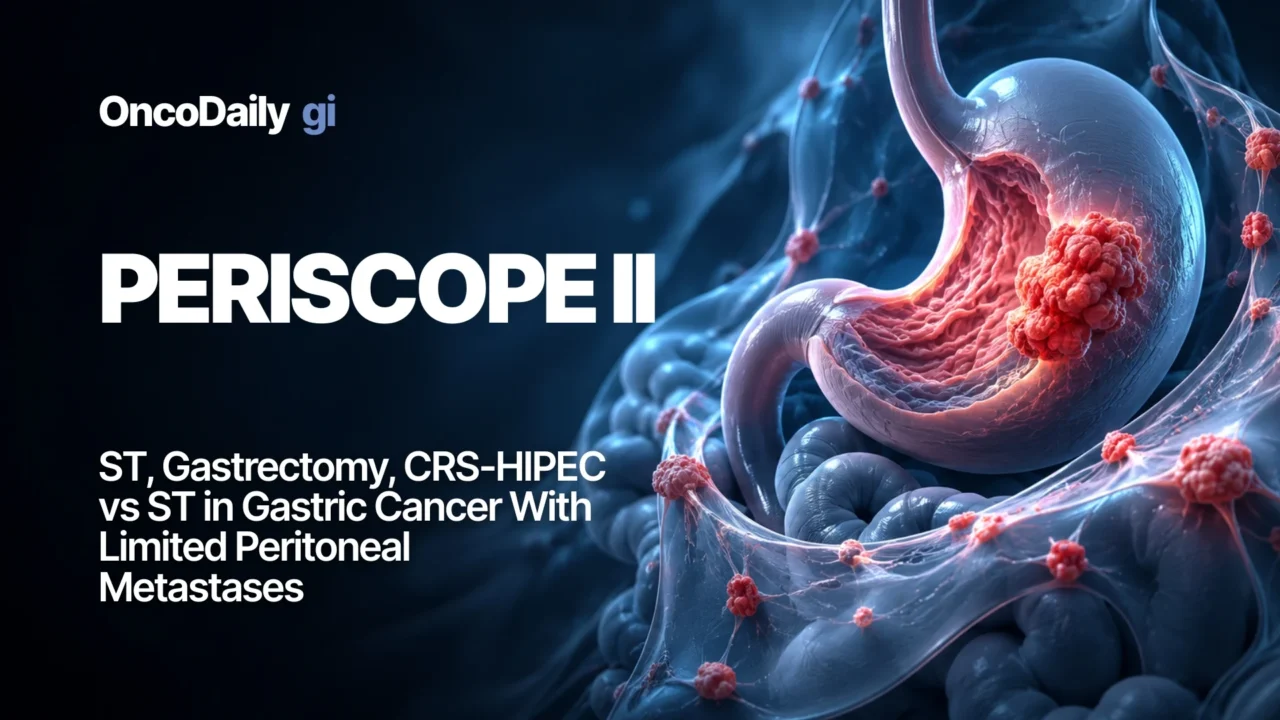
Patients with gastric cancer and peritoneal metastases have a poor prognosis, and systemic therapy remains the standard treatment approach. Although cytoreductive surgery combined with hyperthermic intraperitoneal chemotherapy has been used in selected patients, its efficacy had not previously been directly compared with systemic therapy alone in a prospective randomized trial.
Final results from the phase 3 PERISCOPE II trial showed that adding gastrectomy, cytoreductive surgery, and hyperthermic intraperitoneal chemotherapy to systemic therapy did not improve overall survival in patients with gastric cancer and limited peritoneal metastases. The intensive surgical approach was also associated with substantially higher morbidity and three treatment-related deaths.
The article, titled “Systemic Therapy, Gastrectomy, Cytoreductive Surgery, and Hyperthermic Intraperitoneal Chemotherapy Versus Systemic Therapy Alone for Gastric Cancer With Limited Peritoneal Metastases (PERISCOPE II): Final Results of a Multicentre, Randomised, Controlled, Phase 3 Trial After an Unplanned Commissioned Interim Analysis,” was published online in The Lancet Oncology on July 8, 2026.
Authors: Judith S. E. Quik, Marieke A. Vollebergh, Valesca P. Retèl, Karen van der Sluis, Willem J. Koemans, Rosa T. van der Kaaij, Madelon M. Voets, Misha D. P. Luyer, Irene E. G. van Hellemond, Bas P. L. Wijnhoven, Bianca Mostert, Richard van Hillegersberg, Nadia Haj Mohammad, Boudewijn van Etten, Derk J. de Groot, Olli Helminen, Jakob Hedberg, Peter H. Cashin, Julie L. Harbjerg, Alexander A. F. A. Veenhof, Koen J. Hartemink, Liudmila L. Kodach, Vincent van der Noort, and Johanna W. van Sandick, on behalf of the PERISCOPE II consortium.
PERISCOPE II Study Design
PERISCOPE II was a European, multicenter, randomized, controlled phase 3 trial conducted across eight tertiary referral hospitals with experience in gastric cancer surgery and hyperthermic intraperitoneal chemotherapy, or HIPEC.
The study enrolled adults with histologically confirmed, resectable cT3 or cT4a gastric adenocarcinoma and limited peritoneal disease, defined as a Peritoneal Cancer Index below 7, tumor-positive peritoneal cytology, or both.
Patients were required to have no clinical or radiological disease progression after receiving at least three cycles of systemic therapy. The absence of extraperitoneal metastases was confirmed using CT imaging.
Eligible patients were randomly assigned in a 1:1 ratio to:
- Continued systemic therapy, representing the standard group
- Gastrectomy with cytoreductive surgery and HIPEC, representing the experimental group
Randomization was stratified according to the participating center, histological subtype, and extent of peritoneal disease.
The HIPEC regimen consisted of intraperitoneal oxaliplatin at 460 mg/m² administered at 41°C for 30 minutes, followed by docetaxel at 50 mg/m² administered at 37°C for 90 minutes.
The primary endpoint was overall survival. Secondary endpoints included progression-free survival, treatment-related toxicity, health-related quality of life, cost-effectiveness, pharmacokinetics, and translational research. The study was registered with ClinicalTrials.gov as NCT03348150.
Trial Enrollment and Early Closure
Between November 6, 2017, and August 21, 2024, 102 patients were enrolled, with 51 assigned to each treatment group.
One patient in the experimental group was excluded from the intention-to-treat population after an unexpected postoperative diagnosis of a neuroendocrine tumor. The final intention-to-treat analysis included 101 patients: 51 assigned to continued systemic therapy and 50 assigned to gastrectomy, cytoreductive surgery, and HIPEC.
The median age was 60 years, 57% of participants were men, and 85% were White. Most patients had diffuse or mixed-type adenocarcinoma, and 15% had tumor-positive peritoneal cytology without macroscopic peritoneal metastases.
The study was initially designed to enroll 106 patients, but the target sample size was increased to 226 patients in March 2020 on the basis of updated overall survival estimates. However, an unplanned interim analysis for futility was commissioned by the Dutch National Health Care Institute. Following a recommendation from the data and safety monitoring board, enrollment was stopped prematurely on September 17, 2024.
Simulations performed as part of the interim analysis estimated a 21% conditional probability that either treatment group would demonstrate a statistically significant survival advantage if enrollment continued to the planned sample size.

You can also read about Gastric Cancer Remission Rate on OncoDaily.
Delivery of the Experimental Treatment
Among the 50 patients assigned to the experimental group, 37, or 74%, underwent gastrectomy, cytoreductive surgery, and HIPEC according to the study protocol. Thirteen patients did not undergo the planned procedure. Ten were found intraoperatively to have extensive peritoneal disease or other disease characteristics that precluded the protocol-defined procedure, one died before surgery, and two declined surgery.
Among the 37 patients who underwent protocol-defined surgery, 29 received a total gastrectomy, and all underwent D2 lymph-node dissection. Nine patients had microscopically incomplete resection of the primary tumor.
Pathological findings indicated substantial residual disease. Seventeen patients, or 46%, had ypN3 disease, and the same proportion had a poor or absent pathological response to systemic therapy. One patient achieved a pathological complete response.
Protocol crossover also occurred. Seven patients assigned to the systemic therapy group underwent cytoreductive surgery and HIPEC outside the PERISCOPE II protocol in nonparticipating countries.
No Overall Survival Benefit
After a median follow-up of 67 months, median overall survival was:
- 16.6 months in the continued systemic therapy group
- 15.7 months in the gastrectomy, cytoreductive surgery, and HIPEC group
The hazard ratio for death was 1.10, with a 95% confidence interval of 0.69–1.74 and a p value of 0.70.
There were 39 deaths in each treatment group.
The intensive surgical strategy therefore did not improve the trial’s primary endpoint of overall survival compared with systemic therapy alone. Prespecified subgroup analyses also did not identify a group with a statistically significant survival advantage from the experimental treatment.
Among the 15 patients with tumor-positive cytology alone, the hazard ratio for death was 0.40. Among the 86 patients with macroscopic peritoneal metastases, the hazard ratio was 1.19. However, the interaction between treatment and the extent of peritoneal disease was not statistically significant. Histological subtype did not significantly modify the effect of treatment on overall survival.
Progression-Free Survival
Median progression-free survival in the intention-to-treat population was:
- 7.6 months in the continued systemic therapy group
- 9.3 months in the gastrectomy, cytoreductive surgery, and HIPEC group
The hazard ratio for progression or death was 0.93, with a 95% confidence interval of 0.60–1.43 and a p value of 0.73.
Overall, disease progression occurred in 42 of 51 patients in the systemic therapy group and 37 of 50 patients in the experimental group.
Post Hoc Per-Protocol Analysis
In a post hoc per-protocol analysis, median overall survival was 15.2 months in the systemic therapy group and 17.3 months in the experimental group. The difference was not statistically significant, with a hazard ratio of 0.65 and a p value of 0.12.
After adjustment for relevant prognostic factors, the hazard ratio was 0.70, with a p value of 0.22.
Median progression-free survival in the per-protocol population was 7.2 months with systemic therapy and 13.2 months with the experimental treatment. The hazard ratio was 0.51, with a p value of 0.0092. The association remained statistically significant after multivariable adjustment.
However, the investigators emphasized that these findings require careful interpretation. Patients found to have more extensive peritoneal disease during surgery were excluded from the experimental group in the per-protocol analysis, whereas comparable patients could have remained in the systemic therapy group. This loss of balance limits causal interpretation and does not alter the negative findings from the randomized intention-to-treat analysis.

You can also read about French Intergroup Guidelines 2026: Updates on Gastric Cancer Management on OncoDaily.
Higher Morbidity With Surgery and HIPEC
The experimental strategy was associated with substantially greater toxicity. Grade 3 or worse adverse events occurred in:
- 10 of 51 patients, or 20%, in the systemic therapy group
- 21 of 50 patients, or 42%, in the experimental group
The most common grade 3 or worse adverse events in the experimental group were anemia and elevated liver enzymes, each occurring in four patients.
Serious adverse events were reported in:
- 3 of 51 patients, or 6%, in the systemic therapy group
- 22 of 50 patients, or 44%, in the experimental group
Among the 37 patients who underwent the protocol-defined surgical procedure, ileus occurred in 13 patients, or 35%, and anastomotic leakage occurred in ten, or 27%.
Three treatment-related deaths occurred within 100 days after randomization, all in the experimental group. The deaths were attributed to acute respiratory distress syndrome, anastomotic leakage, and bleeding. Among patients who underwent surgery according to the study protocol, 90-day postoperative mortality was 8%.
Health-Related Quality of Life
At baseline, global health status scores were similar between the treatment groups. At three months, patients in the experimental group experienced a decline in global health status, which the investigators considered likely to reflect the immediate effects of extensive surgery.
Scores subsequently improved among the patients who remained available for assessment. However, the investigators noted that later quality-of-life findings could have been affected by decreasing questionnaire completion, selection bias, and the greater likelihood that long-term survivors would report better outcomes. A more detailed analysis of health-related quality of life is expected to be published separately.
Study Limitations
The investigators identified several limitations. Restaging after initial systemic therapy was performed using CT imaging without repeat staging laparoscopy. This could have underestimated the extent of peritoneal disease, as demonstrated by the patients found to have more advanced disease during surgery.
The study was also closed before reaching its planned enrollment following the futility analysis. However, simulations suggested that continuation to the planned sample size of 226 patients was unlikely to change the study’s conclusion.
Crossover was another limitation, as seven patients assigned to systemic therapy received cytoreductive surgery and HIPEC outside the trial protocol. Finally, most participants were White, limiting the generalizability of the findings to more racially and ethnically diverse populations.
Takeaway
According to the investigators, PERISCOPE II was the first prospective, multicenter, randomized controlled trial to directly compare gastrectomy, cytoreductive surgery, and HIPEC with systemic therapy alone in patients with gastric cancer and limited peritoneal metastases who had not progressed during initial systemic treatment.
Despite selecting patients with limited peritoneal disease, adequate performance status, and no disease progression after initial systemic therapy, the addition of extensive surgery and HIPEC did not improve overall survival or progression-free survival in the intention-to-treat population.
The experimental group also had substantially more serious adverse events, a high incidence of surgical complications, and three treatment-related deaths. Based on these findings, the investigators concluded that gastrectomy with cytoreductive surgery and HIPEC should not be considered standard treatment for gastric cancer with limited peritoneal metastases or tumor-positive peritoneal cytology.
Systemic therapy—including chemotherapy with immunotherapy, targeted therapy, or both when indicated—remains the standard treatment approach. Until a clearly defined population that benefits from this strategy can be identified, gastrectomy, cytoreductive surgery, and HIPEC should not be offered outside clinical trials.
The full article is available in The Lancet Oncology.
You can also read about Top 10 Gastroesophageal Cancer Updates – March 2026 on OncoDaily.