At the 2026 ASCO Annual Meeting, Bingjun Bai, MD, from Sir Run Run Shaw Hospital, Zhejiang University School of Medicine, presented results from mRCAT-III, a multicenter randomized phase 3 trial evaluating node-sparing modified short-course radiotherapy combined with chemotherapy and tislelizumab in patients with pMMR locally advanced rectal cancer.
The study was presented as Abstract LBA3515.
Background
Total neoadjuvant therapy is a standard treatment for locally advanced rectal cancer, but pathological complete response rates remain modest. Adding PD-1 inhibitors has improved outcomes in pMMR locally advanced rectal cancer, although many patients still do not achieve pCR. Conventional lymph node irradiation may suppress the immune microenvironment.
mRCAT-III evaluated a node-sparing radiotherapy strategy targeting only the primary tumor and excluding lymph nodes. A prior phase 2 study using this strategy combined with immunochemotherapy reported a pCR rate of 78.8%.
Study Design
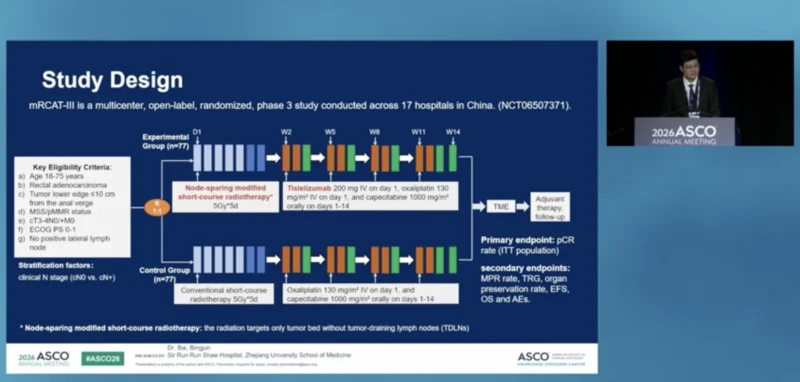
mRCAT-III was a multicenter, open-label, randomized phase 3 study conducted across 17 hospitals in China. Eligible patients were 18 to 75 years old and had MSS/pMMR middle or low rectal adenocarcinoma, cT3-4N0/+M0 disease, ECOG performance status 0–1, and no positive lateral lymph nodes.
A total of 154 patients were enrolled between July 2024 and December 2025, with 77 patients assigned to each group. Patients were randomly assigned 1:1 to: Experimental group: node-sparing modified short-course radiotherapy followed by CAPOX plus tislelizumab
Control group: conventional short-course radiotherapy followed by CAPOX
Node-sparing modified short-course radiotherapy was given as 5 Gy for 5 days and targeted only the tumor bed without tumor-draining lymph nodes. Tislelizumab was administered at 200 mg intravenously on day 1. Oxaliplatin was administered at 130 mg/m² intravenously on day 1, and capecitabine at 1000 mg/m² orally on days 1–14.
The primary endpoint was pCR rate in the intent-to-treat population. Secondary endpoints included MPR rate, tumor regression grade, organ preservation rate, event-free survival, overall survival, and adverse events.
Results
Baseline characteristics were balanced between the two groups, and most patients had clinical stage III disease.
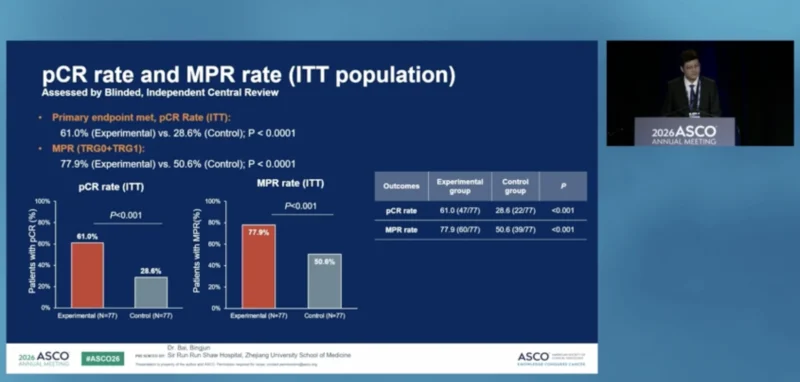
The study met its primary endpoint. In the intent-to-treat population, pCR was significantly higher in the experimental group than in the control group:
- 61.0% vs 28.6%; P < 0.001
MPR was also significantly higher in the experimental group:
- 77.9% vs 50.6%; P < 0.001
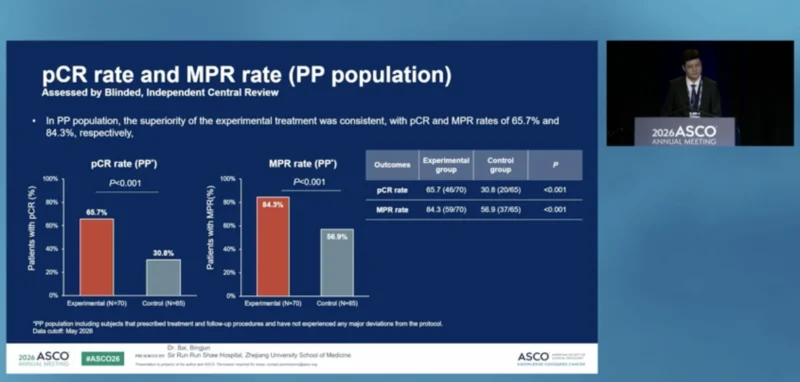
In the per-protocol population, the pCR rate was 65.7% in the experimental group and 30.8% in the control group. The MPR rate in the per-protocol population was 84.3% versus 56.9%, respectively.
Safety
The incidence of grade 3 or higher treatment-related adverse events was comparable between the experimental and control groups:
- 22.1% vs 26.0%
The experimental group showed a low incidence of grade 3 or higher diarrhea and rectal pain. Grade 3–4 diarrhea occurred in 2.6% of patients in the experimental group and 7.8% in the control group. One grade 5 diarrhea event occurred in the control group. Grade 3–4 rectal pain occurred in 1.3% of patients in the experimental group and 5.2% in the control group.
Immune-related adverse events occurred in the experimental group, mostly grade 1–2. Grade 3–4 immune-related adverse events occurred in 2.6% of patients, and one grade 5 immune-related event was reported.
Conclusion
Node-sparing radiotherapy combined with tislelizumab and chemotherapy achieved a significantly higher pCR rate than conventional short-course radiotherapy plus chemotherapy in patients with pMMR locally advanced rectal cancer.
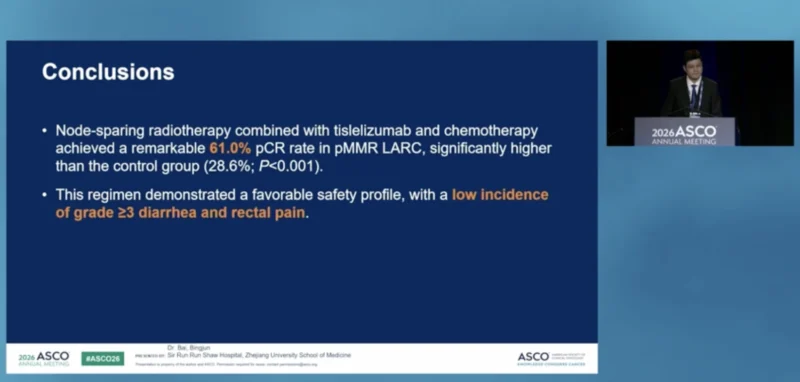
The experimental arm achieved a pCR rate of 61.0% compared with 28.6% in the control group. The regimen showed a favorable safety profile, with comparable rates of grade 3 or higher treatment-related adverse events and low rates of grade 3 or higher diarrhea and rectal pain.
The full abstract is available on the official ASCO website.