In the Proffered Paper session, Joseph P. Erinjeri from New York, United States, presented updated tumour response analyses from the phase III EMERALD-3 study.
The abstract, titled “Tumour response analyses by RECIST v1.1 and mRECIST in the phase III EMERALD-3 study of tremelimumab plus durvalumab with or without lenvatinib plus transarterial chemoembolisation (TACE) in embolisation-eligible hepatocellular carcinoma,” was presented as LBA2.
EMERALD-3 evaluated the STRIDE regimen, tremelimumab plus durvalumab, with or without lenvatinib, in combination with TACE for patients with embolisation-eligible hepatocellular carcinoma.
Background
STRIDE, which consists of a single dose of tremelimumab with regular-interval durvalumab, is a first-line standard of care in advanced hepatocellular carcinoma.
In embolisation-eligible HCC, TACE remains an important treatment approach. EMERALD-3 was designed to evaluate whether adding STRIDE-based systemic therapy, with or without lenvatinib, to TACE could improve disease control compared with TACE alone.
This analysis focused on progression-free survival and tumour response using RECIST v1.1 by blinded independent central review and mRECIST by both investigator and blinded independent central review assessment. Clinical trial identification: NCT05301842.
Methods
Patients aged 18 years or older with embolisation-eligible HCC were randomised to receive:
- STRIDE plus lenvatinib plus TACE,
- STRIDE plus TACE,
- or TACE alone.
Randomisation was stratified by region, prior palliative locoregional therapy, and baseline tumour burden.
Patients in the STRIDE arms received tremelimumab 300 mg plus durvalumab 1500 mg on Day 1, followed by durvalumab 1500 mg every 4 weeks. Lenvatinib was given once daily at 8 mg or 12 mg. Durvalumab and lenvatinib could continue for up to 36 months or until progression or other discontinuation criteria were met.
The primary endpoint was progression-free survival by RECIST v1.1, assessed by blinded independent central review, for STRIDE plus lenvatinib plus TACE versus TACE. Secondary endpoints included progression-free survival by mRECIST and tumour response by RECIST v1.1 and mRECIST.

Read more about EMERALD-3 Trial on OncoDaily.
Results
At the second data cutoff on February 23, 2026, 293 patients had been randomised to STRIDE plus lenvatinib plus TACE, 175 to STRIDE plus TACE, and 292 to TACE alone.
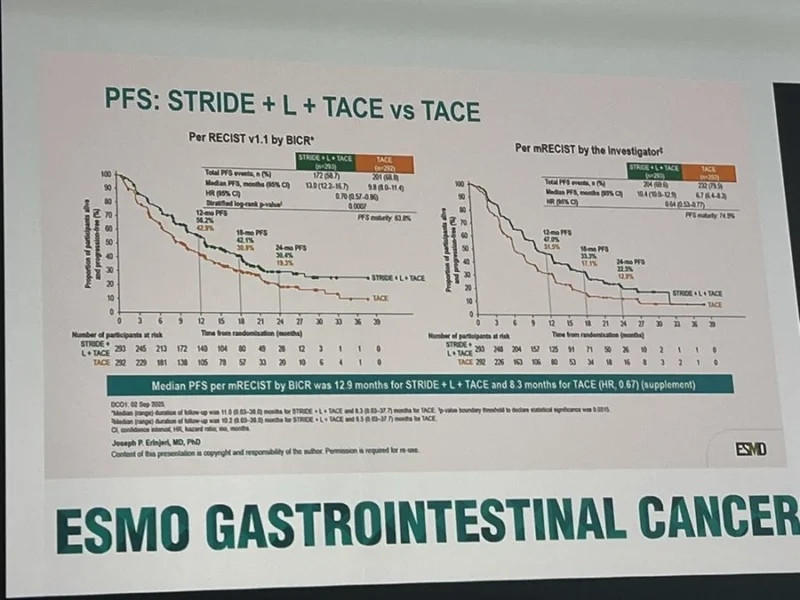
EMERALD-3 met its primary endpoint. At the first data cutoff on September 2, 2025, STRIDE plus lenvatinib plus TACE significantly improved progression-free survival compared with TACE by RECIST v1.1 central review, with a median PFS of 13.0 versus 9.8 months and a hazard ratio of 0.70 (95% CI, 0.57–0.86; p=0.0007).
Progression-free survival also favored STRIDE plus lenvatinib plus TACE by mRECIST investigator assessment, with a median PFS of 10.4 versus 6.7 months and a hazard ratio of 0.64 (95% CI, 0.53–0.77). Per mRECIST by blinded independent central review, median PFS was 12.9 versus 8.3 months, with a hazard ratio of 0.67.
At the second data cutoff, STRIDE plus TACE showed improved progression-free survival compared with TACE among the first 175 patients in each arm. By RECIST v1.1 central review, median PFS was 12.9 versus 8.1 months, with a hazard ratio of 0.71 (95% CI, 0.56–0.91). By mRECIST investigator assessment, median PFS was 12.0 versus 6.6 months, with a hazard ratio of 0.59 (95% CI, 0.46–0.75). Per mRECIST by central review, median PFS was 12.9 versus 7.5 months, with a hazard ratio of 0.70.
Objective response rates were numerically higher with STRIDE-based treatment. At the first data cutoff, ORR by RECIST v1.1 central review was 36.6% with STRIDE plus lenvatinib plus TACE versus 30.0% with TACE (OR 1.37, 95% CI 0.96–1.95). By mRECIST investigator assessment, ORR was 58.9% versus 42.5% (OR 1.99, 95% CI 1.42–2.79). ORR per mRECIST by central review was 67.8% versus 54.8%.
Overall survival data were also reported at the second data cutoff. For STRIDE plus TACE versus TACE, median OS was not calculable versus 32.9 months, with a hazard ratio of 0.70 (95% CI, 0.51–0.95). This analysis had a nominal p-value of 0.0233 and was not formally tested.
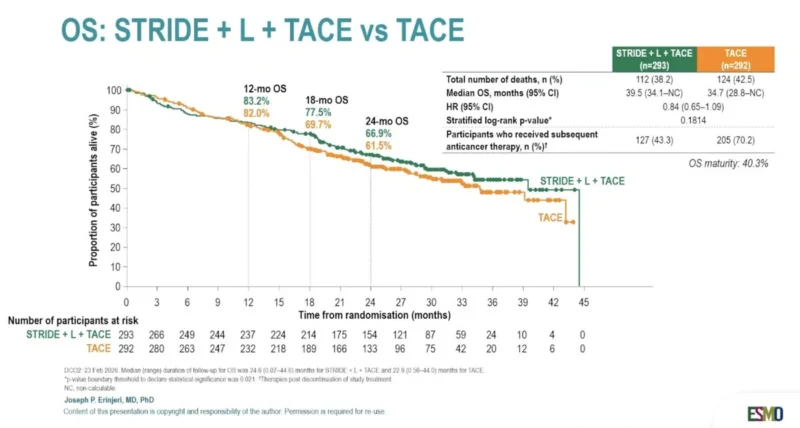
For STRIDE plus lenvatinib plus TACE versus TACE, median OS was 39.5 months versus 34.7 months, with a hazard ratio of 0.84 (95% CI, 0.65–1.09; p=0.1814).

Read more about EMERALD-3 at ASCO 2026 on OncoDaily.
Expert Highlights
Arndt Vogel shared on his X page:
“Tumour response analyses by RECIST v1.1 and mRECIST in the phase III EMERALD-3 study of tremelimumab plus durvalumab with or without lenvatinib TACE in HCC
Primary endpoint met
ORR & PFS improved
OS benefit for STRIDE
Option to be considered”
Erman Akkus shared on his X page:
“EMERALD-3 response analysis
Proffered paper ESMO GI 26ORR and PFS benefit”
Conclusions
In EMERALD-3, the study met its primary endpoint, with STRIDE plus lenvatinib plus TACE improving progression-free survival compared with TACE alone in patients with embolisation-eligible hepatocellular carcinoma.
Assessments by RECIST v1.1 and mRECIST showed consistent improvements in progression-free survival and objective response rate with STRIDE-based treatment, with or without lenvatinib, plus TACE compared with TACE alone.
The safety profile was described as acceptable and consistent with the known safety profiles of STRIDE, lenvatinib, and TACE. These findings support STRIDE-based therapy plus TACE as a potential new treatment option for embolisation-eligible HCC.
More details are available in the official ESMO Gastrointestinal Cancers Congress 2026 programme.

You can also read about PROACTIF at ESMO GI 2026 on OncoDaily.