At the ESMO Gastrointestinal Cancers Congress 2026, Boris Guiu presented real-world data from PROACTIF on overall survival in patients with hepatocellular carcinoma treated with selective internal radioembolization therapy with yttrium-90.
The presentation, titled “Real-world data from PROACTIF: Overall survival of hepatocellular carcinoma patients with large tumors or portal vein thrombosis treated with selective internal radioembolization therapy with yttrium-90,” was presented as abstract 184RO.
Background
The objective of this analysis was to report median overall survival in PROACTIF patients with large hepatocellular carcinoma tumors, portal vein thrombosis, and associated tumor dose.
Read more about Liver Cancer Success Rate on OncoDaily.
Methods
PROACTIF was conducted across 34 French institutions and included 989 patients with hepatocellular carcinoma. Pretreatment tumor dose, portal vein thrombosis status, and index lesion size were centrally assessed. Index lesion size was evaluated using mRECIST. Tumor-size thresholds were defined as 5 cm, 7 cm, 10 cm, and 14 cm.
Median overall survival was assessed using Kaplan-Meier methods. Post-hoc log-rank p-values were calculated to compare median overall survival between subgroups. The clinical trial identification number was NCT04069468.
Key Findings
The baseline median index lesion size was 6.8 cm. By tumor-size thresholds, 631 patients had index lesions larger than 5 cm, 408 had lesions larger than 7 cm, 161 had lesions larger than 10 cm, and 43 had lesions larger than 14 cm.
The proportion of patients with ALBI grade 2 increased with tumor size, from 44.2% among patients with lesions larger than 5 cm to 58.1% among those with lesions larger than 14 cm. Mean pretreatment absorbed dose to the index lesion decreased as tumor size increased.
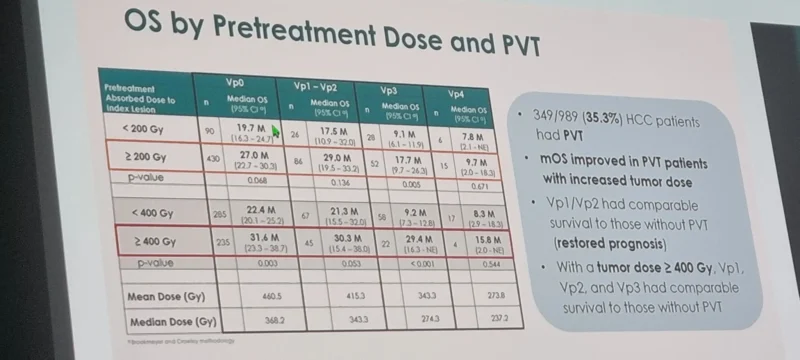
Median overall survival was prolonged as pretreatment tumor dose increased, independent of tumor size.
Portal vein thrombosis was reported in 349 of 989 patients, representing 35.3% of the cohort. Median overall survival also improved in patients with portal vein thrombosis as tumor dose increased.
Conclusions
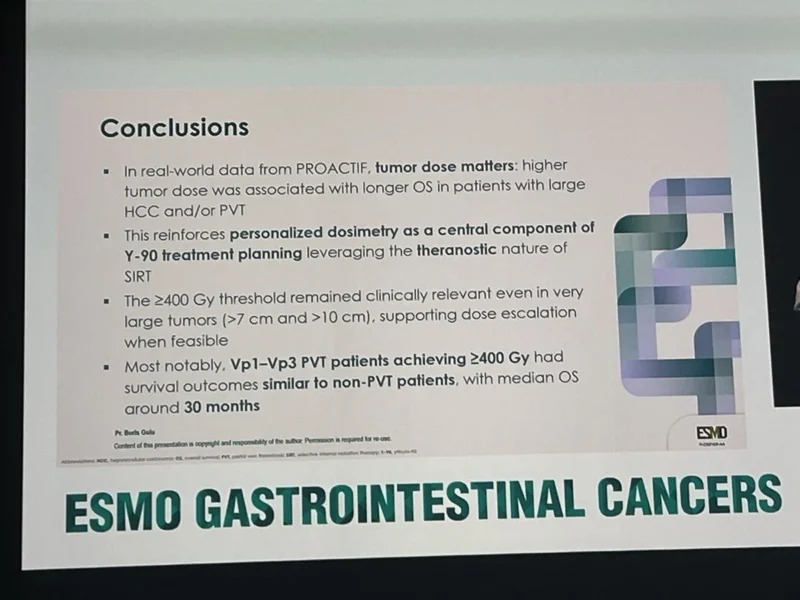
Real-world data from PROACTIF showed that tumor dose matters in yttrium-90 radioembolization for hepatocellular carcinoma, with higher pretreatment tumor dose associated with longer overall survival in patients with large tumors and/or portal vein thrombosis.
Median overall survival in patients with Vp1–Vp2 portal vein thrombosis was comparable to patients without portal vein thrombosis at tumor doses of 200 Gy or higher and 400 Gy or higher. With a tumor dose of at least 400 Gy, patients with Vp1–Vp2 and Vp3 portal vein thrombosis had survival outcomes similar to those without portal vein thrombosis.
The 400 Gy threshold remained clinically relevant for large lesions, highlighting the importance of tumor dose optimization.
Expert Highlight
Michel Ducreux, Chef du service d’Oncologie Digestive, shared on his LinkedIn page:
“Rapid oral presentation of Pr Boris Guiu at ESMO GI: Real-world cohort of radioembolisation of HCC with portal vein thrombosis. Dose matters!!!”
Erman Akkus shared on X:
“Dosing is crucial with TARE in HCC”
More details are available in the official ESMO Gastrointestinal Cancers Congress 2026 programme.