At the 2026 ASCO Annual Meeting, Filippo Pietrantonio, MD, from Fondazione IRCCS Istituto Nazionale dei Tumori in Milan, presented an exploratory retrospective analysis from the phase 3 CodeBreaK 300 study evaluating circulating tumor DNA clearance as an early indicator of efficacy and prognosis in KRAS G12C-mutated metastatic colorectal cancer.
CodeBreaK 300 evaluated sotorasib 240 mg plus panitumumab, sotorasib 960 mg plus panitumumab, and investigator’s choice of trifluridine–tipiracil or regorafenib in patients with pretreated KRAS G12C-mutated metastatic colorectal cancer. The study previously demonstrated superior progression-free survival with sotorasib 960 mg plus panitumumab compared with investigator’s choice therapy.
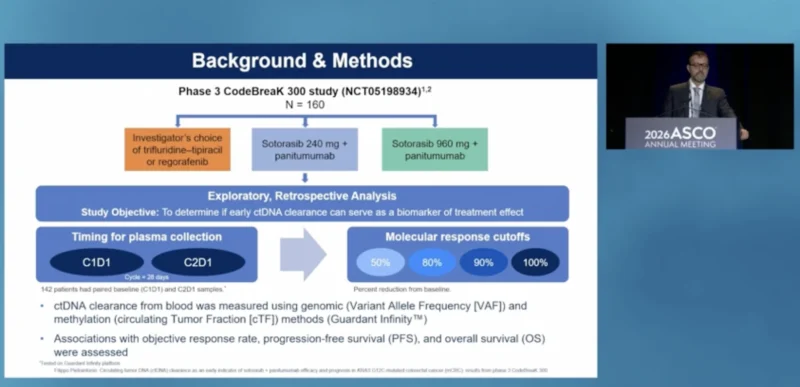
This analysis assessed whether early ctDNA clearance could serve as a biomarker of treatment effect.
Study Design
CodeBreaK 300 enrolled 160 patients. For this ctDNA analysis, 142 patients had paired baseline and Cycle 2 Day 1 plasma samples. ctDNA clearance was measured using the Guardant Infinity assay with two approaches: KRAS G12C variant allele frequency and methylation-based circulating tumor fraction. Molecular response was assessed using reduction thresholds of at least 50%, 80%, 90%, and 100% from baseline. Associations with objective response rate, progression-free survival, and overall survival were assessed.
Results
Early ctDNA clearance at Cycle 2 Day 1 was more frequent with sotorasib plus panitumumab than with investigator’s choice therapy.
At the ≥80% KRAS G12C variant allele frequency clearance threshold, clearance rates were:
- 77.3% with sotorasib 960 mg plus panitumumab
- 65.9% with sotorasib 240 mg plus panitumumab
- 15.0% with investigator’s choice therapy
At the ≥100% KRAS G12C variant allele frequency clearance threshold, clearance rates were:
- 45.5% with sotorasib 960 mg plus panitumumab
- 31.8% with sotorasib 240 mg plus panitumumab
- 5.0% with investigator’s choice therapy
Sotorasib-treated arms showed higher ctDNA clearance than investigator’s choice across molecular thresholds. Differences between the two sotorasib dose arms were not statistically significant.
ctDNA decline also aligned with radiographic tumor shrinkage and objective response. Patients with less than 50% ctDNA clearance did not show an objective response, while patients with objective response had at least 80% ctDNA clearance.
Among patients treated with sotorasib 960 mg plus panitumumab who achieved at least 80% KRAS G12C variant allele frequency clearance, the objective response rate was 35.3%.
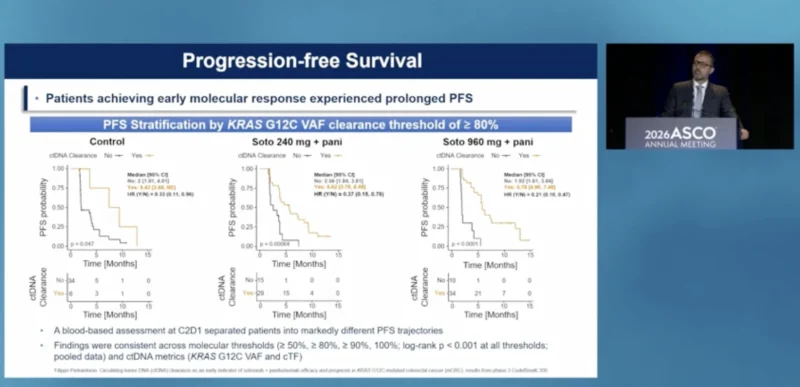
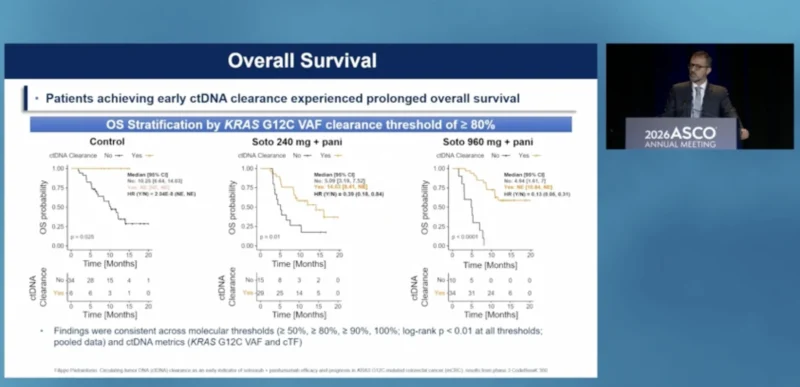
Patients achieving early ctDNA clearance experienced prolonged progression-free survival and overall survival. These findings were consistent across molecular thresholds and ctDNA metrics, including KRAS G12C variant allele frequency and circulating tumor fraction.
Conclusion
In this exploratory retrospective analysis of CodeBreaK 300, early ctDNA clearance was more frequent with sotorasib plus panitumumab than with investigator’s choice therapy and correlated with tumor shrinkage, objective response, progression-free survival, and overall survival.
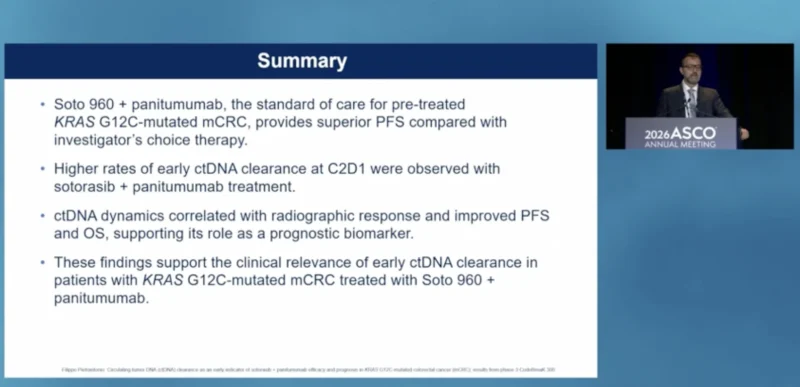
The findings support the clinical relevance of early ctDNA clearance as a prognostic biomarker in patients with KRAS G12C-mutated metastatic colorectal cancer treated with sotorasib plus panitumumab.
The full abstract is available on the official ASCO website.
You can also read about CRDF-004 at ASCO 2026 on OncoDaily.