At the ESMO GI Cancers Congress 2026, Scott Kopetz presented molecular analyses from the phase 3 BREAKWATER study in first-line BRAF V600E-mutant metastatic colorectal cancer.
The presentation, titled “Molecular correlates of enhanced outcome with first-line encorafenib + cetuximab ± mFOLFOX6 in BRAF V600E-mutant metastatic colorectal cancer from the BREAKWATER study,” was presented as abstract 7RO.
Background
The phase 3 BREAKWATER study previously demonstrated statistically significant and clinically meaningful improvements in objective response rate, progression-free survival, and overall survival with encorafenib plus cetuximab and mFOLFOX6 compared with chemotherapy with or without bevacizumab in the first-line setting.
This analysis evaluated molecular correlates of overall survival and treatment-specific genomic resistance patterns with encorafenib plus cetuximab, with or without mFOLFOX6.

Read more about ESMO 2026 Guideline: Redefining the Management of Metastatic Colorectal Cancer on OncoDaily.
Methods
Baseline tumor tissue was analyzed using whole-exome sequencing and whole-transcriptome sequencing. The analysis evaluated genomic alterations, consensus molecular subtypes, BRAF-mutant transcriptional subtypes, and pathway-level activity in relation to overall survival.
Acquired resistance alterations were assessed using end-of-treatment circulating tumor DNA profiling. The control arm included chemotherapy with or without bevacizumab. The clinical trial identification number was NCT04607421.
You can also read about BREAKWATER at ASCO 2026 on OncoDaily.
Key Findings
Of 514 patients with baseline samples, 498 were included for whole-exome sequencing, 497 for whole-transcriptome sequencing, and 310 for end-of-treatment ctDNA profiling.
Overall survival benefit with encorafenib plus cetuximab and mFOLFOX6 versus control was consistent across common baseline genomic alterations, including APC, PIK3CA, RNF43, and TP53.
The benefit was also consistent across evaluated consensus molecular subtypes and BRAF-mutant transcriptional subtypes.
Elevated UV response pathway activity, a marker of DNA repair and replication stress, was associated with aggressive biology and improved overall survival benefit with encorafenib plus cetuximab and mFOLFOX6. In patients with higher baseline UV response activity, overall survival favored encorafenib plus cetuximab and mFOLFOX6 versus control: HR 0.39; 95% CI, 0.25–0.60. For encorafenib plus cetuximab versus control, the HR was 0.71; 95% CI, 0.46–1.11.
End-of-treatment ctDNA profiling showed fewer acquired mutations with encorafenib plus cetuximab and mFOLFOX6 compared with encorafenib plus cetuximab alone. Patients in the encorafenib plus cetuximab arm had multiple MAPK-pathway resistance alterations compared with patients in the encorafenib plus cetuximab and mFOLFOX6 arm.
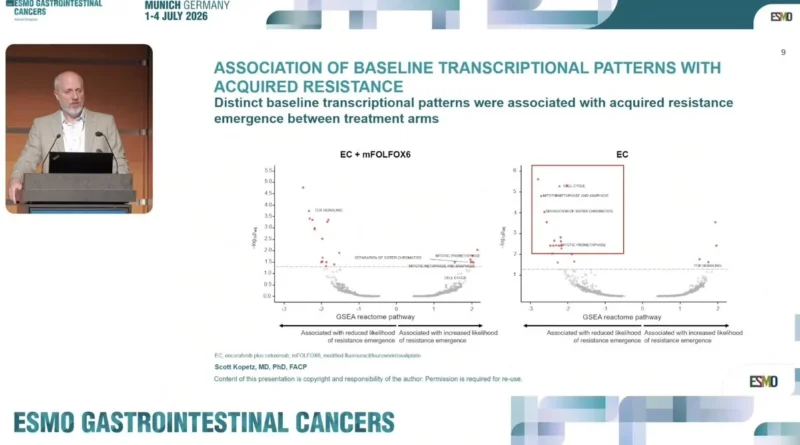
Distinct baseline transcriptional patterns were associated with acquired resistance emergence between treatment arms.
Conclusions
Encorafenib plus cetuximab and mFOLFOX6 showed overall survival benefit versus chemotherapy with or without bevacizumab across molecular subgroups in first-line BRAF V600E-mutant metastatic colorectal cancer. The combination also showed fewer MAPK-pathway resistance alterations compared with encorafenib plus cetuximab alone.
Expert Highlight
Paolo Ciracì commented on X about the translational analyses from BREAKWATER:
“Translational analyses of BREAKWATER (1L BRAF V600E mCRC):
- EC/FOLFOX OS benefit was consistent across molecular subgroups
- Elevated UV response pathway activity improved OS benefit with EC/FOLFOX
- Distinct resistance profiles at PD (EC vs EC/FOLFOX)”
More details are available in the official ESMO Gastrointestinal Cancers Congress 2026 programme.