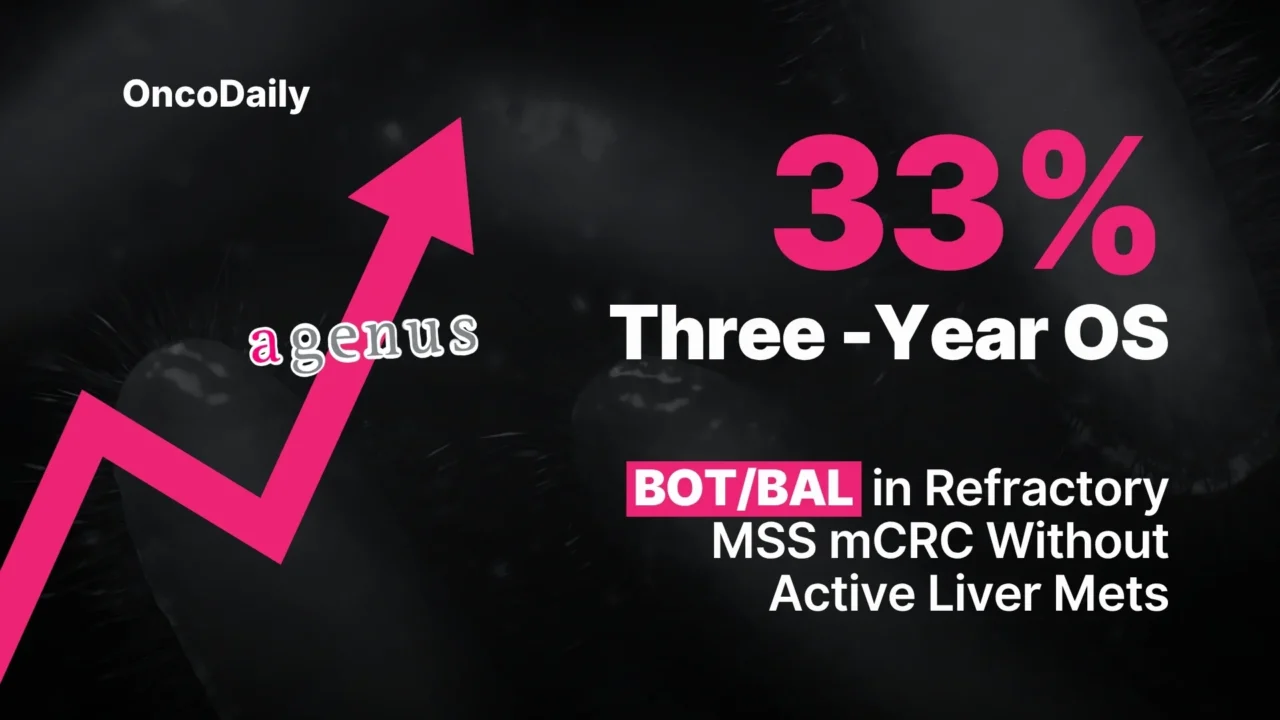
On July 6, Agenus announced three-year landmark Phase 1b data from the fully enrolled C-800-01 cohort evaluating botensilimab plus balstilimab (BOT/BAL) in patients with refractory microsatellite-stable metastatic colorectal cancer without active liver metastases.
The data were presented at the ESMO Gastrointestinal Cancers Congress 2026 on July 2 in Munich, Germany, by Benjamin L. Schlechter from Dana-Farber Cancer Institute.
The presentation, titled “Botensilimab + Balstilimab in Microsatellite-Stable Metastatic Colorectal Cancer Without Active Liver Metastases: Extended Follow-Up and 3-Year Survival,” was listed as poster 91P.
Steven O’Day, M.D., Chief Medical Officer of Agenus, said:
“BOT+BAL is not simply another checkpoint combination; it was designed to activate antitumor immunity in tumors that have been difficult to reach with conventional immunotherapy. With longer follow-up, we are seeing the elements that matter for a potentially differentiated immunotherapy regimen: durable survival, sustained responses, treatment-free intervals, and a manageable safety profile. These findings strengthen the foundation for BATTMAN and our broader development strategy in MSS colorectal cancer.”
Background
Patients with refractory MSS metastatic colorectal cancer have limited treatment options after progression on standard therapies. Conventional immune checkpoint inhibitors have generally shown limited benefit in this setting, especially in heavily pretreated disease.
Botensilimab is an Fc-enhanced anti-CTLA-4 antibody designed to stimulate antitumor immunity, while balstilimab is an anti-PD-1 antibody. The combination is being developed to extend immunotherapy benefit to tumors that have historically been difficult to treat with checkpoint blockade.

C-800-01 Study
C-800-01 is a first-in-human Phase 1b trial evaluating botensilimab with or without balstilimab in patients with advanced solid tumors.
The MSS metastatic colorectal cancer cohort included 123 patients without active liver metastases. Patients had received a median of three prior lines of therapy. Overall, 67% had received at least three prior lines, 15% had received prior anti-PD-(L)1 therapy with or without anti-CTLA-4 therapy, and 30% had received at least one later-line regimen such as regorafenib, trifluridine/tipiracil with or without bevacizumab, or fruquintinib.
Patients received botensilimab 1 mg/kg or 2 mg/kg every six weeks plus balstilimab 3 mg/kg every two weeks.
The primary endpoint was safety and tolerability. Secondary endpoints included objective response rate, duration of response, disease control rate, and progression-free survival. Exploratory endpoints included overall survival and clinical benefit rate.
Key Results
With extended follow-up, botensilimab plus balstilimab showed a median overall survival of 21.2 months. The 24-month overall survival rate was 41%, and the 36-month overall survival rate was 33%. The Kaplan-Meier curve showed a plateau beyond two years.
The confirmed objective response rate was 21%, including three complete responses and 23 partial responses. Median duration of response was not reached, with responses ranging from 1.9 months to at least 37.4 months.
Disease control rate at six weeks was 69%, and clinical benefit rate at 24 weeks was 28%. Tumor regression was observed in more than 40% of patients. At last follow-up, 21 patients, or 17%, were alive and off all systemic anticancer therapy, including 13 responders.
In a post hoc subgroup of 37 patients previously treated with at least one later-line regimen, botensilimab plus balstilimab showed a confirmed objective response rate of 22%, median overall survival of 16.2 months, and a three-year overall survival rate of 30%.
Safety
No new safety signals were observed with extended follow-up, and there were no treatment-related deaths. Immune-mediated diarrhea/colitis resolved in 98% of affected patients, with a median time to resolution of 14 days from onset.
Treatment-related immune-mediated diarrhea/colitis was the most common immune-mediated adverse event, occurring in 42% of patients, including grade 3 or higher events in 15%.
The selected Phase 3 regimen of botensilimab 1 mg/kg plus balstilimab showed improved tolerability, with immune-mediated diarrhea/colitis reported in 27% of patients and grade 3 or higher events in 10%.
Expert Highlights
Benjamin L. Schlechter, M.D., of Dana-Farber Cancer Institute and presenting author of the study, said:
“These three-year data are important because they show a pattern of benefit that is not typically expected in refractory MSS colorectal cancer. These are patients who had received multiple prior lines of therapy and had few remaining options. Seeing a subset of patients remain alive and off systemic anticancer therapy after treatment speaks to the clinical relevance of these results and the potential for botensilimab plus balstilimab to change expectations for what immunotherapy may achieve in this setting.”
Takeaway
The three-year results from the C-800-01 cohort suggest that botensilimab plus balstilimab may provide durable survival benefit in a subset of patients with refractory MSS metastatic colorectal cancer without active liver metastases.
The findings support continued evaluation of the regimen in the ongoing randomized Phase 3 BATTMAN trial in refractory MSS/pMMR metastatic colorectal cancer.
The full press release is available on the official Agenus website.