At the ESMO GI Cancers Congress 2026, Benjamin L. Schlechter presented extended follow-up results of botensilimab plus balstilimab in patients with microsatellite-stable metastatic colorectal cancer without active liver metastases.
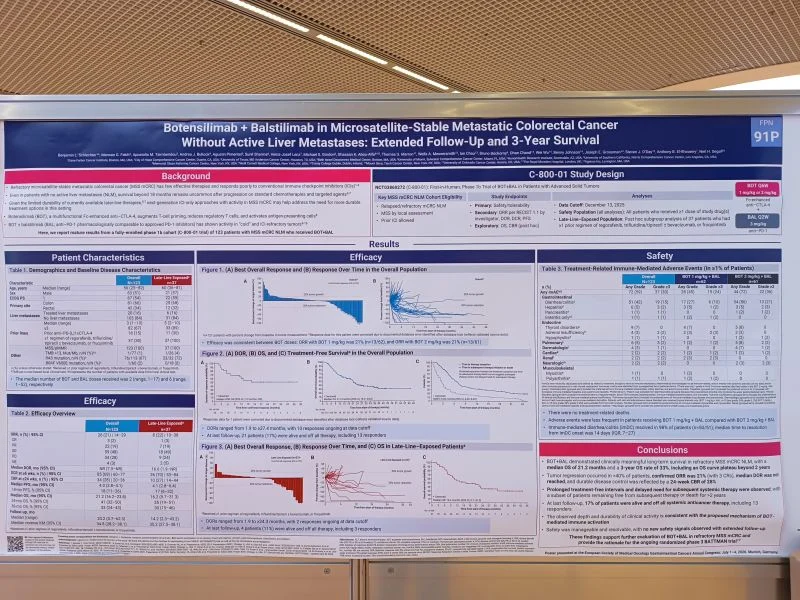
The poster, titled “Botensilimab (BOT) + balstilimab (BAL) in microsatellite-stable metastatic colorectal cancer without active liver metastases (MSS mCRC NLM): Extended follow-up and 3-year survival,” was presented as abstract 91P during the Poster Display Session on July 2, 2026.
Background
Treatment options remain limited for patients with microsatellite-stable metastatic colorectal cancer. Responses to immune checkpoint inhibitors are generally poor in this setting, and durable survival beyond 18 months is uncommon in heavily pretreated disease. This analysis reported mature results from a fully enrolled phase 1b cohort of patients with MSS metastatic colorectal cancer without active liver metastases.
Understanding BOT/BAL
Botensilimab is an Fc-enhanced anti-CTLA-4 antibody designed to stimulate anti-tumor immune responses. According to Agenus, botensilimab helps activate cancer-fighting T cells, remove suppressive immune cells that block response, and strengthen long-term immune memory.
These effects are intended to improve immune recognition in tumors that are typically less responsive to standard immunotherapy approaches. Balstilimab is an anti-PD-1 antibody. Agenus describes balstilimab as helping keep activated immune cells engaged and preventing them from shutting down too soon.
Together, botensilimab and balstilimab are designed to generate a coordinated immune response, with the goal of improving activity in tumors that have historically shown limited sensitivity to immunotherapy.
You can read about BOT/BAL at ESMO GI 2025 on OncoDaily.
Methods
This was a fully enrolled phase 1b cohort from C-800-01, evaluating botensilimab plus balstilimab in patients with MSS metastatic colorectal cancer without active liver metastases. The clinical trial identification number is NCT03860272.
In this cohort, 123 patients received botensilimab plus balstilimab. Patients received botensilimab 1 or 2 mg/kg every 6 weeks plus balstilimab 3 mg/kg every 2 weeks for up to 2 years, or until disease progression or unacceptable toxicity.
The primary objective was safety and tolerability. Efficacy endpoints included objective response rate, duration of response, and progression-free survival by RECIST v1.1. Overall survival was exploratory.
A post hoc analysis evaluated patients who had received at least one prior regimen of regorafenib, fruquintinib, or trifluridine/tipiracil with or without bevacizumab.
Key Findings
As of December 13, 2025, 123 patients had received botensilimab plus balstilimab. Median follow-up was 16.4 months, with a range of 0.7 to 62.3 months. Median follow-up by reverse Kaplan-Meier was 34.8 months, with a 95% confidence interval of 28.2 to 37.8 months.
The median number of prior treatment lines was 3, with a range of 1 to 10. Overall, 67% of patients had received at least 3 prior lines, and 15% had received prior anti-PD-(L)1 therapy with or without anti-CTLA-4 therapy.
The most common treatment-related adverse events were diarrhea and fatigue. Diarrhea occurred in 39% of patients, including grade 3 or higher events in 8%. Fatigue occurred in 37% of patients, including grade 3 or higher events in 2%. The confirmed objective response rate was 21%, with a 95% confidence interval of 14% to 29%. This included 2 additional responders since the prior report.
Median duration of response was not reached, with a 95% confidence interval of 7.3 months to not reached. Median progression-free survival was 4.0 months, with a 95% confidence interval of 2.8 to 4.1 months. The 18-month progression-free survival rate was 18%, with a 95% confidence interval of 11% to 26%.
Median overall survival was 21.2 months, with a 95% confidence interval of 16.2 to 23.8 months. The 36-month overall survival rate was 33%, with a 95% confidence interval of 24% to 43%.
Efficacy was consistent in patients exposed to late-line therapy. In this subgroup, which included 37 patients, or 30% of the cohort, the objective response rate was 22%, with a 95% confidence interval of 10% to 38%. Median overall survival was 16.2 months, with a 95% confidence interval of 9.7 to 31.3 months. The 36-month overall survival rate was 30%, with a 95% confidence interval of 15% to 46%.
You can also read about Phase 3 BATTMAN Trial Launches BOT/BAL in MSS or pMMR Metastatic Colorectal Cancer on OncoDaily.
Conclusions
Extended follow-up of this phase 1b cohort showed continued evidence of durable activity with botensilimab plus balstilimab in previously treated MSS metastatic colorectal cancer without active liver metastases.
At 3 years, 33% of patients were alive, and the safety profile remained manageable. Similar activity was reported in the subgroup of patients previously exposed to late-line treatment. The findings suggest a survival plateau in this population and support further randomized evaluation of botensilimab plus balstilimab.
The study was funded by Agenus Inc.
Expert Highlight
Santiago Fontes, medical oncologist specializing in gastrointestinal malignancies and immuno-oncology, shared on LinkedIn:
“BOT-BAL in MSS mCRC; Extended follow up
Promising advances in the treatment of microsatellite-stable metastatic colorectal cancer (MSS mCRC) at this year’s meeting.
A Phase 1 study evaluating the combination of botensilimab + balstilimab in patients without active liver metastases demonstrated encouraging long-term outcomes, including:
- 21% overall response rate
- Median overall survival of 21.2 months
Durable responses lasting beyond two years in several patients
A manageable safety profile with no new safety signals during extended follow-up
These findings highlight the potential of dual immune checkpoint inhibition to improve outcomes in a patient population that has traditionally had limited response to immunotherapy and few effective therapies.
It will be exciting to see how these results are further validated in ongoing Phase 3 studies.”
More details are available in the official ESMO Gastrointestinal Cancers Congress 2026 programme.