Aspirin has been investigated as an accessible and affordable adjuvant treatment for colorectal cancer. Previous observational studies suggested a possible benefit among patients with PIK3CA-mutated tumours, although results from randomised trials have not been entirely consistent.
Findings from the ASCOLT Translational Research study showed that adjuvant aspirin did not significantly improve disease-free survival among patients with PIK3CA-mutated or cyclooxygenase-2-overexpressing colorectal cancer within the ASCOLT population.
However, a meta-analysis combining ASCOLT with two other randomised trials showed improved disease-free survival among patients whose tumours carried PIK3CA exon 9 or 20 mutations.
The article, titled “Adjuvant aspirin for colorectal cancer with PIK3CA-mutated and COX-2 overexpressed tumours: the ASCOLT translational research study and meta-analysis,” was published in eBioMedicine, Volume 130, August 2026, article 106389.
Authors: Eva Segelov, Shan Li, Isabel Li, Dmitri Mouradov, Sonia Yip, Daphne Day, Mark Jeffery, Rob Zielinski, Louise Nott, Yuntian Sun, Michael Christie, Gwo Fuang Ho, Tsu-Yi Chao, Nabilah Rahman, Estelle Foo, John Chia, Val Gebski, Han Chong Toh, Oliver M. Sieber, and John Simes.
Background
ASCOLT was an international, multicentre, randomised, double-blind, placebo-controlled trial evaluating aspirin after standard adjuvant treatment for colorectal cancer.
The main trial included 1,587 patients with Dukes’ C colon cancer, high-risk Dukes’ B colon cancer, or Dukes’ B or C rectal cancer. Participants had completed at least three months of standard adjuvant chemotherapy and were randomly assigned to receive aspirin 200 mg once daily or placebo for three years.
The primary ASCOLT analysis previously showed that aspirin did not significantly improve disease-free survival in the overall, molecularly unselected study population.
The translational research substudy was planned to determine whether patients with specific tumour biomarkers might derive greater benefit from aspirin. The prespecified biomarkers of interest were somatic PIK3CA mutations and PTGS2/COX-2 overexpression. An exploratory analysis also included PTEN mutations and broader alterations affecting the PI3K pathway.
NCCN 2026 Guideline Recommendation on Aspirin
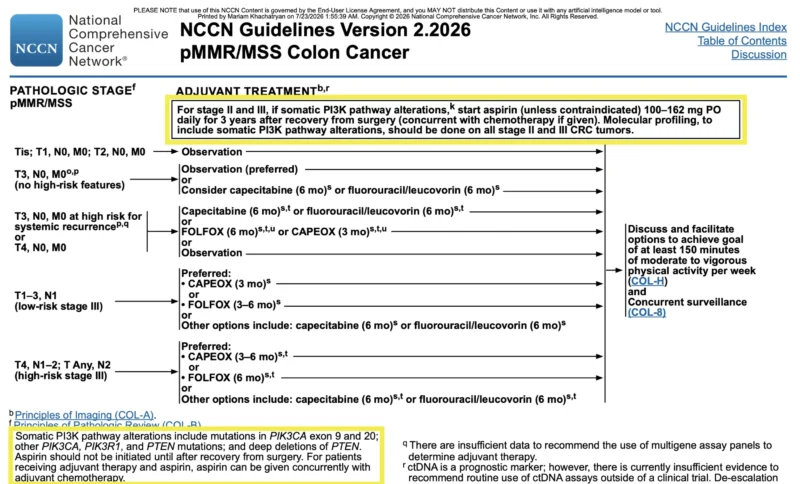
In line with the NCCN Guidelines Version 2.2026, molecular profiling, including assessment for somatic PI3K-pathway alterations, should be performed on tumour tissue from all patients with stage II or III colon cancer.
For patients with stage II or III colon cancer and a somatic PI3K-pathway alteration, aspirin 100–162 mg orally once daily for three years should be initiated unless contraindicated. Aspirin should be started after recovery from surgery and may be administered concurrently with adjuvant chemotherapy.
Somatic PI3K-pathway alterations include PIK3CA exon 9 or 20 mutations, other PIK3CA mutations, PIK3R1 or PTEN mutations, and deep deletions of PTEN. The recommendation applies to patients with stage II or III colon cancer whose tumours harbour a somatic PI3K-pathway alteration.
Study Design
Among 778 participants who commenced the assigned study medication, tumour tissue was accessible from 517 patients. Following histological review, 465 tumours contained sufficient tissue for molecular marker assessment.
Targeted next-generation sequencing was used to evaluate PIK3CA and PTEN mutations in 289 tumours. For samples that did not pass sequencing quality control, Sanger sequencing was used to assess PIK3CA exon 9 and 20 mutations in a further 108 tumours.
PTGS2/COX-2 expression was evaluated by immunohistochemistry.
The primary endpoint was disease-free survival, defined as the time from randomisation to documented colorectal cancer recurrence, development of a new primary colorectal cancer, or death from any cause.
The study was registered as NCT00565708 and ACTRN12614000513617.
Previous Findings on Adjuvant Aspirin in Colorectal Cancer
Previous randomised trials reported different findings in unselected and molecularly selected populations. Aspirin did not significantly improve disease-free survival in the unselected populations evaluated in ASCOLT and EPISODE-III, whereas ALASCCA reported reduced recurrence among patients with PI3K-pathway alterations.
ALASCCA: Benefit in PI3K-Altered Colorectal Cancer
The randomised, double-blind, placebo-controlled ALASCCA trial evaluated aspirin 160 mg once daily for three years versus placebo in patients with resected colorectal cancer harbouring alterations in PIK3CA, PIK3R1, or PTEN.
Among patients with PIK3CA exon 9 or 20 hotspot mutations, the three-year cumulative incidence of recurrence was 7.7% with aspirin and 14.1% with placebo, corresponding to a hazard ratio of 0.49. In patients with other PI3K-pathway alterations, recurrence was 7.7% versus 16.8%, with a hazard ratio of 0.42.
Three-year disease-free survival also favoured aspirin in both molecular groups, although severe adverse events occurred more frequently with aspirin than with placebo. These findings, published in the New England Journal of Medicine in September 2025, showed lower recurrence with aspirin in both molecularly defined groups.
EPISODE-III: No Significant Benefit in an Unselected Population
At the 2026 ASCO Annual Meeting, Atsuo Takashima, MD, PhD, presented Abstract LBA3508, the primary analysis of EPISODE-III: JCOG1503C, a phase 3 trial evaluating low-dose aspirin in an unselected population of patients with resected stage III colorectal cancer.
The trial enrolled 882 patients who were randomly assigned to receive aspirin 100 mg once daily or placebo for three years alongside standard adjuvant chemotherapy.
At a median follow-up of 4.0 years, three-year disease-free survival was 78.8% with aspirin and 75.4% with placebo. Although this represented a numerical difference of 3.4 percentage points in favour of aspirin, the primary endpoint was not met, with a hazard ratio of 0.84, a 95% confidence interval of 0.65–1.09, and a one-sided p-value of 0.0987.
Three-year relapse-free survival was 79.5% with aspirin and 77.2% with placebo, while three-year overall survival was 95.2% and 96.6%, respectively. Aspirin was generally well tolerated.
The results showed that adding low-dose aspirin to standard adjuvant chemotherapy did not significantly improve disease-free survival in an unselected stage III colorectal cancer population. Exploratory analyses of PI3K and PIK3CA biomarkers are ongoing.
Findings According to PIK3CA Status
PIK3CA status was assessable in 397 patients. During five years of follow-up, 80 colorectal cancer recurrences, 40 deaths, and 86 disease-free survival events were reported in this population.
Among all patients with available PIK3CA results, the five-year disease-free survival rate was 77% with placebo and 78% with aspirin. The hazard ratio for aspirin versus placebo was 0.97, with a 95% confidence interval of 0.64–1.49.
A PIK3CA mutation in any exon was identified in 69 patients, representing 17% of the assessable population. Eight disease-free survival events occurred in each treatment group. Aspirin was not associated with a significant improvement in disease-free survival, with a hazard ratio of 0.93 and a 95% confidence interval of 0.35–2.47.
The analysis restricted to PIK3CA exon 9 or 20 mutations included 45 patients. Seven disease-free survival events occurred in the placebo group and four in the aspirin group. Although the numerical result favoured aspirin, the difference was not statistically significant, with a hazard ratio of 0.72 and a 95% confidence interval of 0.21–2.46.
An expanded exploratory subgroup included 84 patients with either a PIK3CA or PTEN mutation. Eight disease-free survival events occurred in the placebo group and nine in the aspirin group, corresponding to a hazard ratio of 1.23 and a 95% confidence interval of 0.47–3.19.
Analyses limited to mutations classified as known or likely oncogenic did not materially change the conclusions.
Findings According to COX-2 Expression
PTGS2/COX-2 overexpression was identified in 307 tumours, representing 69% of those assessable for this biomarker. Among patients with COX-2-overexpressing tumours, 28 disease-free survival events occurred in the placebo group and 34 in the aspirin group. No significant disease-free survival benefit was observed with aspirin, with a hazard ratio of 0.99 and a 95% confidence interval of 0.60–1.63.
Further analyses according to the intensity of COX-2 staining also did not identify a subgroup with a significant treatment benefit.
The previous observational evidence suggesting that COX-2 overexpression could predict benefit from aspirin was therefore not confirmed in the ASCOLT translational analysis.
Meta-analysis of Randomised Trials
The investigators also conducted a systematic review and meta-analysis of completed randomised trials comparing adjuvant aspirin with placebo in patients with colorectal cancer whose tumours had PIK3CA or other PI3K-related mutations.
The analysis included ASCOLT, SAKK 41/13, and ALASCCA.
For patients with PIK3CA exon 9 or 20 mutations, the combined analysis included 471 patients and 79 disease-free survival events. Across the three trials, aspirin was associated with an estimated 39% reduction in disease-free survival events, with a hazard ratio of 0.61 and a 95% confidence interval of 0.39–0.96.
The pooled analysis therefore supported a disease-free survival benefit from aspirin in patients with somatic PIK3CA exon 9 or 20 mutations, despite the absence of a statistically significant result within ASCOLT alone.
When all patients with any assessed PI3K-related mutation were considered, including alterations in PIK3CA, PIK3R1, and PTEN, aspirin was associated with a significant reduction in disease-free survival events, with a hazard ratio of 0.62 and a 95% confidence interval of 0.44–0.87.
However, the findings were less certain for mutations outside PIK3CA exons 9 and 20. Among patients with other PI3K-related mutations, the pooled hazard ratio was 0.59, with a 95% confidence interval of 0.34–1.00. Evidence of heterogeneity between the contributing trials suggested that the treatment effect was not consistent across studies.
These results supported a clear reduction in disease-free survival events among patients with somatic PIK3CA exon 9 or 20 mutations, while findings for other PI3K-related mutations were less clear.
Differences Between the Trials
Several differences may help explain why ASCOLT did not independently reproduce the benefit identified in the pooled analysis.
In ASCOLT, patients generally began aspirin after completing adjuvant chemotherapy, whereas aspirin was initiated closer to surgery in the other trials. Aspirin doses also differed between studies.
Additional differences included the inclusion of rectal cancer, definitions of relevant PI3K-pathway alterations, duration of follow-up, primary endpoints, geographical populations, and the periods during which patients were recruited.
ASCOLT also began approximately a decade before SAKK 41/13 and ALASCCA, during a period when staging techniques and the use of oxaliplatin-containing adjuvant chemotherapy were continuing to evolve.
Study Limitations
The ASCOLT Translational Research study was not powered to provide definitive treatment estimates within individual molecular subgroups.
Only around 30% of the main ASCOLT population participated in the translational substudy, and relatively few disease-free survival events occurred in each biomarker-defined group. Consequently, the estimated treatment effects were accompanied by wide confidence intervals that did not exclude a clinically meaningful benefit.
PIK3R1 mutations were not assessed in ASCOLT, limiting the study’s contribution to analyses of broader PI3K-pathway alterations. Differences in the classification of PI3K-related mutations between trials also complicated the pooled analyses.
In addition, disease-free survival included deaths unrelated to colorectal cancer, which may have diluted a treatment effect specifically related to recurrence. However, analyses of time to recurrence produced broadly similar conclusions.
Interpretation of the COX-2 findings was also complicated by methodological differences in the antibodies used to assess COX-2 expression across previous studies.
Takeaway
The ASCOLT translational analysis did not show a statistically significant disease-free survival benefit from adjuvant aspirin in patients with PIK3CA-mutated tumours, in the expanded subgroup with PIK3CA or PTEN mutations, or in patients with COX-2-overexpressing tumours.
However, the combined results of ASCOLT, SAKK 41/13, and ALASCCA showed improved disease-free survival among patients with somatic PIK3CA exon 9 or 20 mutations.
The findings support PIK3CA exon 9 or 20 mutations as a potential biomarker for selecting patients who may benefit from adjuvant aspirin. Evidence remains less certain for other PI3K-pathway alterations, and further results from ongoing randomised trials and the prospective meta-analysis of randomised trials will be needed to define the broader role of aspirin in adjuvant colorectal cancer treatment.