European Cancer Summit 2026 used this plenary to ask a direct question: five years after Europe’s Beating Cancer Plan and the EU Cancer Mission were launched, is cancer policy paying off? The session also launched the European Cancer Organisation’s (ECO) new study, Investing for High Returns: The Case for Sustained Commitment to Cancer Control.
Opening the session, co-chair Isabel argued that the debate is often framed the wrong way, with cancer care treated as a cost to contain rather than an investment to make. Well-chosen interventions across the cancer pathway “pay back twice.” The first return is human: fewer cases, fewer deaths and better quality of life. The second is economic: people return to work and families, and long-term healthcare costs fall. With the next EU budget under negotiation and health competing with defence and energy, she said, cancer must stay high on the agenda.
Co-chair Gilliosa Spurrier-Bernard, Co-Chair of ECO’s Patient Advisory Committee, added the patient and carer perspective. Drawing on her husband’s diagnosis at 42, she challenged the “cost-only narrative.” Patients and advocates contribute their time, tissue and expertise to research, to care pathways and to their communities, she said, often as volunteers, and that is value to the system.
The Political Reality
Vlad Voiculescu MEP, rapporteur for the European Parliament’s report on Europe’s Beating Cancer Plan, described how the report nearly failed. Days before the vote, about 20 amendments targeted prevention, most of them tobacco control. A cross-party “moral coalition” defeated them, against what he called a well-funded tobacco lobby.
He outlined three realities:
- Europe is ageing.
- Treatments are getting better but also more expensive.
- Social systems funded by taxes on work are already under strain, and AI and automation will add to the pressure.
Of the €4 billion promised under the Plan, €2.7 billion has been committed, and €2.1 billion of that went to research. Europe often pays for the science, he noted, and then pays again for products developed elsewhere. His message to the cancer community was blunt: “We need to organise.”
The Hidden Half of the Cost
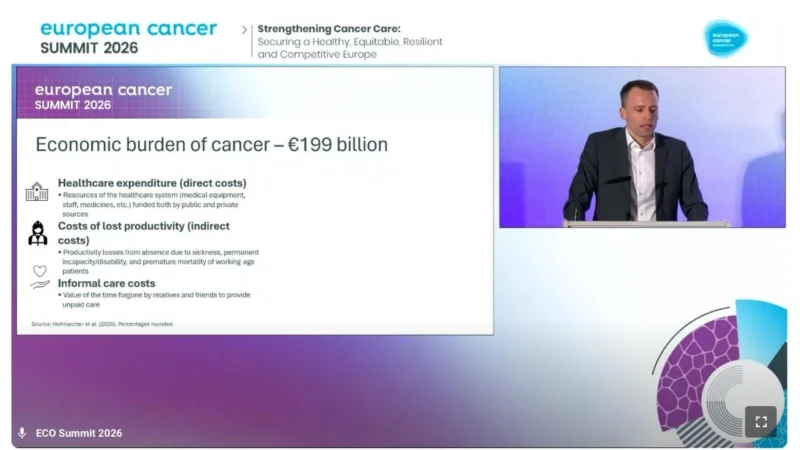
Thomas Hofmarcher, Research Director at the Swedish Institute for Health Economics, presented his estimate that cancer costs Europe €199 billion a year:
- healthcare spending: 51%
- lost productivity: 35%
- informal care: 14%
He compared it to an iceberg. Payers see the healthcare costs, but the other half, which falls on employers, families and patients, rarely makes it into decision-making. He proposed a mandatory minimum dataset in cancer trials that would capture ability to work, hours of informal care and out-of-pocket spending.
His example was a newly approved medicine for previously treated metastatic pancreatic cancer. It improved median overall survival from 6.7 to 13.2 months, but adverse events stayed almost universal in both arms. Without data on work and care needs, he said, the full value to patients and to society stays invisible.
Waste and Variation in Cancer Care
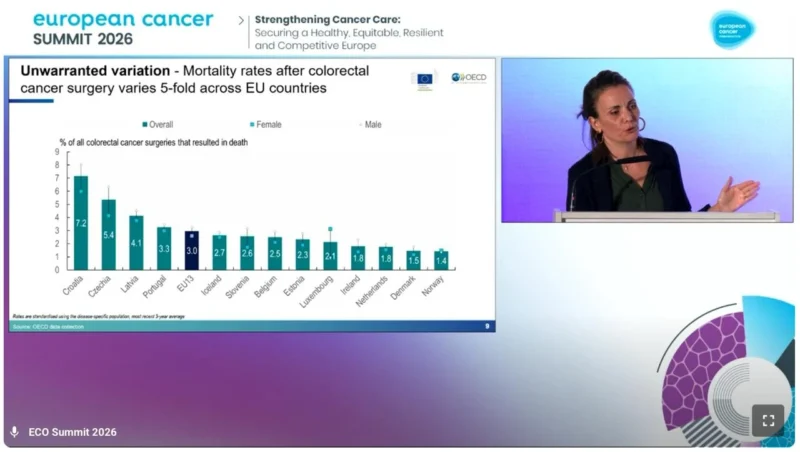
Caroline Berchet, health economist at the OECD, presented data from the European Cancer Inequalities Registry. Direct cancer costs already make up about 7% of EU health spending, and per-capita cancer spending is projected to rise by about 60% by 2050. She identified several gaps in delivering high-value care:
- Late diagnosis. Although most EU countries run breast screening programmes, 44% of breast cancers in women of screening age are diagnosed at a later stage.
- Variation in surgery. Mortality after colorectal cancer surgery varies fivefold between countries, from 7.2% in Croatia to 1.4% in Norway.
- Guideline monitoring. Only 12 EU countries monitor compliance with clinical guidelines.
- Person-centred care. Only a third of patients report highly people-centred care. Half have no care plan, and 42% do not feel confident managing their health.
She recommended fast-track diagnostic pathways, using biosimilars, moving care out of hospitals where possible, better benchmarking and routine collection of patient-reported outcomes.
A Use Case: Risk-Adapted Prostate Cancer Screening
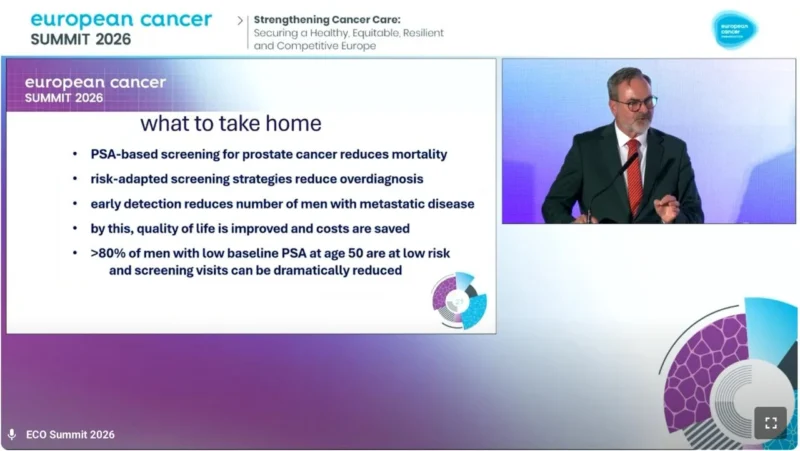
Peter Albers, Professor and Chair of Urology at Heinrich Heine University Düsseldorf, made the clinician’s case. Globally, a man dies of prostate cancer every 75 seconds, yet only 0.3% of the Beating Cancer Plan’s funding goes to prostate cancer.
In his German trial of 50,000 men, digital rectal examination proved ineffective, finding only three cancers among about 7,000 men examined. Starting PSA testing early and adding MRI cuts biopsies by around half and is cost-effective. By contrast, opportunistic testing in older men drives overdiagnosis, while about one in five men in industrialised countries already has metastatic disease when first diagnosed. Treating metastatic disease can cost around €150,000 a year per patient.
His take-home message was that more than 80% of men with a low PSA at age 50 are at low risk, so their screening visits could be greatly reduced.
The Study: Evidence of Returns Across the Pathway
Norbert from the ECO team presented the new study. It reviews evidence across nine areas: the five stages of the cancer pathway and four cross-cutting actions. Its case studies include:
Lithuania. Raising alcohol excise taxes produced a net economic benefit of €136 million.
England. Liquid biopsy (ctDNA testing) for suspected advanced lung cancer delivered results two weeks faster and saved around £9 million. The NHS now offers it routinely.
Germany. Treating all patients in certified cancer centres could prevent more than 4,000 deaths a year and cost less, yet over 40% of patients are still first treated in non-certified hospitals.
The Netherlands. Scaling up return-to-work support was modelled to yield €92 million in productivity gains.
Cross-cutting actions. UK cancer research funding returns about 40% a year. France’s sarcoma reference network is linked to a 24% lower risk of death at one year. Specialist nurse support in England produces benefits that outweigh its costs. And 32% of cancer deaths in European men could be avoided if everyone had the mortality rates of the most educated.
The key message was that cancer control generates measurable human and economic returns, but only with sustained, predictable funding.
Discussion
In the Q&A, participants pointed out that the evidence often fails to change policy because the budgets that pay for care and the budgets that benefit from it sit in different ministries. Baroness Ilora Finlay of the UK House of Lords urged routine collection of family-reported outcomes. Voiculescu closed with a call for the cancer community to organise and make its voice heard as effectively as industry lobbies do.
Read more about the European Cancer Summit 2026 here: From Stigma to Action: HPV and Hepatitis B-Related Cancers and Reimagining Europe’s Cancer Prevention Pathway.