European Cancer Summit 2026 brought together healthcare professionals, patient advocates and policymakers in Brussels, and one plenary session focused on cancers caused by HPV and hepatitis B, which are among the most preventable cancers in oncology. Effective vaccines, reliable screening and proven interventions already exist. Yet Europe is still not on track to eliminate these cancers. Throughout the session, speakers kept returning to one shared barrier that is often overlooked: stigma.
The session was co-chaired by Professor Daniel Kelly and Patrizia Carrieri, Co-Chairs of the European Cancer Organisation’s (ECO) HPV and Hep B Action Network. They described it as “two conditions, but one issue.” Stigma shapes more than patients’ lives. It also limits access to vaccination and screening, and it can influence policy choices, budgets and where governments decide to put their resources.

HPV: The Science Is Settled, the Commitment Is Not
Professor Kelly opened the session the day after World Cervical Cancer Elimination Day. He pointed out that in Scotland, none of the girls vaccinated against HPV in 2008 have since developed cervical cancer. “It’s not a question of science anymore,” he said. “It’s a question of commitment and policy.”
HPV causes more than cervical cancer. It is also linked to anal, anogenital and head and neck cancers. Kelly said the tools to prevent these cancers are in place: vaccines, safe and effective HPV DNA testing, Europe’s Beating Cancer Plan and European benchmarks that show which countries are succeeding. However, the gap between the 80% vaccination target and actual uptake is still large. In some countries uptake remains in single figures, which Kelly called “unacceptable” for the European community.
Countries that once reached 60–70% uptake are now seeing it fall, as complacency and negative messaging on social media take hold. ECO’s work over the past two years in Romania, Croatia and Bulgaria found stigma to be a central barrier, both among parents and among young people themselves. The Network has turned these findings into a good practice guide and a practical blueprint, launched this year.
Kelly said the next step is for governments to adopt it. He described stigma, a word that comes from the Greek for a mark or brand, as “an invisible force” that holds back uptake and investment. “It’s time to name it, talk about it, and reclaim the ground.”
A Patient’s Voice: “Not What Did You Do, but What Do You Need?”
The most powerful moment of the session came from Anne de Middelaer, Co-Chair of the European Network of Gynaecological Cancer Advocacy Groups (ENGAGe). She was diagnosed with advanced cervical cancer in 2018, while she was a single mother of two working full time. She was also diagnosed with a second primary cancer, and her cervical cancer later recurred in her lung.
She said she was not there to talk about her treatment but about the questions people asked her: How many sexual partners did you have? Why didn’t you get a Pap smear? After the lung metastasis, she was asked, You must be a heavy smoker? “It is a question that turns a patient into a suspect,” she said. A short video then played the remarks other women had heard, and she called them what they are: victim blaming. That shame leads women to stay silent, delay seeing a doctor and hide their illness at work and at home.
She pointed out that even the anatomical words are taboo, and she asked the audience to say cervix, ovary, uterus, vulva, vagina out loud. She also highlighted the ESGO–ENGAGe World Gynaecologic Oncology Day campaign, “Show Support, Not Stigma,” which brought together partners and events around the world.
She called on stakeholders to:
- name and measure stigma in cancer plans
- describe HPV as a common virus rather than a sign of guilt
- stop using risk factors as a tool for blame
- put patients’ lived experience at the centre of decision-making
She closed: “I lost part of my lung, but I did not lose my voice.”
The Data Behind Vaccine Confidence
Ben Wells of ORB International presented 15 years of global survey data collected with the Vaccine Confidence Project at the London School of Hygiene & Tropical Medicine. Confidence held steady between 2015 and 2019 but fell sharply after the pandemic:
- perceived importance of vaccines dropped from 90% to 76%
- perceived safety dropped from 83% to 73%
- perceived effectiveness dropped from 87% to 76%
On HPV specifically, a 2025 survey of caregivers in 25 countries found that 61% reported their eligible child had been vaccinated. Among those whose child had not been vaccinated, 84% said they wanted the vaccine. “There’s a delivery problem as much as an attitude problem,” Wells said. Trust in institutions also mattered a great deal. Of vaccine-confident caregivers, 91% trusted the health worker giving the vaccine, compared with 54% of hesitant caregivers.
His recommendations were to:
- identify the specific bottleneck before designing an intervention, for example by using school-based delivery, default offers and reminders where intent is already high
- treat institutional trust as part of vaccine policy infrastructure
- combine data sources into early-warning dashboards
- Hepatitis B: No Elimination Without Trust
Patrizia Carrieri (Marseille) warned that, with four years left until 2030, Europe is on course to miss its hepatitis B elimination targets. About 3.2 million people in the EU/EEA live with hepatitis B, and the number is far higher across the wider WHO European Region. Prevention has worked well: infections in children under five are close to zero, all EU/EEA countries offer antenatal screening, and mother-to-child transmission is below 2%. The problem lies with adults. Many remain undiagnosed, and a large share are diagnosed only once they already have cirrhosis or liver cancer.
Carrieri explained that stigma affects every stage of the cascade of care, from testing through to treatment and monitoring. It is especially heavy for groups who already face stigma, such as people who use drugs, men who have sex with men and undocumented migrants. She described three forms of stigma: enacted, anticipated and internalised. Of these, internalised stigma is the most damaging, because people come to believe they deserve the discrimination they face. “Stigma turns a virus into a moral judgment,” she said.
A recent survey by ECDC and the World Hepatitis Alliance showed that people living with hepatitis B commonly avoid or delay care because they expect to be treated differently. No EU country reports on every stage of the care cascade, and some countries restrict access to care for certain groups.
Her recommendations included:
- building stigma measurement into ECDC surveillance on a fixed cycle
- reporting stigma-related barriers in the European Cancer Inequalities Registry
- funding peer-led community services
- training health professionals in non-stigmatising communication
- moving hepatitis B care into primary care
She summed it up: “No elimination without trust.”
The Policy Lens
Nikos Papandreou MEP said Europe’s Beating Cancer Plan dashboard works as a “political pressure point.” Countries are not penalised for poor results, but they are publicly embarrassed by them, as Greece’s HPV vaccination rate of about 60% shows. He called for continued funding of the Plan, adding hepatitis and stigma indicators to the dashboard, and adding a cancer pillar to the European Semester so that the cost of not investing in prevention is counted in fiscal planning. “Prevention doesn’t bring votes to the Minister of Finance,” he said.
He welcomed Carrieri’s proposal to produce cost-effectiveness data on how reducing stigma lowers liver cancer. He also shared his vision of routine, system-integrated testing that would make screening the default rather than a choice weighed down by stigma.
MASLD: The Next Wave of Liver Cancer
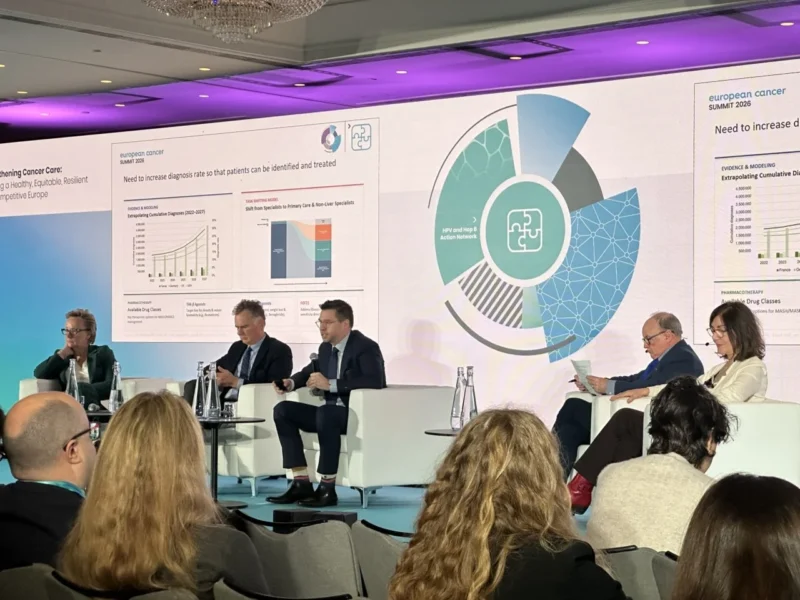
Bruno Golding of Roche Diagnostics extended the discussion to metabolic dysfunction-associated steatotic liver disease (MASLD). It affects about 30% of people worldwide and is a growing cause of hepatocellular carcinoma, while liver cancers of viral origin are declining. MASLD faces similar problems with blame, underdiagnosis and fragmented care. In the EU5 countries fewer than 10% of cases are diagnosed. He highlighted the disease’s new, less stigmatising name, its recent inclusion in the UN non-communicable disease agenda, new therapies such as GLP-1 agonists and FGF21 analogues, and two IHI consortia, GRIP on MASH and LIVERAIM, which are studying biomarker-based early detection in large patient cohorts.
Closing Message
Professor Kelly concluded that cancer prevention’s main challenge is no longer laboratory science but social science, economics and policy. Carrieri added that awareness on its own is not enough: if health professionals are not trained to provide inclusive, non-judgemental care, available services will still go unused.