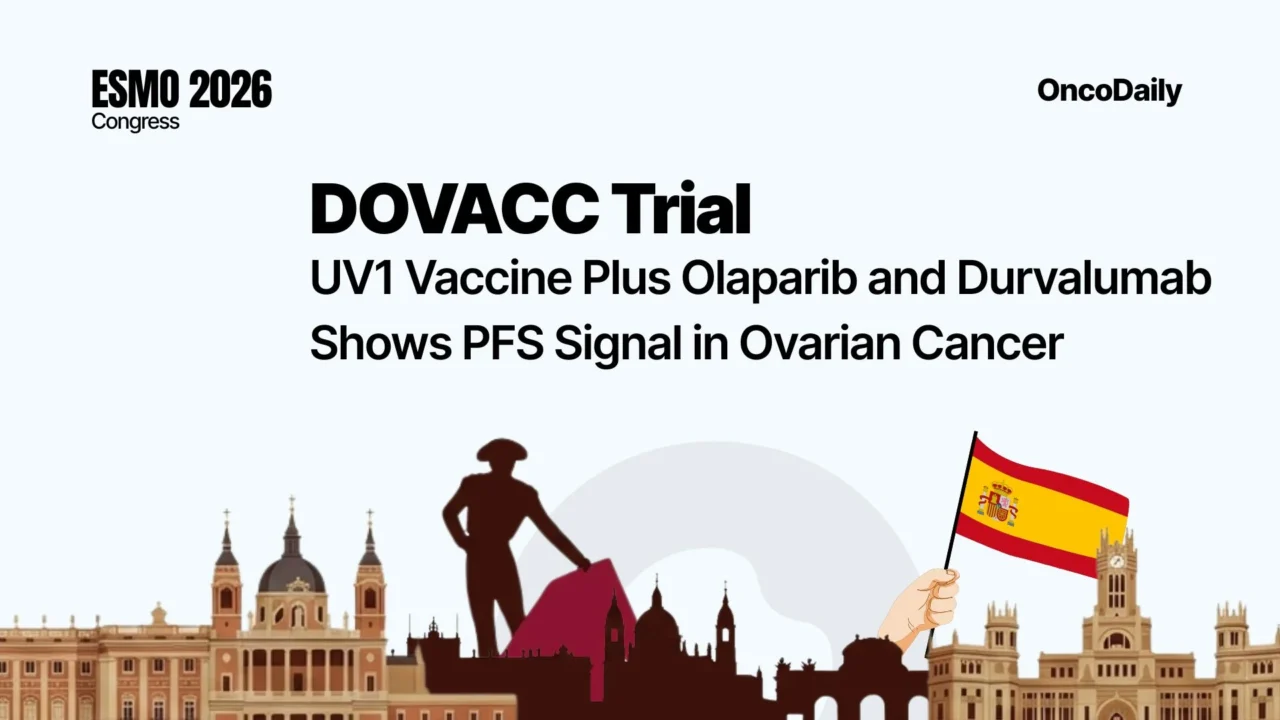
At the ESMO Congress 2026, Trine Jakobi Nøttrup (Copenhagen, Denmark) presented the first results from the randomized phase II ENGOT-OV56/NSGO-CTU-DOVACC trial, evaluating the addition of the UV1 cancer vaccine to olaparib and durvalumab maintenance therapy in patients with BRCA-wildtype recurrent ovarian cancer.
The investigational combination demonstrated a median progression-free survival (PFS) of 8.7 months versus 5.9 months with olaparib alone. However, the study did not meet its primary endpoint of statistically significant PFS improvement.
Methods
DOVACC is an open-label, randomized phase II trial investigating whether UV1, a therapeutic cancer vaccine targeting human telomerase reverse transcriptase (hTERT), can improve the efficacy of olaparib-based maintenance therapy in recurrent ovarian cancer.
The study enrolled 188 patients who had completed 2–3 prior lines of chemotherapy without disease progression following their most recent platinum-based regimen. Previous PARP inhibitor treatment was permitted under specified conditions, while prior immunotherapy was excluded.
Patients were randomized into three treatment arms:
- Arm A (n=46): Olaparib 300 mg twice daily.
- Arm B (n=48): Olaparib plus durvalumab 1,500 mg every four weeks.
- Arm C (n=94): Olaparib plus durvalumab and eight intradermal UV1 vaccinations over five months.
Treatment allocation was stratified by homologous recombination deficiency (HRD) status and prior PARP inhibitor exposure. The primary endpoint was PFS comparing Arm C with Arm A.
Key Takeaways
At the May 22, 2026, data cutoff, the median follow-up was 22.6 months. Overall, 82% of patients were PARP inhibitor-naïve, and 73% had HRD-negative tumors.
- Median progression-free survival: 8.7 months with olaparib, durvalumab, and UV1 versus 5.9 months with olaparib alone (HR 0.83; 95% CI, 0.68–1.01; P=0.066).
- Primary endpoint: The addition of UV1 did not achieve a statistically significant PFS improvement at the prespecified two-sided 0.05 level.
- Comparison with olaparib plus durvalumab: The PFS hazard ratio for Arm C versus Arm B was 0.77 (95% CI, 0.51–1.14).
- HRD-negative subgroup: A favorable PFS signal was observed with triple therapy versus olaparib alone (HR 0.73; 95% CI, 0.58–0.92).
- HRD-positive subgroup: No similar benefit was observed (HR 1.19; 95% CI, 0.74–1.89).
- Prior PARP inhibitor exposure: PFS was significantly better in PARP inhibitor-naïve patients than in previously treated patients across all treatment arms.
- Exploratory analysis: A post hoc restricted mean survival time analysis at 22 months showed a 2.5-month difference favoring triple therapy (95% CI, 0.1–4.9; exploratory P=0.043).
The subgroup and post hoc findings are exploratory and require further validation.
Conclusion
The phase II DOVACC trial did not demonstrate a statistically significant progression-free survival benefit from adding the UV1 cancer vaccine and durvalumab to olaparib maintenance therapy in patients with BRCA-wildtype recurrent ovarian cancer.
Although the 8.7-month median PFS with triple therapy compared with 5.9 months with olaparib alone suggests a potential treatment effect, the primary endpoint was not met.
The exploratory findings in HRD-negative and PARP inhibitor-naïve patients warrant further investigation to determine whether specific patient populations may benefit from this vaccine-based maintenance strategy.
Source: ESMO Congress 2026, Abstract LBA39; ENGOT-OV56/NSGO-CTU-DOVACC trial.