






Cocaine is a powerful stimulant associated with serious cardiovascular, neurological, psychiatric, and infectious complications. But does cocaine also cause cancer? The evidence is much less clear. Current human research does not establish cocaine as a proven direct cause of cancer. However, recent research has suggested a possible association between cocaine inhalation through smoking or snorting and head and neck cancer.
The evidence does not prove that cocaine causes these cancers. Instead, it raises questions about whether repeated exposure, tissue injury, inflammation, combustion products, or substances mixed with illicit cocaine could potentially contribute to cancer risk. For now, the most accurate conclusion is that there may be an association, but causation has not been established.
What Does the Latest Research Say About Cocaine and Cancer?
One of the most important recent investigations came from the International Head and Neck Cancer Epidemiology Consortium (INHANCE). In 2024, Zhang and colleagues published a pooled analysis examining whether cocaine inhalation was associated with head and neck cancer. The researchers combined data from three case-control studies involving 1,639 people with head and neck cancer and 2,506 control participants. The cancers evaluated included malignancies of the oral cavity, oropharynx, hypopharynx, larynx, and other included head and neck sites. Information about cocaine use was collected through interviews.
Investigators then adjusted their analyses for several factors that could independently influence cancer risk, including tobacco use, alcohol consumption, cannabis smoking, age, sex, race or ethnicity, and education.
Was Cocaine Associated With Head and Neck Cancer?
After adjustment for tobacco, alcohol, cannabis, and other factors, participants who had ever used cocaine had an odds ratio of 1.35 for head and neck cancer compared with participants who reported never using cocaine. This means the analysis suggested approximately 35% higher odds of head and neck cancer among people reporting cocaine use. However, the 95% confidence interval was 0.96–1.90. That distinction is important. Because the confidence interval included 1.0, the study could not rule out the possibility that there was no true association.
The authors therefore described the finding as a weak positive association, rather than evidence that cocaine directly causes head and neck cancer. Researchers also examined cumulative exposure. Participants reporting cocaine use on more than 18 lifetime occasions had an adjusted odds ratio of approximately 1.52 compared with never-users. However, the confidence interval of 0.98–2.35 again included the possibility of no association. The results provide a reason for further investigation but do not establish a clear dose-response relationship or prove causation. ( Zhang M, et al. Cancer Medicine. 2024;13(3).)
What About Cocaine Use Together With Tobacco?
The association appeared stronger among people who had also used tobacco. Among tobacco users, participants reporting more than 18 lifetime occasions of cocaine use had an odds ratio of approximately 1.66 for head and neck cancer compared with people who had never used cocaine. The 95% confidence interval was 1.03–2.69. This finding requires careful interpretation.
Tobacco itself is one of the strongest established risk factors for head and neck cancer, and cocaine and tobacco use may frequently occur together. Although the investigators statistically adjusted for tobacco exposure, observational research cannot always eliminate residual confounding. This means some of the apparent association could still be influenced by differences in tobacco exposure or other factors that were not perfectly measured.
What About Cocaine and Alcohol?
A similar pattern was observed among people who consumed alcohol. Among alcohol users, participants reporting more than 18 lifetime occasions of cocaine use had an odds ratio of approximately 1.59 for head and neck cancer compared with never-users. The confidence interval was 1.00–2.51, placing the finding at the threshold of statistical significance.
Again, this is difficult to interpret independently because alcohol is already an established risk factor for several head and neck cancers. People who use cocaine may also use alcohol, tobacco, cannabis, or other substances, making it challenging to isolate the contribution of cocaine itself.
How Could Cocaine Potentially Affect Cancer Risk?
Several biological mechanisms have been proposed to explain why researchers are investigating cocaine in relation to cancer. None currently proves that cocaine causes cancer in humans.
Repeated Tissue Injury
Snorting cocaine repeatedly exposes the nasal cavity and surrounding tissues to direct chemical irritation. Cocaine also produces strong vasoconstriction, meaning it narrows blood vessels and reduces blood flow to exposed tissues. With chronic use, this can contribute to significant injury of the nose and upper airway. Smoking crack cocaine exposes the mouth, throat, and respiratory tract to high temperatures, smoke, and products generated during combustion. Repeated tissue injury could potentially create conditions that favor chronic inflammation and abnormal cellular changes.
Chronic Inflammation
Long-term tissue injury may lead to persistent inflammation. Chronic inflammation is involved in the development of several cancers because it can alter the tissue environment, increase cellular turnover, and contribute to DNA damage over time. However, showing that an exposure causes inflammation does not automatically establish that it causes cancer.
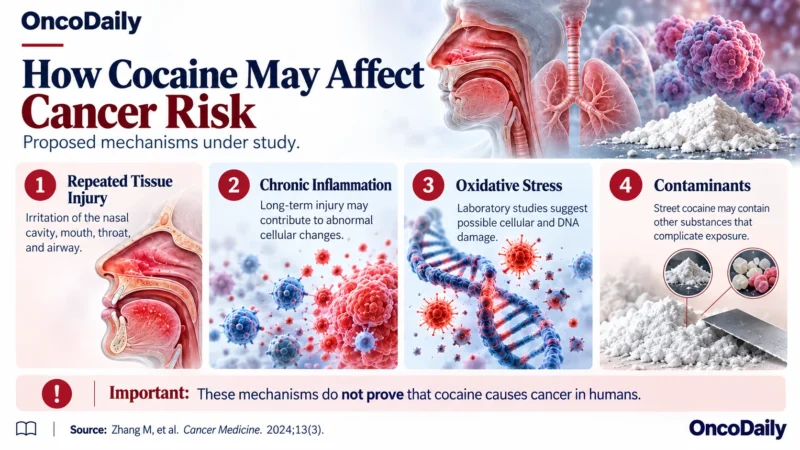
Oxidative Stress and Cellular Damage
Laboratory studies have also investigated whether cocaine or substances generated when crack cocaine is smoked can contribute to oxidative stress, genotoxicity, and cellular injury. These findings provide biological reasons to continue studying the question. However, laboratory findings alone cannot establish that cocaine causes cancer in humans.
Contaminants and Adulterants
Another major complication is that illicit cocaine may contain substances other than cocaine itself. Street cocaine can contain adulterants, contaminants, or other pharmacologically active compounds, and its composition may vary substantially. As a result, researchers may struggle to determine whether an observed health effect is caused by cocaine, another substance, the way the drug was consumed, or a combination of different exposures. Zhang M, et al. Cancer Medicine. 2024;13(3).
Which Cancers Are Being Studied?
The strongest recent human evidence is focused on head and neck cancer. Head and neck cancers can arise in areas including the:
- oral cavity;
- oropharynx;
- hypopharynx;
- larynx;
- nasal cavity and paranasal sinuses;
- salivary glands.
Many head and neck cancers originate in the squamous cells lining the moist surfaces of these structures. The 2024 cocaine study should not be interpreted as evidence that cocaine causes every type of cancer. At present, the research does not establish a causal relationship between cocaine use and cancers such as breast, colorectal, pancreatic, liver, or lung cancer.
What Are the Established Risk Factors for Head and Neck Cancer?
When considering the possible cocaine association, it is important to place it alongside much stronger and well-established cancer risks. Tobacco and alcohol remain two of the major risk factors for several types of head and neck cancer. Using both can increase risk further. Certain infections with human papillomavirus (HPV) are also major causes of oropharyngeal cancer.

Photo: Depositphotos
HPV16 is particularly important in cancers involving areas such as the tonsils and base of the tongue. Other risk factors vary by tumor location and may include occupational exposures, ultraviolet radiation for lip cancer, Epstein-Barr virus for certain nasopharyngeal cancers, and additional environmental or behavioral factors. Because people who use cocaine may also have tobacco, alcohol, cannabis, HPV, or other exposures, separating the individual contribution of cocaine is difficult.
Why Is the Evidence Still Uncertain?
The 2024 analysis is important because relatively little epidemiological research has specifically examined cocaine use and head and neck cancer. However, the study also had several limitations. The number of cocaine-exposed participants was relatively small. Cocaine use was self-reported, meaning exposure could have been underreported or remembered inaccurately. The researchers did not have complete information about cocaine purity, adulterants, precise routes of administration, or every potentially relevant co-exposure. Some important factors, including oral HPV infection, could not be adequately evaluated across the entire dataset. The study was also observational.
Case-control studies can identify associations between an exposure and a disease, but they cannot by themselves establish that the exposure directly caused the disease. Larger studies with more detailed information about dose, duration, route of administration, contaminants, and accompanying substance use will be needed.
Does Cocaine Cause Cancer?
Based on current evidence, the most scientifically accurate answer is: We do not yet know whether cocaine directly causes cancer. Recent human research suggests a possible association between cocaine inhalation and head and neck cancer, with somewhat stronger associations among people who also use tobacco or alcohol. But an association is not the same as causation.
The overall estimate in the 2024 study remained statistically uncertain, the number of cocaine-exposed participants was relatively small, and several important confounding factors are difficult to completely separate. It would therefore be inaccurate to say that cocaine has been definitively proven to cause head and neck cancer. It would also be premature to conclude that there is no possible relationship.
Symptoms That Should Not Be Ignored
Symptoms of head and neck cancer vary according to where the cancer develops. Possible warning signs of head and neck cancer include a mouth or throat sore that does not heal, a lump or swelling in the neck, persistent sore throat, difficulty or pain when swallowing, prolonged hoarseness or other voice changes, persistent nasal blockage, recurrent or unexplained nosebleeds, red or white patches inside the mouth, unexplained mouth pain or bleeding, and unexplained weight loss.
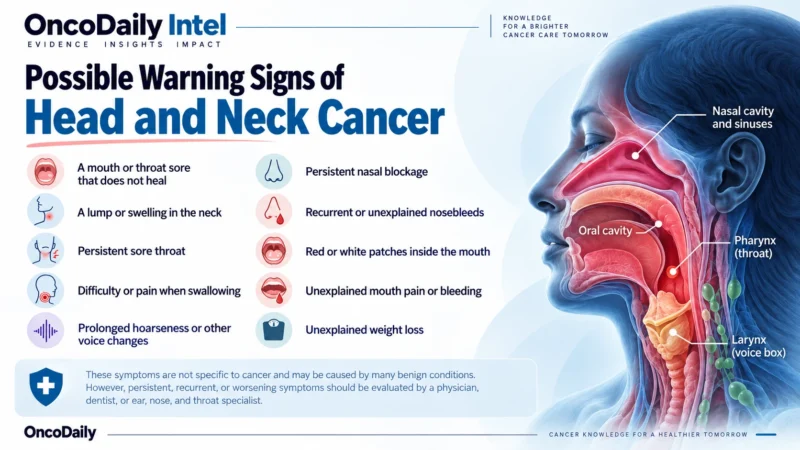
These symptoms are not specific to cancer and may be caused by many benign conditions; however, persistent, recurrent, or worsening symptoms should be evaluated by a physician, dentist, or ear, nose, and throat specialist. However, persistent, recurrent, or worsening symptoms should be evaluated by a physician, dentist, or ear, nose, and throat specialist.
Cocaine Carries Serious Health Risks Even Without Proven Cancer Causation
The uncertainty surrounding cancer risk should not be interpreted as evidence that cocaine is safe. Cancer represents only one possible long-term concern. Cocaine is already associated with serious health complications, including cardiovascular disease, heart attack, arrhythmias, stroke, neurological complications, psychiatric effects, respiratory injury, and risks related to contaminated drug supplies. The cancer question should therefore be viewed as an emerging area of research, rather than the primary established health risk associated with cocaine.
Cocaine has not been conclusively established as a direct cause of human cancer. The strongest recent evidence comes from a 2024 pooled analysis involving 1,639 head and neck cancer cases and 2,506 controls. After adjustment for important confounding factors, investigators found a weak positive association between cocaine inhalation and head and neck cancer, with an odds ratio of 1.35. Because the confidence interval included the possibility of no increased risk and the study was observational, the finding does not prove causation.
Stronger associations were observed among people with higher cumulative cocaine exposure who also used tobacco or alcohol, but these findings remain difficult to separate from established cancer risks. For now, the most accurate conclusion is straightforward: Cocaine may be associated with an increased risk of head and neck cancer, but current human evidence is still too limited to establish that cocaine itself directly causes cancer.
Cocaine Use in Teenagers: Why the Risks Are Different
Cocaine use among teenagers is far less common today than it was several decades ago, but it remains a serious public-health concern. Recent Monitoring the Future data show that past-year cocaine use among U.S. 8th, 10th, and 12th graders remains below 1%, reflecting a substantial decline from the much higher levels seen in the 1980s. Low prevalence, however, does not mean low risk. Cocaine is a powerful and highly addictive stimulant that can sharply increase heart rate and blood pressure and is associated with arrhythmias, heart attack, stroke, seizures, overheating, anxiety, agitation, and overdose. These complications can occur even in young people without known cardiovascular disease.
Adolescence is also a period of continuing brain development, making prevention of substance use particularly important. Repeated stimulant exposure can reinforce patterns of compulsive drug-seeking and increase the risk of developing a substance use disorder. Another major concern today is the unpredictable illicit drug supply. Illegally manufactured fentanyl can be mixed with cocaine without the person using it knowing. Because fentanyl is a potent opioid, exposure can cause life-threatening respiratory depression and overdose. CDC data show that fentanyl is frequently involved in deaths that also involve stimulants, including cocaine.
For teenagers, the immediate risks of cocaine including addiction, cardiovascular complications, impaired judgment, and accidental overdose—are much better established than its possible long-term relationship with cancer. The emerging cancer evidence should therefore be viewed as an additional concern rather than the primary reason cocaine use is dangerous in adolescence.
You Can Also Read Do Energy Drinks Cause Cancer? Myths, Facts, and What Science Really Shows by OncoDaily

Written by Aharon Tsaturyan, MD, Editor at OncoDaily Intelligence Unit
FAQ
Does cocaine cause cancer?
Current human evidence does not prove that cocaine directly causes cancer. A 2024 pooled analysis found a weak positive association between cocaine inhalation and head and neck cancer, but the result was not strong enough to establish causation.
Can snorting cocaine cause cancer?
It has not been proven that snorting cocaine causes cancer. However, repeated intranasal cocaine use can injure nasal tissues, and recent research has raised the possibility of an association between cocaine inhalation and head and neck cancer.
Can smoking crack cocaine cause cancer?
There is currently no definitive evidence that smoking crack directly causes cancer. Smoking crack exposes the mouth, throat, and lungs to heat, smoke, and combustion products, which is one reason researchers are investigating possible long-term cancer risks.
What types of cancer have been linked to cocaine?
The strongest recent human research has focused on head and neck cancers, including cancers of the oral cavity, throat, and larynx. Current evidence does not establish cocaine as a cause of breast, pancreatic, colorectal, liver, or other cancers.
Is cocaine a carcinogen?
Cocaine is not currently established as a confirmed human carcinogen based on available evidence. Research is still limited, and more epidemiological studies are needed before a causal classification could be supported.
Does cocaine cause oral or throat cancer?
Current evidence does not prove that cocaine causes oral or throat cancer. However, a recent study found a possible association between cocaine inhalation and head and neck cancer, particularly among people who also used tobacco or alcohol.
Does cocaine increase cancer risk if you smoke or drink alcohol?
The 2024 study found stronger associations among cocaine users who also used tobacco or alcohol. However, tobacco and alcohol are themselves established causes of several head and neck cancers, so it is difficult to determine how much additional risk—if any—is specifically attributable to cocaine.
What are the symptoms of head and neck cancer?
Possible symptoms include a persistent mouth or throat sore, a neck lump, difficulty swallowing, long-lasting hoarseness, unexplained nosebleeds, persistent nasal blockage, red or white patches in the mouth, mouth bleeding, and unexplained weight loss. Persistent symptoms should be medically evaluated.
Can cocaine damage the nose and throat?
Yes. Long-term snorting can cause nosebleeds, loss of smell, nasal tissue damage, and swallowing problems. Smoking cocaine can also damage the respiratory tract. These effects are established even though the cancer relationship remains uncertain.
What does the latest research say about cocaine and cancer?
A 2024 INHANCE Consortium analysis of 1,639 head and neck cancer cases and 2,506 controls found a weak positive association between cocaine use and head and neck cancer, with an adjusted odds ratio of 1.35. Because the confidence interval included no increased risk and the study was observational, the findings are considered preliminary rather than proof that cocaine causes cancer.