
Datopotamab deruxtecan demonstrated a distinct and generally manageable safety profile while delaying deterioration in several patient-reported outcomes compared with chemotherapy in previously treated hormone receptor–positive, HER2-negative advanced breast cancer.
The final safety and patient-reported outcome analysis from the phase 3 TROPION-Breast01 trial showed that grade 3 or higher treatment-related adverse events occurred in 22.2% of patients receiving datopotamab deruxtecan, compared with 45.6% receiving investigator’s choice of chemotherapy.
The safety advantage was accompanied by longer time to deterioration in global health status and quality of life, pain, and physical functioning. However, datopotamab deruxtecan was associated with characteristic toxicities that require active prevention, monitoring, and management, particularly oral mucositis or stomatitis, ocular surface events, nausea, and interstitial lung disease or pneumonitis.
The findings were published in ESMO Open and provide a more detailed view of treatment tolerability from both the clinician and patient perspectives (Rugo et al., 2026).
What Did TROPION-Breast01 Evaluate?
TROPION-Breast01 was a randomized phase 3 trial involving patients with inoperable or metastatic HR-positive, HER2-negative breast cancer.
Eligible patients had experienced disease progression on endocrine therapy, were no longer considered suitable for further endocrine therapy, and had received one or two previous chemotherapy regimens for inoperable or metastatic disease.
A total of 732 patients were randomly assigned:
- 365 to datopotamab deruxtecan
- 367 to investigator’s choice of chemotherapy
Datopotamab deruxtecan was administered at 6 mg/kg every three weeks. The chemotherapy options were eribulin, capecitabine, vinorelbine, or gemcitabine.
The safety population included 360 patients who received datopotamab deruxtecan and 351 who received chemotherapy.
Earlier findings from TROPION-Breast01 showed a progression-free survival advantage with datopotamab deruxtecan, with a hazard ratio of 0.63. The final overall survival analysis did not demonstrate a statistically significant difference between the treatment groups, with a hazard ratio of 1.01.
The current analysis focused on detailed safety findings and patient-reported outcomes from the final overall survival data cutoff.
Were Severe Treatment-Related Adverse Events Less Frequent?
Treatment-related adverse events of any grade were reported in 94.7% of patients receiving datopotamab deruxtecan and 86.3% receiving chemotherapy.
Despite the higher overall incidence, severe events were substantially less frequent with datopotamab deruxtecan:
Grade 3 or higher treatment-related adverse events:
- Datopotamab deruxtecan: 22.2%
- Chemotherapy: 45.6%
Treatment-related adverse events led to dose interruptions in 15.8% versus 24.2% of patients and dose reductions in 24.2% versus 30.2%, respectively.
Treatment discontinuation due to treatment-related adverse events occurred in 3.3% with datopotamab deruxtecan and 2.6% with chemotherapy.
Median treatment duration was longer with datopotamab deruxtecan, at 6.8 months compared with 4.1 months for chemotherapy.
What Were the Most Common Adverse Events With Dato-DXd?
The most common treatment-related adverse event with datopotamab deruxtecan was nausea, reported in 51.9% of patients. Most cases were low grade, with grade 3 or higher nausea occurring in 1.4%.
Other frequently reported treatment-related adverse events included:
- Stomatitis: 51.4%
- Alopecia: 36.4%
- Fatigue: 25.0%
- Dry eye: 23.9%
- Vomiting: 20.6%
- Constipation: 18.9%
- Keratitis: 15.8%
The overall safety profile differed from that of investigator’s choice chemotherapy. Datopotamab deruxtecan was more strongly associated with nausea, oral toxicity, and ocular events, while chemotherapy produced substantially greater hematologic toxicity.
Nausea Developed Early but Was Usually Low Grade
When nausea and vomiting were analyzed together, treatment-related events were reported in 55.6% of patients receiving datopotamab deruxtecan, compared with 24.8% receiving chemotherapy.
Among affected patients in the datopotamab deruxtecan group, the first nausea or vomiting event occurred during the first treatment cycle in 69.5%.
Prophylactic antiemetic treatment was strongly recommended by the study protocol. Antiemetics were administered to 76.7% of patients receiving datopotamab deruxtecan, compared with 49.6% receiving chemotherapy.
Although nausea was common, grade 3 events remained uncommon, and no patients discontinued either treatment because of nausea.
These results indicate that nausea management needs to begin from the first treatment cycle rather than waiting for symptoms to develop.
Oral Mucositis and Stomatitis Were Central Safety Concerns
Treatment-related oral mucositis or stomatitis, assessed as a grouped adverse event of special interest, occurred in 57.2% of patients receiving datopotamab deruxtecan.
Most events were grade 1 or 2:
- Grade 1: 25.8%
- Grade 2: 24.2%
- Grade 3 or higher: 7.2%
The median time to onset was 22 days, placing many initial events early in treatment.
Oral mucositis or stomatitis led to dose reduction in 13.9% of patients, dose interruption in 2.2%, and treatment discontinuation in 0.3%.
At the data cutoff, 178 of the 206 affected patients had events that had resolved or were resolving. Median time to resolution was 68.5 days.
The protocol advised prophylactic mouthwash and strongly recommended steroid mouthwash for patients receiving datopotamab deruxtecan. Overall, 77.2% received prophylactic mouthwash, but only 38.6% received steroid mouthwash.
The investigators cautioned that the trial was not designed to determine the effectiveness of these preventive strategies. Mouthwash use was not mandated, adherence was not fully documented, and the available data did not consistently distinguish primary prevention from treatment introduced after symptom onset.
Ocular Surface Events Required Structured Monitoring
Treatment-related ocular surface events occurred in 43.9% of patients receiving datopotamab deruxtecan, compared with 12.0% receiving chemotherapy.
Most were low grade:
- Grade 1: 32.2%
- Grade 2: 9.7%
- Grade 3: 1.9%
The most common ocular events were dry eye, reported in 23.9%, and keratitis, reported in 15.8%.
Median time to onset was 69.5 days, and the median time to resolution among resolved events was 98 days.
Ocular events led to dose reduction in 1.9% of patients, dose interruption in 3.6%, and discontinuation in 0.8%.
The protocol included ophthalmologic assessments at screening, every three treatment cycles, when clinically indicated, and at the end of treatment. Artificial tears were used by 71.7% of patients receiving datopotamab deruxtecan.
The frequent assessments may also have increased the detection of mild or asymptomatic ocular findings.
ILD and Pneumonitis Were Uncommon but Clinically Important
Adjudicated drug-related interstitial lung disease or pneumonitis occurred in 14 patients, or 3.9%, receiving datopotamab deruxtecan.
The events included:
- Six grade 1 events
- Five grade 2 events
- Two grade 3 events
- One grade 5 event
The rate of grade 3 or higher ILD or pneumonitis was 0.8%.
Median time to onset was 105.5 days. Six of the 14 events had resolved or were resolving at the data cutoff, with a median time to resolution of 45.5 days among resolved cases.
ILD or pneumonitis led to dose reduction in two patients, dose interruption in three, and treatment discontinuation in six.
No adjudicated drug-related ILD or pneumonitis was reported in the chemotherapy group.
Although the overall incidence was low, the grade 5 event reinforces the need for continued surveillance and prompt evaluation of potential pulmonary symptoms.
Chemotherapy Produced Greater Hematologic Toxicity
Hematologic toxicity was the most prominent feature of the investigator’s choice chemotherapy safety profile.
Treatment-related neutropenia occurred in:
- 43.3% with chemotherapy
- 11.7% with datopotamab deruxtecan
Grade 3 or higher neutropenia occurred in 31.1% and 1.1%, respectively.
Treatment-related anemia occurred in 19.9% with chemotherapy and 12.2% with datopotamab deruxtecan. Leukopenia occurred in 17.4% and 7.5%, respectively.
Colony-stimulating factors were used in 22.6% of patients receiving chemotherapy, compared with 2.7% receiving datopotamab deruxtecan.
Neuropathy and palmar-plantar erythrodysesthesia were also more common with chemotherapy.
These findings demonstrate that the two treatment strategies carry different toxicity burdens rather than one regimen being free of clinically relevant adverse effects.
What Did Patients Report About Quality of Life?
Patient-reported outcomes were assessed using the EORTC QLQ-C30 and additional validated questionnaires.
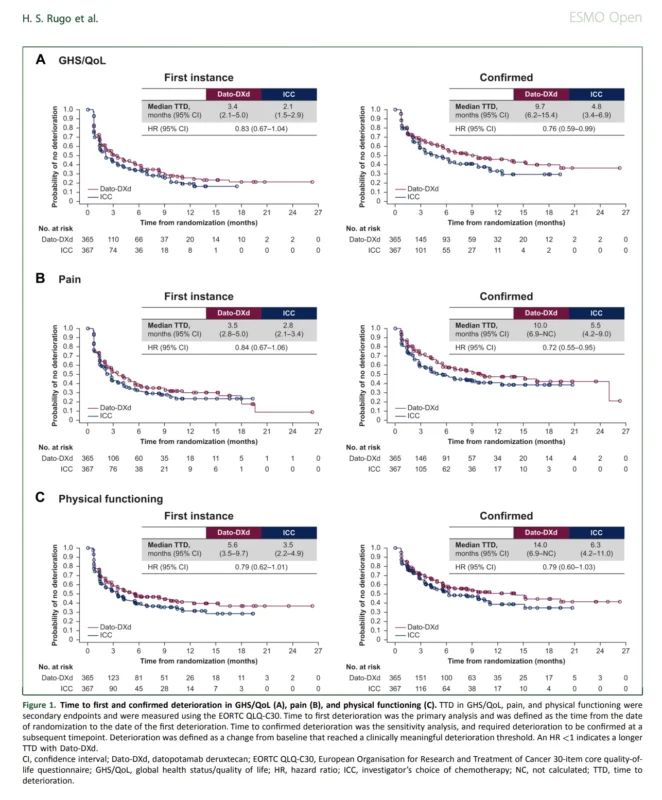
The secondary endpoints included time to deterioration in:
- Global health status and quality of life
- Pain
- Physical functioning
Both time to first deterioration and time to confirmed deterioration favored datopotamab deruxtecan, with hazard ratios below 1 across all three domains.
For confirmed deterioration, median results were:
Global health status/quality of life
- Datopotamab deruxtecan: 9.7 months
- Chemotherapy: 4.8 months
- HR: 0.76
Pain
- Datopotamab deruxtecan: 10.0 months
- Chemotherapy: 5.5 months
- HR: 0.72
Physical functioning
- Datopotamab deruxtecan: 14.0 months
- Chemotherapy: 6.3 months
- HR: 0.79
The confidence interval for confirmed physical-function deterioration crossed 1, while the intervals for confirmed deterioration in global health status and pain did not.
The results support a delay in deterioration with datopotamab deruxtecan but need to be interpreted within the prespecified patient-reported outcome framework rather than as separate survival endpoints.
Did Patient Reports Match Clinician-Reported Toxicity?
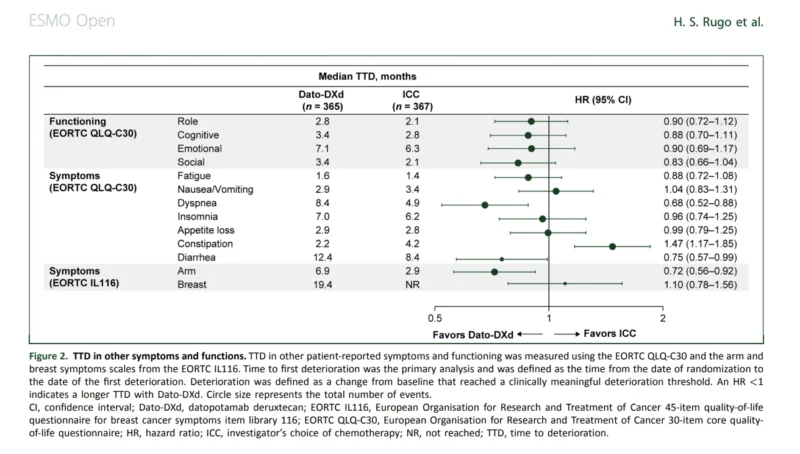
Patient-reported symptomatic adverse events were generally consistent with the safety findings recorded by investigators.
Patients receiving datopotamab deruxtecan less frequently reported numbness or tingling, diarrhea, shortness of breath, and hand-foot syndrome.
Patients receiving chemotherapy less frequently reported mouth or throat sores, nausea, vomiting, constipation, hair loss, and dry eyes.
Among patients who reported mouth or throat sores, numbness or tingling, or shortness of breath, most described the effect on daily activities as none, slight, or moderate rather than severe.
Overall patient-reported treatment tolerability was comparable between the groups over time, and patient-reported general health status was also similar.
This distinction is important: datopotamab deruxtecan delayed deterioration in several key quality-of-life domains, but patients did not report that treatment was universally easier or free of burdensome symptoms.
What Are the Main Limitations?
TROPION-Breast01 was an open-label study, meaning patients and investigators knew which treatment was being administered. Knowledge of treatment assignment can potentially influence the reporting of subjective outcomes, although the investigators cited published analyses indicating that blinding has not consistently produced significant differences in oncology patient-reported outcomes.
The study also cannot determine how effectively mouthwash, artificial tears, or antiemetics prevented adverse events.
Preventive measures were recommended but not universally mandated. The available records did not fully document adherence, timing, or whether interventions were used before symptoms or after toxicity developed.
These limitations mean that the study supports proactive toxicity management but does not validate a specific prophylactic regimen.
The Bottom Line
The final safety and patient-reported outcome analysis from TROPION-Breast01 adds important context to the previously reported progression-free survival benefit of datopotamab deruxtecan.
Grade 3 or higher treatment-related adverse events occurred in 22.2% with datopotamab deruxtecan and 45.6% with chemotherapy.
Datopotamab deruxtecan delayed deterioration in global health status and quality of life, pain, and physical functioning. Its safety profile was characterized by nausea, oral mucositis or stomatitis, and ocular surface events, while chemotherapy was associated with substantially greater hematologic toxicity.
Adjudicated drug-related ILD or pneumonitis occurred in 3.9% of patients receiving datopotamab deruxtecan, including one grade 5 event.
The findings support datopotamab deruxtecan as a treatment option for previously treated inoperable or metastatic HR-positive, HER2-negative breast cancer while emphasizing the need for early oral care, antiemetic treatment, ocular monitoring, and continued pulmonary surveillance.
References
- Rugo HS, Jhaveri K, Pernas S, et al. Datopotamab deruxtecan versus chemotherapy in previously treated inoperable/metastatic hormone receptor-positive HER2-negative breast cancer: safety and patient-reported outcomes from the phase III TROPION-Breast01 study. ESMO Open. 2026;11(8):108330. doi:10.1016/j.esmoop.2026.108330.
- Bardia A, Jhaveri K, Im SA, et al. Datopotamab deruxtecan versus chemotherapy in previously treated inoperable or metastatic hormone receptor-positive, HER2-negative breast cancer: primary results from TROPION-Breast01. Journal of Clinical Oncology. 2025;43:285–296.
- Pistilli B, Jhaveri K, Im SA, et al. Datopotamab deruxtecan versus chemotherapy in previously treated inoperable or metastatic hormone receptor-positive, HER2-negative breast cancer: final overall survival analysis of TROPION-Breast01. Annals of Oncology. 2026;37:663–674.