For patients with HER2-positive metastatic breast cancer, treatment progress has increasingly been defined by antibody–drug conjugates.
These therapies use HER2 as an address. The antibody identifies the cancer cell, while the linked cytotoxic payload is delivered directly to the tumor. This approach has reshaped expectations after progression on trastuzumab-based treatment.
Yet access to effective post-trastuzumab treatment strategies remains uneven across regions. In China, pyrotinib plus capecitabine has been an established option for patients with HER2-positive advanced or metastatic breast cancer previously treated with trastuzumab and chemotherapy.
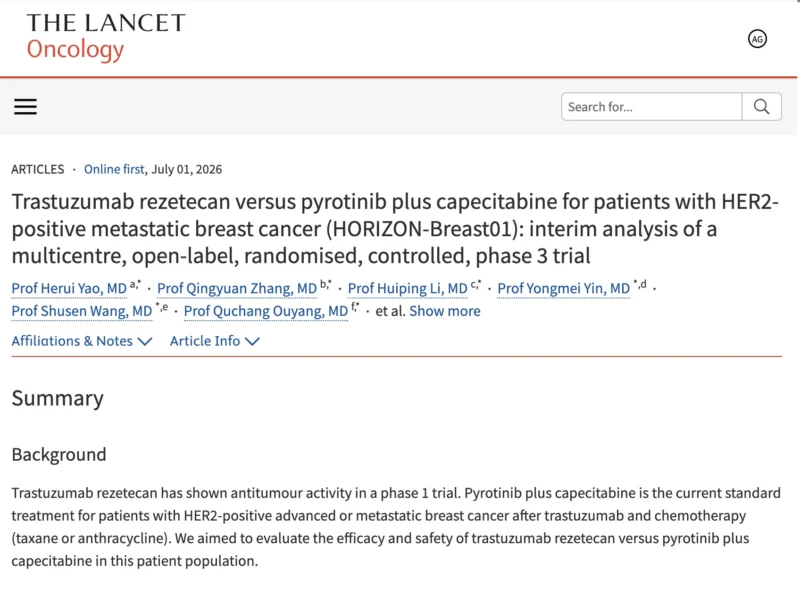
The phase 3 HORIZON-Breast01 trial now introduces another potential option.
In a prespecified interim analysis, trastuzumab rezetecan, a HER2-directed antibody–drug conjugate, substantially improved progression-free survival compared with pyrotinib plus capecitabine in patients with previously treated HER2-positive metastatic breast cancer.
The median progression-free survival was 30.6 months with trastuzumab rezetecan, compared with 8.3 months with pyrotinib plus capecitabine.
The results are striking. But they also need to be interpreted in the context of the comparator, the patient population, the interim nature of the analysis, and the treatment landscape outside China.
Why Does This Trial Matter?
HER2-positive metastatic breast cancer is no longer managed through a single linear treatment pathway.
Patients may receive HER2-targeted antibodies, chemotherapy, tyrosine kinase inhibitors, antibody–drug conjugates, and combinations that continue HER2 blockade while addressing resistance through different mechanisms.
The question is not whether HER2 remains an important target after progression. It does.
The question is which HER2-directed strategy provides the most durable disease control after prior trastuzumab and taxane exposure.
HORIZON-Breast01 was designed in a treatment setting where pyrotinib plus capecitabine was a standard option. The trial therefore asks a clinically practical question for this population: can a HER2-directed antibody–drug conjugate improve outcomes compared with a widely used oral HER2 tyrosine kinase inhibitor and chemotherapy combination?
Who Was Included in HORIZON-Breast01?
HORIZON-Breast01 was a multicentre, open-label, randomized phase 3 study conducted across 50 hospitals in China.
Eligible patients had HER2-positive unresectable or metastatic breast cancer and had either:
Received prior trastuzumab and taxane therapy for advanced disease, or
Experienced disease progression within 12 months after completing neoadjuvant or adjuvant treatment with an anti-HER2 monoclonal antibody and taxane-based chemotherapy
Patients were required to have measurable disease and an ECOG performance status of 0 or 1.
A total of 287 patients were included in the modified intention-to-treat population used for the primary evaluation.
All participants were female, with a median age of 55 years.
Patients were randomly assigned to receive:
- Trastuzumab rezetecan 4.8 mg/kg intravenously every 21 days, or
- Pyrotinib 400 mg orally once daily plus capecitabine 1,000 mg/m² twice daily on days 1–14 of each 21-day cycle
The study protocol temporarily evaluated a higher trastuzumab rezetecan dose of 6.4 mg/kg during part of the trial. However, the primary analysis focused on the 4.8 mg/kg population.
A Large Progression-Free Survival Difference
At the interim data cutoff of June 30, 2025, median follow-up was:
- 15.0 months in the trastuzumab rezetecan group
- 13.9 months in the pyrotinib plus capecitabine group
There had been 124 progression-free survival events:
- 37 events, or 26%, with trastuzumab rezetecan
- 87 events, or 60%, with pyrotinib plus capecitabine
The blinded independent central review-assessed median progression-free survival was:
- 30.6 months with trastuzumab rezetecan
- 8.3 months with pyrotinib plus capecitabine
This translated into a 78% relative reduction in the risk of progression or death:
- Hazard ratio: 0.22
- 95% CI: 0.15–0.34
- P < 0.0001
The 12-month progression-free survival rate was also notably higher:
- 84.7% with trastuzumab rezetecan
- 35.5% with pyrotinib plus capecitabine
For patients living with metastatic disease, this difference is clinically meaningful. It suggests a substantially longer interval before the cancer progresses or treatment must change.
What Is Trastuzumab Rezetecan?
Trastuzumab rezetecan is a HER2-directed antibody–drug conjugate.
Like other therapies in this class, it is designed to bind HER2-expressing tumor cells and deliver a cytotoxic payload after internalization.
The broader significance of HORIZON-Breast01 is not simply another positive HER2 trial. It is the continued confirmation that antibody–drug conjugates can produce durable disease control in HER2-positive metastatic breast cancer after prior treatment.
However, not all HER2-directed antibody–drug conjugates are interchangeable.
Their antibodies, linker technologies, payloads, drug-to-antibody ratios, dosing, toxicity profiles, trial populations, and comparators differ. Results from one ADC trial should therefore not be assumed to apply directly to another drug or treatment setting.
The Safety Profile Requires Careful Attention
The efficacy signal was accompanied by a distinct hematologic toxicity profile.
The most common grade 3 or higher treatment-related adverse events with trastuzumab rezetecan were:
- Decreased neutrophil count: 54%
- Decreased white blood cell count: 20%
- Decreased platelet count: 11%
By comparison, grade 3 or higher decreases in neutrophils, white blood cells, and platelets occurred less frequently with pyrotinib plus capecitabine.
Treatment-related serious adverse events occurred in:
- 13% of patients receiving trastuzumab rezetecan
- 12% of patients receiving pyrotinib plus capecitabine
Interstitial lung disease occurred in four patients, or 3%, treated with trastuzumab rezetecan.
This safety signal is especially important in the antibody–drug conjugate era.
Myelosuppression can require dose delays, dose reductions, growth-factor support, laboratory monitoring, and careful evaluation for infection. Interstitial lung disease is a potentially serious complication that requires prompt recognition, interruption of treatment when appropriate, and multidisciplinary assessment.
The study reported two deaths from adverse events: one septic shock event in the trastuzumab rezetecan group considered unrelated to study treatment, and one death from an unknown cause in the control group considered related to pyrotinib plus capecitabine.
How Does This Fit Into the Current HER2-Positive Landscape?
The HORIZON-Breast01 result should be interpreted within the Chinese treatment context.
Pyrotinib plus capecitabine is an established treatment option in China after trastuzumab and chemotherapy. But treatment sequencing differs internationally, depending on drug availability, regulatory approvals, reimbursement, prior exposure, CNS disease status, and local clinical guidelines.
In many countries, trastuzumab deruxtecan has become a major treatment option in previously treated HER2-positive metastatic breast cancer. Other HER2-directed therapies also have defined roles in selected settings.
HORIZON-Breast01 does not directly compare trastuzumab rezetecan with trastuzumab deruxtecan, trastuzumab emtansine, tucatinib-based therapy, or other contemporary HER2-directed strategies.
For that reason, the study should not be interpreted as establishing superiority over all available global treatment options.
Instead, it shows that trastuzumab rezetecan has produced a strong progression-free survival signal against pyrotinib plus capecitabine in a defined, previously treated HER2-positive metastatic breast cancer population.
What Questions Remain?
The interim analysis raises several important questions.
First, overall survival data are still immature. Progression-free survival is a meaningful endpoint in metastatic breast cancer, but overall survival and longer follow-up will help define the full clinical value of this approach.
Second, the optimal position of trastuzumab rezetecan within treatment sequencing remains to be determined. This will depend on prior exposure to other HER2-directed ADCs, availability of therapy, CNS activity, resistance mechanisms, and patient-specific safety considerations.
Third, longer follow-up will be important to better characterize durability of benefit and cumulative toxicity, particularly hematologic adverse events and interstitial lung disease.
Finally, the findings need to be considered across diverse populations. All patients in the primary analysis were treated in China, and broader global evidence will help clarify generalizability.
The Bottom Line
HORIZON-Breast01 adds another important result to the evolving HER2-positive metastatic breast cancer landscape.
Trastuzumab rezetecan improved median progression-free survival to 30.6 months, compared with 8.3 months for pyrotinib plus capecitabine, in patients previously treated with trastuzumab and taxane-based therapy.
The benefit was large, but treatment came with clinically relevant hematologic toxicity and a 3% incidence of interstitial lung disease.
The findings position trastuzumab rezetecan as a potential new treatment option in this setting. Its eventual role in global practice will depend on longer follow-up, overall survival results, regulatory decisions, and direct consideration alongside other HER2-directed therapies.