
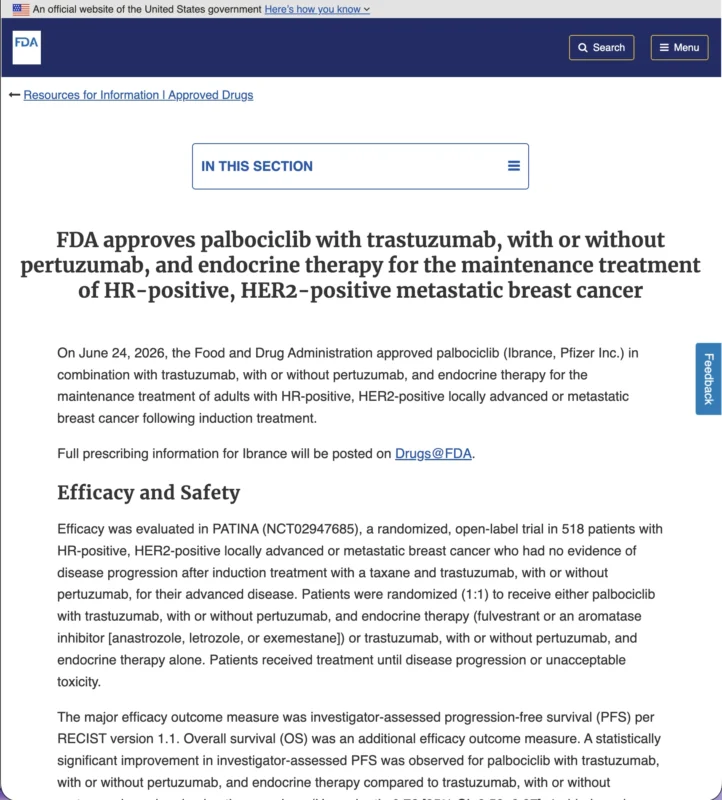
he U.S. Food and Drug Administration has approved palbociclib (Ibrance) in combination with trastuzumab, with or without pertuzumab, and endocrine therapy for the maintenance treatment of adults with hormone receptor-positive, HER2-positive locally advanced or metastatic breast cancer following induction treatment.
The June 24, 2026 decision is based on the phase III PATINA trial and introduces a new maintenance strategy for a biologically distinct subtype of HER2-positive metastatic breast cancer. Rather than continuing cytotoxic chemotherapy indefinitely, the regimen combines HER2-directed therapy, endocrine therapy, and CDK4/6 inhibition after disease control has been achieved with taxane-based induction therapy.
What Does the New FDA Approval Cover?
The indication is for adults with HR-positive, HER2-positive locally advanced or metastatic breast cancer whose disease has not progressed after induction therapy with a taxane plus trastuzumab, with or without pertuzumab, for advanced disease.
In practical terms, this is a maintenance approval. It does not replace initial taxane-based induction therapy. Instead, it provides an option for treatment continuation once patients have completed induction and remain without progression.
The approved regimen includes:
- Palbociclib
- Trastuzumab, with or without pertuzumab
- Endocrine therapy, either fulvestrant or an aromatase inhibitor
Permitted aromatase inhibitors include anastrozole, letrozole, and exemestane. Treatment is continued until disease progression or unacceptable toxicity.
Why Is This Strategy Important in HR-Positive, HER2-Positive Disease?
HR-positive, HER2-positive metastatic breast cancer is influenced by two major growth pathways: HER2 signaling and hormone receptor signaling. HER2-directed therapy has long been central to treatment, while endocrine therapy can help suppress hormone-driven tumor activity.
CDK4/6 inhibitors such as palbociclib are already established in HR-positive, HER2-negative metastatic breast cancer. Their use in HER2-positive disease has been investigated because HER2 and estrogen receptor pathways can interact and contribute to resistance over time.
The PATINA strategy was designed around this biology. It sought to maintain HER2 blockade and endocrine suppression while adding CDK4/6 inhibition after chemotherapy induction. The goal is to prolong disease control without requiring continuous chemotherapy exposure.
PATINA Trial Design
PATINA was a randomized, open-label trial enrolling 518 patients with HR-positive, HER2-positive locally advanced or metastatic breast cancer.
To participate, patients needed to have no evidence of disease progression after induction treatment with a taxane and trastuzumab, with or without pertuzumab, for their advanced disease.
Participants were randomized 1:1 to receive either:
- Palbociclib plus trastuzumab, with or without pertuzumab, and endocrine therapy
- Trastuzumab, with or without pertuzumab, and endocrine therapy alone
The major efficacy endpoint was investigator-assessed progression-free survival according to RECIST version 1.1. Overall survival was also evaluated, although those data were not mature at the time of the PFS analysis.
Palbociclib Improved Progression-Free Survival
The addition of palbociclib resulted in a statistically significant improvement in progression-free survival compared with HER2-targeted therapy and endocrine therapy alone.
The PFS hazard ratio was 0.76 with a 95% confidence interval of 0.59 to 0.97. The one-sided p value was 0.0134.
This result corresponds to a 24% reduction in the risk of disease progression or death for the palbociclib-containing maintenance regimen. Median PFS could not be adequately estimated at the time of analysis because of censoring, meaning that a substantial proportion of patients had not yet experienced progression when the data were assessed.
Although overall survival is an important endpoint in metastatic breast cancer, the OS data from PATINA were immature at the time of the FDA’s review. Longer follow-up will be needed to clarify whether the PFS advantage is accompanied by an overall survival benefit.
What Could This Change for Patients and Clinicians?
The approval creates a new maintenance option for patients whose metastatic HR-positive, HER2-positive breast cancer remains controlled after taxane-based induction therapy.
For some patients, the approach may allow treatment to transition away from continuous chemotherapy while maintaining pressure on the tumor through three complementary mechanisms:
- HER2 blockade with trastuzumab, with or without pertuzumab
- Hormone receptor suppression with endocrine therapy
- Cell-cycle inhibition with palbociclib
The treatment choice will still depend on prior therapy, disease burden, response to induction, menopausal status, tolerability, patient preference, and access to trastuzumab and pertuzumab. It also needs to be considered within a rapidly evolving HER2-positive treatment landscape, where antibody–drug conjugates and other targeted strategies are reshaping first-line and later-line care.
Safety and Monitoring Considerations
Palbociclib has an established safety profile, but its use requires ongoing monitoring. The prescribing information includes warnings and precautions for neutropenia, interstitial lung disease/pneumonitis, and embryo-fetal toxicity.
The recommended palbociclib dose is 125 mg orally once daily for 21 consecutive days, followed by 7 days off treatment, creating a 28-day cycle. Dosing for trastuzumab, pertuzumab, and the selected endocrine therapy should follow their individual prescribing information.
Regular blood-count monitoring is particularly important because neutropenia is a well-recognized toxicity of palbociclib. Treatment interruptions, dose reductions, and supportive care may be needed according to the severity and persistence of adverse events.
A Maintenance Approach Rather Than a New Induction Regimen
It is important to distinguish this approval from a new first-line induction regimen. Patients in PATINA first received a taxane with trastuzumab, with or without pertuzumab. Palbociclib was introduced after induction in patients who had achieved disease control.
This sequencing is clinically meaningful. It reflects an effort to balance rapid tumor control at the start of metastatic treatment with a longer-term strategy designed to reduce chemotherapy exposure while maintaining targeted and endocrine pressure on the disease.
Looking Ahead
The FDA approval establishes palbociclib plus trastuzumab, with or without pertuzumab, and endocrine therapy as a maintenance option in HR-positive, HER2-positive advanced or metastatic breast cancer after induction treatment.
The PFS result from PATINA is statistically significant and supports a new strategy for this subgroup. However, several questions remain, including the durability of benefit, the eventual overall survival results, optimal sequencing with newer HER2-directed therapies, and how broadly the regimen will be adopted in routine practice.
For now, PATINA provides a clear example of treatment becoming more biologically tailored in metastatic breast cancer: maintaining HER2-directed therapy, addressing hormone receptor signaling, and adding CDK4/6 inhibition in a defined population after initial chemotherapy response.