Longitudinal transcriptomic profiling from the NeoTRIPaPDL1 trial provides new insight into why some patients with triple-negative breast cancer respond to neoadjuvant chemoimmunotherapy while others have residual disease after treatment.
In this translational analysis, Dugo, Huang, Egle, Gianni, Bianchini, and colleagues evaluated baseline and early on-treatment tumor biopsies from patients with high-risk TNBC treated with neoadjuvant carboplatin plus nab-paclitaxel, with or without atezolizumab. The study shows that response prediction in TNBC is not based on a single static biomarker. Instead, it reflects both the biology of the untreated tumor and the early molecular remodeling that occurs after treatment begins (Dugo et al.).
Why This Study Matters
Immune checkpoint inhibitors have improved outcomes for patients with intermediate- and high-risk early TNBC, but many patients are already cured with chemotherapy alone, while others relapse despite immunotherapy. This creates an urgent need for biomarkers that can identify who is most likely to benefit from adding immunotherapy and who may need alternative or adaptive strategies.
Most biomarker studies in early TNBC have focused on pretreatment samples. The NeoTRIPaPDL1 analysis is important because it used longitudinal RNA sequencing, evaluating tumor samples both at baseline and early during treatment, on the first day of cycle 2.
This design allowed investigators to study not only what the tumor looked like before therapy, but how it changed shortly after exposure to chemotherapy or chemoimmunotherapy.
Study Design
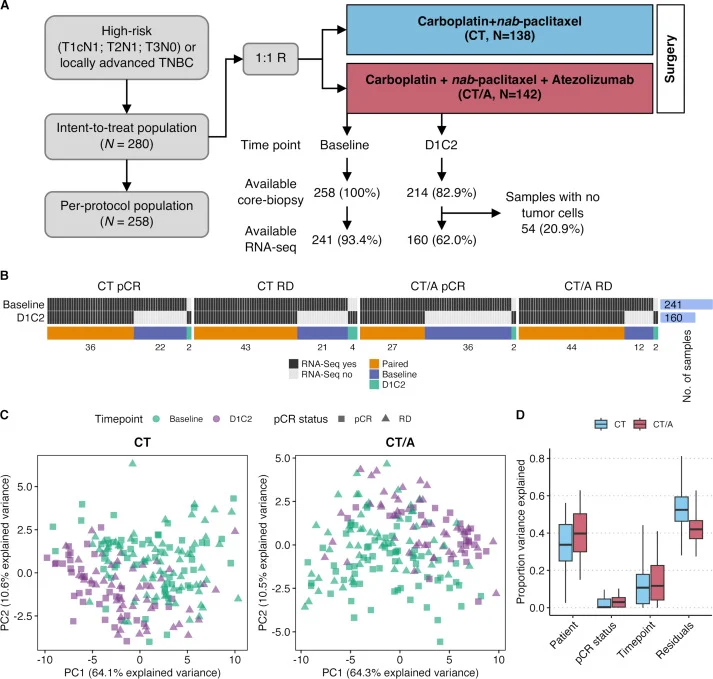
NeoTRIPaPDL1 was a randomized phase III trial that enrolled 280 patients with high-risk TNBC. Patients received either neoadjuvant carboplatin plus nab-paclitaxel or the same chemotherapy combined with atezolizumab.
For this transcriptomic analysis, the investigators focused on the per-protocol population. Longitudinal RNA sequencing was obtained from 251 of 258 evaluable patients, including 241 baseline samples and 160 early on-treatment samples collected on day 1 of cycle 2. Paired baseline and on-treatment RNA-seq data were available for 150 patients.
The analysis evaluated hallmark biological pathways, immune cell signatures, and ferroptosis-related gene programs. Associations with pathologic complete response were assessed using logistic regression and exploratory multivariable XGBoost models.
Baseline Predictors Were Strongest in the Atezolizumab Arm
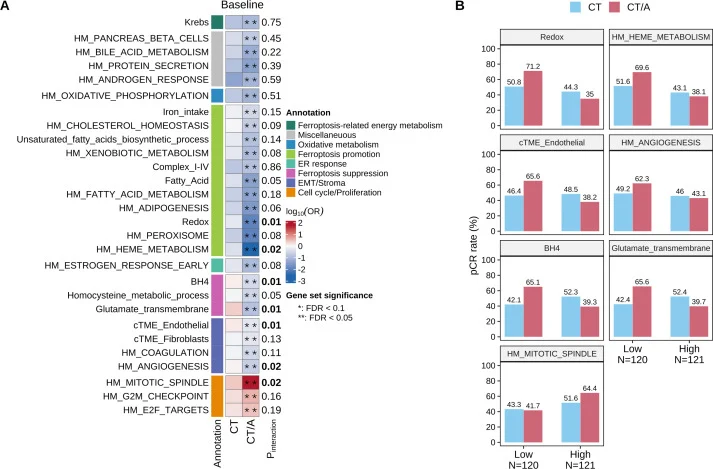
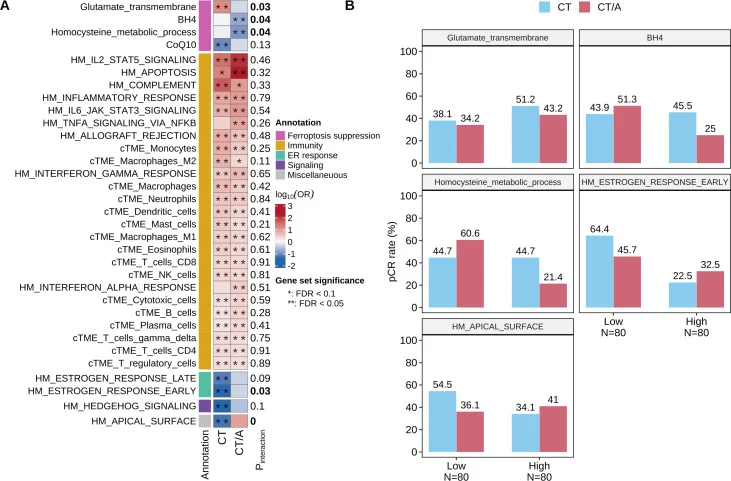
At baseline, the strongest predictive signals were observed in the chemoimmunotherapy arm. In patients treated with chemotherapy plus atezolizumab, higher proliferation signatures were associated with higher pCR rates. In contrast, higher stromal, metabolic, hormonal, and signaling programs were associated with lower pCR rates.
This suggests that tumors with active proliferative biology may be more sensitive to the carboplatin/nab-paclitaxel plus atezolizumab regimen, while tumors enriched for stromal and metabolic resistance programs may be less likely to achieve pCR.
The study also found treatment-specific associations for several signatures related to ferroptosis, stroma, and proliferation. For example, high expression of the mitotic spindle signature was linked with higher pCR rates in the atezolizumab-containing arm but not in the chemotherapy-alone arm.
Early Tumor Clearance Strongly Predicted Final pCR
One of the most clinically relevant findings was the value of the early on-treatment biopsy.
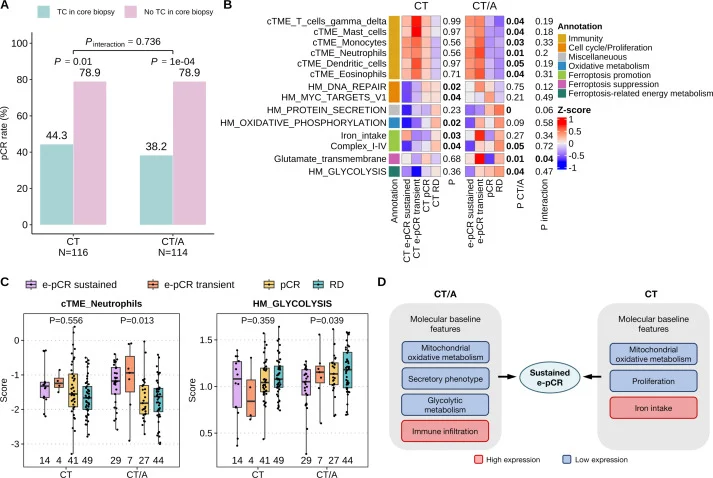
Among 225 patients with evaluable D1C2 biopsies, 54 had no detectable cancer cells in the early biopsy. This early pathologic complete response occurred more often in patients receiving chemoimmunotherapy than chemotherapy alone: 33.6% versus 16.8%, with a p value of 0.007.
The absence of tumor cells at D1C2 strongly predicted final pCR at surgery in both treatment arms. The positive predictive value was 77.8% in the chemotherapy arm and 80.6% in the chemoimmunotherapy arm. However, early tumor clearance was not perfect, as 12 patients with early pCR still had residual disease at surgery.
This finding supports the concept that early biopsy response may serve as a strong surrogate marker for final pCR, while also showing that it cannot fully replace surgical pathology.
On-Treatment Biology Shifted Toward Immune Activation
The transcriptomic profile changed substantially after treatment began. Compared with baseline, on-treatment samples showed reduced proliferation and increased immune and stromal signatures. These changes were more pronounced in tumors that ultimately achieved pCR, particularly in the atezolizumab arm.
At baseline, metabolic signatures carried strong predictive information, especially in the chemoimmunotherapy arm. By D1C2, many of these metabolic signatures lost predictive value, while immune-related programs became the dominant correlates of response.
This shift is important because it suggests that pretreatment biomarkers and on-treatment biomarkers answer different clinical questions. Baseline biomarkers may help identify patients more likely to respond to a specific regimen, while on-treatment biomarkers may capture whether the tumor is actually responding biologically.
Tumor Microenvironment Remodeling Was Linked With Response
Immune deconvolution confirmed that treatment induced dynamic remodeling of the tumor microenvironment. In both treatment arms, tumors achieving pCR showed reduced cancer epithelial fractions and increased immune cell populations.
In the chemoimmunotherapy arm, higher baseline T-cell proportions and lower cancer-associated fibroblast and normal cell proportions were associated with pCR. On treatment, pCR tumors showed increased myeloid cells and decreased cancer epithelial cells, while T-cell enrichment was particularly associated with response in the atezolizumab arm.
These findings support the idea that response to neoadjuvant chemoimmunotherapy depends not only on tumor-cell killing but also on early immune activation and immune microenvironment remodeling.
Cytotoxic Immunity and Iron Metabolism May Work Together
The exploratory multivariable modeling identified distinct predictors across treatment arms and timepoints. In the atezolizumab arm, baseline redox metabolism and the mitotic spindle signature were among the most informative predictors.
At D1C2, cytotoxic immune activity and iron utilization emerged as important features. The study suggested that these two programs may interact rather than act independently. When cytotoxic immune infiltration was low, iron utilization was not strongly predictive. But when cytotoxic T-cell activity was high, iron utilization helped separate patients with different pCR probabilities.
This finding is exploratory, but it points toward a more complex interaction between immune activity and tumor metabolic state in shaping response to chemoimmunotherapy.
Clinical Meaning
This analysis supports a more dynamic model of biomarker development in early TNBC. Baseline tumor biology matters, but early treatment-induced changes may provide additional and clinically useful information.
In practice, this could support future response-adapted neoadjuvant strategies. Patients showing early tumor clearance or strong immune activation might be candidates for de-escalation approaches in future trials. Patients with persistent tumor cells, low immune activation, or resistant metabolic/stromal programs may need early treatment modification or novel combinations.
The study does not yet define a biomarker ready for routine clinical use. It also lacks event-free survival analysis and independent validation. However, it provides a strong translational framework for using longitudinal tumor sampling to guide personalized neoadjuvant therapy in TNBC.
Conclusion
The NeoTRIPaPDL1 transcriptomic analysis shows that response to neoadjuvant chemoimmunotherapy in TNBC is shaped by both baseline tumor-intrinsic features and early therapy-induced immune remodeling.
Higher baseline proliferation and lower stromal/metabolic programs predicted response in the atezolizumab arm, while early absence of tumor cells at D1C2 was a strong surrogate of final pCR. On-treatment immune activation, reduced proliferation, and dynamic tumor microenvironment remodeling were associated with response, especially with chemoimmunotherapy.
These findings support further development of longitudinal biomarkers and response-adapted neoadjuvant strategies in triple-negative breast cancer.