
The treatment landscape of hormone receptor–positive, HER2-negative metastatic breast cancer has become increasingly crowded, but also increasingly fragmented.
After progression on endocrine therapy and CDK4/6 inhibition, treatment decisions are now shaped by ESR1 mutations, PIK3CA alterations, AKT pathway abnormalities, HER2-low or HER2-ultralow expression, prior endocrine sensitivity, visceral disease, and previous exposure to antibody-drug conjugates.
Eventually, however, many patients reach a point at which endocrine-based strategies have been exhausted and chemotherapy becomes necessary. That is the setting in which izalontamab brengitecan (iza-bren; BL-B01D1) is now generating considerable interest.
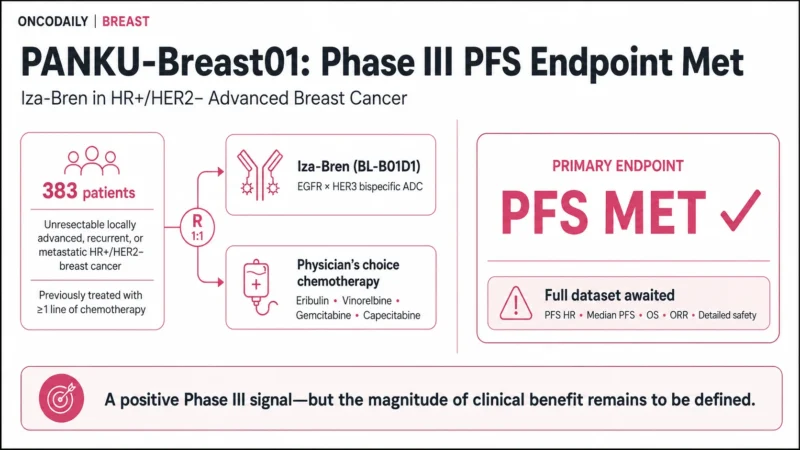
On August 26, 2026, Sichuan Biokin Pharmaceutical announced that the randomized phase III PANKU-Breast01 (BL-B01D1-306) trial met its primary endpoint of progression-free survival at a prespecified interim analysis in patients with unresectable locally advanced, recurrent, or metastatic HR-positive/HER2-negative breast cancer previously treated with at least one line of chemotherapy.
An independent data monitoring committee determined that the PFS endpoint had been met. The announcement is potentially important. But it is also a topline corporate disclosure, not a mature clinical-trial presentation.
No hazard ratio, median PFS, objective response rate, overall survival result, or detailed safety dataset has yet been disclosed for PANKU-Breast01.
That distinction should shape how the result is interpreted. The trial is positive. How clinically important that positivity is remains to be seen.
PANKU-Breast01 Tests an ADC Against Active Chemotherapy
PANKU-Breast01 is a randomized, open-label phase III trial registered as NCT06343948. The study enrolled 383 patients with unresectable locally advanced, recurrent, or metastatic HR+/HER2− breast cancer whose disease had progressed after at least one previous line of chemotherapy.
Rather than using placebo or best supportive care, iza-bren is being compared with physician’s choice chemotherapy, including eribulin, vinorelbine, gemcitabine, or capecitabine. The primary endpoint is progression-free survival assessed by blinded independent central review, while secondary endpoints include overall survival, response rate, disease control rate, duration of response, and safety.
That comparator is clinically relevant. This is a population in which treatment has already moved beyond the predominantly endocrine-sensitive phase of HR-positive disease. The question is therefore not whether iza-bren can produce tumor responses in heavily pretreated breast cancer.
It is whether a bispecific ADC can outperform established cytotoxic therapy in a randomized phase III setting. According to the company announcement, it has now crossed that first threshold for PFS.
Iza-Bren Is Not a HER2-Directed ADC
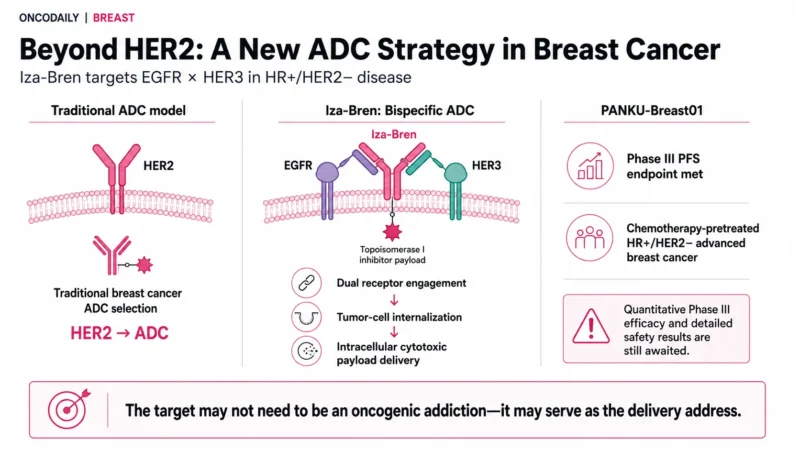
One of the most interesting aspects of the result is what iza-bren targets. The drug is an EGFR×HER3 bispecific antibody-drug conjugate, rather than a HER2-directed ADC.
Its antibody component simultaneously targets EGFR and HER3, while internalization delivers a topoisomerase I inhibitor payload. SystImmune describes the construct as combining receptor targeting and signaling inhibition with intracellular delivery of its cytotoxic payload.
That creates a fundamentally different therapeutic concept from the HER2-directed ADC strategy that has already transformed HR+/HER2− metastatic breast cancer.
The therapeutic relevance of trastuzumab deruxtecan, for example, depends heavily on HER2 expression categories. Iza-bren potentially opens another route:
ADC activity in HER2-negative breast cancer based on EGFR and HER3 biology rather than HER2 expression.
If the phase III benefit ultimately proves robust across HER2-zero and HER2-low tumors, that could be particularly important. It would suggest that the ADC era in breast cancer is expanding beyond the idea that a tumor must express a traditional breast cancer therapeutic target such as HER2.
Instead, alternative cell-surface proteins may function primarily as delivery addresses for highly potent cytotoxic payloads.
Early-Phase Data Already Suggested Activity Across HER2 Expression Levels
The phase III announcement did not emerge without prior evidence. Earlier phase I data in heavily pretreated HER2-negative advanced breast cancer showed activity with iza-bren across both HER2-zero and HER2-low disease.
At the 2.5 mg/kg Days 1 and 8 every 3 weeks dose, an analysis of 121 efficacy-evaluable patients reported an overall response rate of approximately 42%, a confirmed response rate of 36%, median duration of response of 9.7 months, and median PFS of 6.9 months.
Notably, outcomes appeared broadly similar according to HER2 expression. Patients with HER2 IHC 0 disease had an ORR of 41.8% and median PFS of 8.3 months, while those with HER2-low disease had an ORR of 42.4% and median PFS of 6.3 months.
Those were early-phase, nonrandomized data and cannot establish comparative efficacy. But they provided an important biological signal, iza-bren activity did not appear to require HER2 expression.
That observation makes the positive PANKU-Breast01 readout particularly interesting in HR+/HER2− disease.
The Result Could Broaden the ADC Concept Beyond HER2-Low Disease
The modern HR-positive metastatic breast cancer sequence has become deeply influenced by HER2 expression. For patients entering the ADC phase of treatment, HER2-low and HER2-ultralow status can affect therapeutic options.
But HER2-negative breast cancer includes a substantial population with very low or absent HER2 expression. An EGFR×HER3-directed ADC could potentially provide another biologically independent route to payload delivery.
This is important because ADC selection may increasingly move away from a single linear sequence.
The future question may not simply be:
- Which ADC should be given first?
It may become:
- Which target-payload combination is most appropriate for the tumor at this point in its evolution?
HER2, TROP2, HER3, EGFR and other surface proteins may eventually define overlapping rather than mutually exclusive ADC strategies.
Iza-bren is particularly interesting because its bispecific architecture attempts to exploit two receptors simultaneously. Whether that dual targeting meaningfully improves internalization, tumor selectivity, depth of response, or resistance biology compared with monospecific ADCs remains an important unanswered question.
The Positive TNBC Experience Adds Biological Credibility
Iza-bren has already generated randomized phase III evidence in another breast cancer subtype. In the phase III PANKU-Breast02 trial in previously treated triple-negative breast cancer, iza-bren significantly improved both PFS and OS compared with physician’s choice chemotherapy.
At the reported interim analysis, median PFS was 8.5 versus 3.1 months (HR 0.29), while median OS was 15.9 versus 12.5 months (HR 0.60). Confirmed ORR was 51.7% versus 20.5%. Cross-trial comparisons should obviously be avoided.
TNBC and HR-positive breast cancer are biologically different diseases, and the PANKU-Breast01 data have not yet been presented. But the TNBC result demonstrates that iza-bren is capable of producing a substantial randomized advantage over chemotherapy in breast cancer.
That makes the HR+/HER2− PFS announcement more credible than an isolated topline result from a completely unvalidated platform. According to Biokin, PANKU-Breast01 is now the fifth phase III study of iza-bren to meet its primary endpoint.
Where Could Iza-Bren Fit in an Increasingly Crowded Sequence?
This may ultimately be the most difficult question. The PANKU-Breast01 population had already failed at least one line of chemotherapy. But contemporary HR+/HER2− advanced breast cancer has multiple treatment options before and during the chemotherapy phase.
Depending on tumor biology and previous therapy, patients may receive oral SERDs, PI3K/AKT/mTOR-directed treatments, CDK4/6-based strategies, HER2-directed ADCs in appropriate HER2-expression groups, TROP2-directed ADCs, and conventional chemotherapy.
Therefore, a positive PFS result alone will not automatically establish where iza-bren belongs. The magnitude of benefit will matter enormously. If the eventual PFS advantage is modest, the drug may become another useful later-line ADC.
If the hazard ratio and duration of disease control resemble the striking findings already observed in TNBC, the discussion could become considerably different.
Overall survival will also matter. So will prior ADC exposure.
One particularly important question will be whether iza-bren remains active after treatment with other topoisomerase I inhibitor, based ADCs. As more ADCs enter the HR-positive disease sequence, payload cross-resistance may become just as important as target expression.
The Safety Dataset Will Be Crucial
The company announcement states only that the PFS endpoint was achieved. It does not provide detailed safety results from PANKU-Breast01. That information will be essential. Earlier breast cancer experience with iza-bren showed a predominantly hematologic toxicity profile.
In phase I breast cancer data, frequent treatment-related adverse events included anemia, leukopenia, neutropenia, thrombocytopenia, nausea, stomatitis, fatigue, and vomiting. Grade ≥3 neutropenia, leukopenia, anemia, and thrombocytopenia were clinically relevant.
That differs somewhat from the toxicity profiles clinicians associate with several currently used breast cancer ADCs and could influence sequencing.
The key question will not simply be whether iza-bren is tolerable. It will be its therapeutic index relative to the chemotherapy it replaces and the ADCs with which it will compete.
Rates of febrile neutropenia, treatment discontinuation, dose reduction, interstitial lung disease, gastrointestinal toxicity, and treatment-related mortality will therefore deserve careful attention when the full phase III results are presented.
A Positive Topline Result Is Not Yet a Practice-Changing Dataset
There is a strong temptation to interpret “phase III primary endpoint met” as synonymous with a new standard of care. That would be premature here.
The August 26 announcement does not disclose:
- the median PFS in either arm
- the PFS hazard ratio
- the absolute PFS improvement
- ORR or duration of response
- overall survival
- subgroup outcomes
- detailed adverse events
or outcomes according to HER2 expression and previous ADC exposure. Until those data are available, it is impossible to determine the true clinical magnitude of benefit.
A statistically positive PFS endpoint can represent very different therapeutic realities depending on the hazard ratio, absolute separation between curves, durability of benefit, toxicity, and subsequent OS. For now, the appropriate interpretation is therefore:
PANKU-Breast01 has validated phase III activity of iza-bren in chemotherapy-pretreated HR+/HER2− advanced breast cancer, but it has not yet defined its clinical value or treatment position.
The Larger Signal: ADC Development Is Becoming Target-Agnostic to Traditional Breast Subtypes
The most important long-term implication may extend beyond iza-bren itself. Breast oncology has traditionally categorized systemic treatment through ER, PR and HER2.
ADC development is beginning to challenge the completeness of that framework. A tumor may be HR-positive and HER2-negative yet still express other cell-surface proteins capable of efficiently delivering a cytotoxic payload.
In that sense, EGFR and HER3 do not necessarily need to function like classical oncogenic addictions. They may function as therapeutic entry points. This represents a broader evolution of precision oncology.
Traditional targeted therapy asks:
- Is the tumor dependent on this target?
ADC therapy increasingly asks:
- Can this target reliably deliver the payload into the tumor?
A bispecific ADC adds another layer:
- Can engaging two targets improve that delivery or overcome heterogeneity?
PANKU-Breast01 may become an important test of that concept in one of the largest molecularly and therapeutically diverse breast cancer populations.
The Bottom Line
The phase III PANKU-Breast01 study has met its primary PFS endpoint at a prespecified interim analysis, according to the August 26, 2026 disclosure from Sichuan Biokin.
The randomized trial enrolled 383 patients with unresectable locally advanced, recurrent, or metastatic HR+/HER2− breast cancer after failure of at least one previous chemotherapy line and compares the EGFR×HER3 bispecific ADC iza-bren with physician’s choice chemotherapy.
This is potentially an important development for post-endocrine, chemotherapy-exposed HR-positive metastatic breast cancer.
But the most important numbers have not yet been released.
Without the PFS hazard ratio, median PFS, OS, response durability, subgroup analyses, and phase III safety data, the result should be viewed as promising topline evidence rather than a practice-changing dataset.
What is already clear, however, is that the ADC landscape is expanding beyond HER2.
If the full PANKU-Breast01 results demonstrate a clinically meaningful benefit with an acceptable safety profile, iza-bren could establish EGFR×HER3 as another actionable ADC platform in HR+/HER2− breast cancer.
And that would reinforce a broader shift in metastatic breast cancer:
The next generation of ADC selection may depend less on traditional subtype labels alone, and increasingly on which surface target provides the best route for delivering the right payload to the tumor.
Reference
- Sichuan Biokin Pharmaceutical Co., Ltd. Voluntary Disclosure Regarding the Prespecified Interim Analysis of the Phase III Trial of Iza-Bren (BL-B01D1) in Locally Advanced, Recurrent or Metastatic HR-Positive/HER2-Negative Breast Cancer. August 26, 2026. The company reported that PANKU-Breast01 met its primary PFS endpoint; quantitative efficacy and safety results were not disclosed in the announcement.
- ClinicalTrials.gov. PANKU-Breast01 (BL-B01D1-306), NCT06343948. Phase III randomized study of iza-bren versus physician’s choice chemotherapy in previously chemotherapy-treated HR+/HER2− advanced breast cancer.