
Regional nodal irradiation has long carried a central question in early breast cancer: how much benefit is gained, and what is the long-term cost?
A new 20-year analysis of the EORTC 22922/10925 trial adds important nuance for patients with node-negative breast cancer.
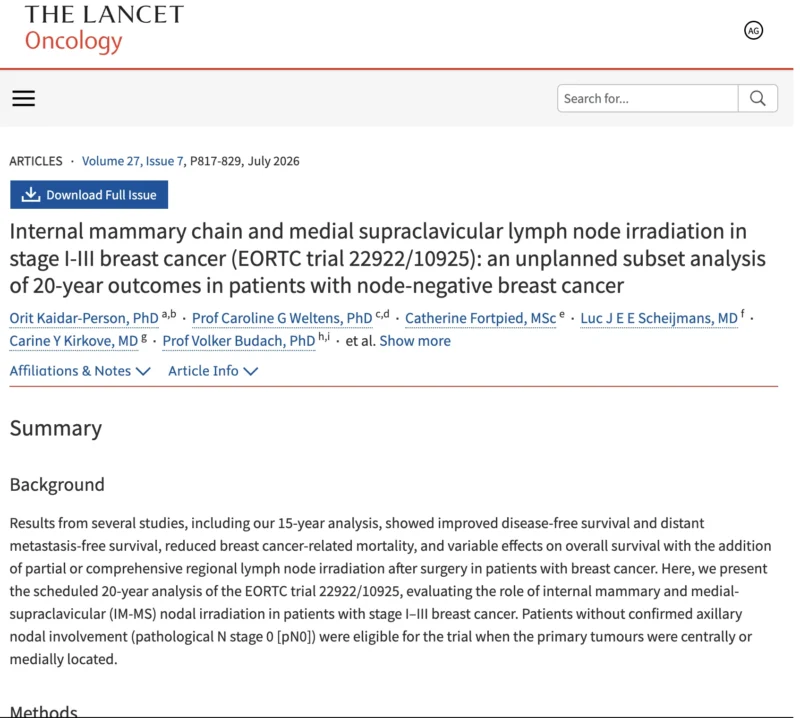
The study evaluated internal mammary and medial supraclavicular lymph node irradiation, known as IM-MS irradiation, in women with stage I–III breast cancer. This unplanned subgroup analysis focused only on patients without clinically and histopathologically confirmed axillary nodal involvement, classified as pathological N0.
At 20 years, IM-MS irradiation was associated with a significant reduction in breast cancer mortality.
But that reduction did not translate into an overall survival benefit.
The finding is clinically important because it shows both sides of regional nodal irradiation: better breast cancer-specific outcomes, but no clear long-term survival advantage in this node-negative subgroup, with a signal toward higher non-breast cancer mortality after longer follow-up.
Why This Question Still Matters
Regional nodal irradiation can reduce recurrence risk and breast cancer mortality in selected patients.
But for node-negative breast cancer, the decision is more delicate.
The absolute risk of regional relapse or distant spread may be lower than in node-positive disease. At the same time, treating internal mammary and supraclavicular lymph node regions can increase exposure to organs at risk, including the heart and lungs.
This makes long-term follow-up essential.
Shorter follow-up may capture fewer breast cancer events, while very late toxicity and non-breast cancer mortality may take many years to become visible.
That is why the 20-year EORTC analysis matters.
It does not simply ask whether IM-MS irradiation reduces breast cancer deaths.
It asks whether that benefit is large enough, durable enough, and safe enough to improve survival over decades.
Trial Design
EORTC 22922/10925 was a randomized, open-label, phase 3 trial conducted across 46 radiation oncology departments in 13 countries.
Eligible participants were women up to 75 years of age with unilateral, histologically confirmed stage I–III breast adenocarcinoma. Patients were eligible if they had involved axillary nodes or a central or medially located primary tumor.
Patients were randomly assigned to receive either:
- IM-MS irradiation at 50 Gy in 25 fractions
or
- No IM-MS irradiation
Randomization was stratified by institution, menopausal status, primary tumor site within the breast, type of breast and axillary surgery, and pathological T and N stage.
The current analysis focused only on patients with pN0 disease.
Who Was Included in the Node-Negative Analysis?
The full trial enrolled 4,004 patients between August 1996 and January 2004.
Among them, 1,778 patients had pN0 disease and were included in this unplanned subset analysis.
The median age was 55 years.
The median follow-up was 22.2 years, allowing the investigators to assess not only breast cancer outcomes, but also late mortality and long-term toxicity.
This is one of the strengths of the analysis.
In radiotherapy, time matters.
A treatment that reduces breast cancer events at 10 or 15 years may still need to be judged against late competing mortality and organ-related toxicity after 20 years.
Breast Cancer Mortality Was Lower With IM-MS Irradiation
At 20 years, breast cancer mortality was lower in the IM-MS irradiation group.
The breast cancer mortality rate was:
- 10.0% with IM-MS irradiation
- 14.2% in the control group
This corresponded to a hazard ratio of 0.70, with a 95% confidence interval of 0.53–0.92 and a p value of 0.010.
This suggests a statistically significant reduction in breast cancer mortality.
For clinicians, this is the key efficacy signal from the analysis.
In a population without confirmed axillary nodal involvement, irradiation of the internal mammary and medial supraclavicular regions appeared to reduce the probability of dying from breast cancer over two decades.
Overall Survival Was Not Improved
Despite the reduction in breast cancer mortality, overall survival was nearly identical between the two groups.
At 20 years, overall survival was:
- 69.0% with IM-MS irradiation
- 68.4% in the control group
The hazard ratio for overall survival was 0.98, with a 95% confidence interval of 0.83–1.15 and a p value of 0.77.
This means the breast cancer-specific benefit did not produce a measurable overall survival advantage in this pN0 subset.
That distinction is important.
A reduction in breast cancer mortality is clinically meaningful. But when overall survival remains unchanged, the decision to add treatment must consider absolute benefit, competing risks, baseline recurrence risk, radiation technique, later toxicity, and patient preference.
A Late Signal in Non-Breast Cancer Mortality
The analysis also reported a higher cumulative mortality from unknown or non-breast cancer causes in the IM-MS irradiation group.
At 20 years, cumulative mortality of unknown cause or non-breast cancer cause was:
- 20.9% with IM-MS irradiation
- 17.4% in the control group
The hazard ratio was 1.24, with a 95% confidence interval of 1.00–1.53 and a p value of 0.048.
The authors noted that non-breast cancer mortality was numerically higher in the IM-MS irradiation group after 15 years.
This finding should be interpreted carefully.
The analysis was unplanned, and cause-specific mortality over decades can be influenced by many factors. Still, the signal reinforces a central principle in breast radiotherapy: long-term organ-at-risk exposure matters, especially when expected breast cancer benefit is modest.
What About Cardiac and Lung Toxicity?
Late toxicity was also reported.
Among patients with left-sided breast cancer, late cardiac fibrosis occurred in:
- 3.4% of patients in the IM-MS irradiation group
- 2.8% of patients in the control group
Lung fibrosis of any grade occurred in:
- 6.4% of patients in the IM-MS irradiation group
- 2.1% of patients in the control group
These data do not suggest a dramatic excess of severe cardiac events from the information provided, but they do show higher lung fibrosis with IM-MS irradiation.
The broader message is not that IM-MS irradiation should be avoided.
It is that the benefit-risk balance depends heavily on patient selection and radiation technique.
Modern radiotherapy planning, deep inspiration breath hold for left-sided cancers, image guidance, more conformal planning, and careful heart and lung dose constraints may reduce exposure compared with older-era techniques used during trial enrollment from 1996 to 2004.
How Should These Results Be Read Today?
This analysis should not be read as a simple “yes” or “no” answer for regional nodal irradiation.
It should be read as a long-term cautionary dataset.
In pN0 patients with central or medial tumors, IM-MS irradiation reduced breast cancer mortality at 20 years. However, it did not improve overall survival, and non-breast cancer mortality was higher after long follow-up.
For contemporary practice, this supports individualized decision-making.
The patients most likely to benefit may be those with higher estimated risk of occult regional disease or distant recurrence, while patients with lower baseline risk may have smaller absolute benefit and less tolerance for additional organ exposure.
The results also highlight the importance of modern radiation techniques designed to reduce dose to the heart, lungs, and other organs at risk.
Why Very Long Follow-Up Matters
Breast cancer is a disease where treatment effects can unfold over decades.
Radiotherapy can prevent recurrence and breast cancer death, but late effects may also emerge many years after treatment. This is particularly relevant in early breast cancer, where many patients live long enough for competing risks and late toxicity to influence overall outcomes.
The EORTC 22922/10925 pN0 analysis shows why 5-year or even 10-year results are not always enough.
At 20 years, the clinical picture becomes more complex.
The breast cancer mortality benefit remained visible.
The overall survival benefit did not emerge.
And late non-breast cancer mortality required attention.
The Bottom Line
In this 20-year unplanned subset analysis of EORTC 22922/10925, IM-MS irradiation in node-negative breast cancer reduced breast cancer mortality but did not improve overall survival.
At 20 years, breast cancer mortality was 10.0% with IM-MS irradiation versus 14.2% without it. Overall survival was 69.0% versus 68.4%, respectively.
The findings support the potential disease-specific benefit of regional nodal irradiation in selected pN0 patients with central or medial tumors, but they also underscore the need for careful patient selection, long-term toxicity awareness, and modern organ-sparing radiation techniques.
For early breast cancer, more treatment is not always better for every patient.
The goal is the right treatment, for the right risk, delivered with the safest possible technique.
References
- Kaidar-Person O, Weltens CG, Fortpied C, Scheijmans LJE, Kirkove CY, Budach V, et al. Internal mammary chain and medial supraclavicular lymph node irradiation in stage I–III breast cancer (EORTC trial 22922/10925): an unplanned subset analysis of 20-year outcomes in patients with node-negative breast cancer. The Lancet Oncology. 2026.
- Poortmans PM, Weltens C, Fortpied C, et al. Internal mammary and medial supraclavicular lymph node chain irradiation in stage I–III breast cancer (EORTC 22922/10925): 15-year results of a randomised, phase 3 trial. The Lancet Oncology. 2020;21:1602–1610.
- Poortmans PM, Collette S, Kirkove C, et al. Internal mammary and medial supraclavicular irradiation in breast cancer. New England Journal of Medicine. 2015;373:317–327.
- Poortmans PM, Struikmans H, De Brouwer P, et al. Side effects 15 years after lymph node irradiation in breast cancer: randomized EORTC trial 22922/10925. Journal of the National Cancer Institute. 2021;113:1360–1368.
- Taylor C, Dodwell D, McGale P, et al; Early Breast Cancer Trialists’ Collaborative Group. Radiotherapy to regional nodes in early breast cancer: an individual patient data meta-analysis of 14,324 women in 16 trials. The Lancet. 2023;402:1991–2003.