
HER2-low status may provide important prognostic information in hormone receptor-positive, HER2-negative metastatic breast cancer treated with first-line endocrine therapy plus a CDK4/6 inhibitor.
The CYCLHER study, published in The Breast, analyzed real-world outcomes from 597 patients treated across 16 Italian oncology centers. The results suggest that patients with HER2-low disease experienced shorter real-world progression-free survival than those with HER2-0 tumors. Higher estrogen receptor and progesterone receptor expression were associated with more favorable outcomes.
Although the findings are retrospective and should not change treatment selection on their own, they add to the growing evidence that HR-positive/HER2-negative metastatic breast cancer is not a biologically uniform disease.
Why HER2-Low Status Matters
HER2-low breast cancer is typically defined as HER2 immunohistochemistry 1+ or 2+ with negative in situ hybridization. The category has become clinically relevant because antibody–drug conjugates, particularly trastuzumab deruxtecan, have demonstrated activity in previously treated HER2-low metastatic breast cancer.
Its prognostic role during first-line endocrine therapy plus CDK4/6 inhibition remains less clear. Previous real-world studies have produced mixed results, often because of small patient populations, treatment-line heterogeneity, and variation in HER2 assessment.
The CYCLHER investigators therefore examined whether HER2 status, together with quantitative ER and PgR expression, could help identify patients with different outcomes after starting first-line CDK4/6 inhibitor-based therapy.
The CYCLHER Cohort
CYCLHER was a retrospective, multicenter cohort study that included patients with locally advanced unresectable or metastatic HR-positive/HER2-negative breast cancer who began endocrine therapy plus palbociclib, ribociclib, or abemaciclib between November 2016 and May 2023.
Most patients received palbociclib, followed by ribociclib and abemaciclib. Aromatase inhibitors were the most common endocrine therapy partner, while fulvestrant was used in just over one-third of the cohort.
After a median follow-up of 41 months, median real-world progression-free survival was 28.1 months. Median overall survival was not reached.
HER2-Low Disease Was Associated With Less Favorable Outcomes
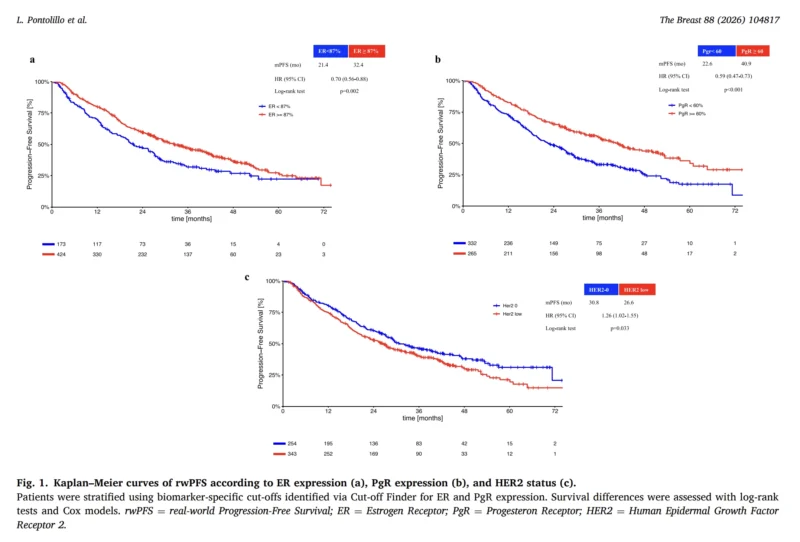
Patients with HER2-low disease had a median real-world progression-free survival of 26.6 months, compared with 30.8 months for those with HER2-0 disease.
The association remained significant after adjustment for relevant clinical and treatment variables. HER2-low status was associated with a 28% higher risk of progression or death than HER2-0 status, with an adjusted hazard ratio of 1.28.
The analysis also suggested a stepwise decline in progression-free survival with increasing HER2 immunohistochemical expression. Median real-world PFS was 30.8 months in HER2-0 tumors, 27.3 months in HER2 1+ tumors, and 23.0 months in HER2 2+/ISH-negative tumors.
A numerical difference in 5-year overall survival was also observed, with rates of 58.0% in the HER2-0 group and 48.2% in the HER2-low group. However, this comparison did not reach conventional statistical significance.
These findings do not show that HER2-low tumors fail to benefit from CDK4/6 inhibitors. Instead, they suggest that HER2-low status may identify a subgroup with less favorable baseline disease biology in this treatment setting.
ER and PgR Expression Added Further Prognostic Information
The investigators used a data-driven approach to identify thresholds associated with progression-free survival. ER expression of at least 87% and PgR expression of at least 60% were associated with better outcomes.
Patients with ER expression of 87% or higher had a median real-world PFS of 32.4 months, compared with 21.4 months among patients below this threshold. Similarly, patients with PgR expression of at least 60% had a median PFS of 40.9 months, compared with 22.6 months in the lower-expression group.
Both ER and PgR remained independently associated with better PFS in multivariable analysis. Higher receptor expression was also linked to stronger disease control, while higher PgR expression was associated with a longer duration of response.
This reinforces the possibility that quantitative hormone receptor expression, rather than simple positive-versus-negative classification alone, may provide meaningful prognostic information in metastatic breast cancer.
A Simple Three-Marker Score
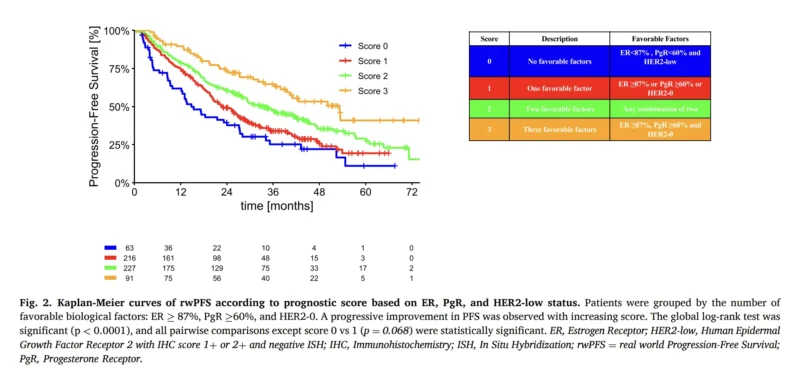
The authors combined three favorable factors: ER expression of at least 87%, PgR expression of at least 60%, and HER2-0 status.
Patients were categorized according to the number of favorable features present. The results showed a clear gradient in outcomes. Median real-world PFS ranged from 14.8 months among patients with none of the favorable factors to 53.2 months among those with all three.
The intermediate groups had median PFS values of 22.8 months for one favorable factor and 32.4 months for two favorable factors.
Because the score relies on standard immunohistochemistry, it could potentially offer a practical approach to prognostic stratification. However, the thresholds were derived within this retrospective dataset and need independent prospective validation before they can be used in routine decision-making.
Outcomes After First-Line Therapy
The overall objective response rate was 44.7%, while the disease control rate was 84.4%.
Patients with higher ER expression had a higher objective response rate, and patients with higher ER or PgR expression had better disease control. The study did not identify a significant association between HER2-low status and response rate or disease control.
The median time to next treatment was 29.5 months. Among patients evaluable for attrition, 16.2% did not transition to second-line treatment and died within 6 months after ending first-line therapy.
More than half of patients received second-line treatment, most commonly chemotherapy. Median real-world PFS in the second-line setting was 6.1 months. ER, PgR, and HER2 status did not significantly influence second-line outcomes, although treatment patterns reflected an earlier treatment landscape and no patient received an antibody–drug conjugate after first-line therapy.
Important Limitations
The retrospective design leaves the possibility of selection bias and incomplete data capture. HER2 assessment was not centrally reviewed, and HER2-ultralow disease could not be evaluated reliably.
The cohort also lacked comprehensive genomic profiling, including information on biomarkers such as PIK3CA mutations that may influence prognosis and subsequent treatment decisions. In addition, the analysis was not designed to compare the three CDK4/6 inhibitors directly.
For these reasons, the proposed score and biomarker thresholds should be viewed as hypothesis-generating rather than as ready for clinical implementation.
Clinical Meaning
CYCLHER adds real-world evidence that routine pathology markers may help refine prognosis in HR-positive/HER2-negative metastatic breast cancer treated with first-line endocrine therapy plus a CDK4/6 inhibitor.
HER2-low disease was associated with shorter progression-free survival, while higher ER and PgR expression were associated with more favorable outcomes. Together, these three variables created a prognostic framework that separated patients into groups with markedly different PFS durations.
Future prospective studies incorporating centralized pathology review, genomic profiling, and contemporary post-CDK4/6 treatment strategies will be needed to determine whether this information can support treatment personalization.
Key Takeaway
In the CYCLHER study, HER2-low status was independently associated with shorter real-world progression-free survival in patients with HR-positive/HER2-negative metastatic breast cancer treated with first-line CDK4/6 inhibitors plus endocrine therapy.
Higher ER and PgR expression were linked to better outcomes, and a three-marker score based on ER, PgR, and HER2 status identified groups with median PFS ranging from 14.8 to 53.2 months.
The results support further investigation of HER2-low disease as a prognostic marker, but they do not yet justify changing first-line treatment decisions.