
Key takeaways
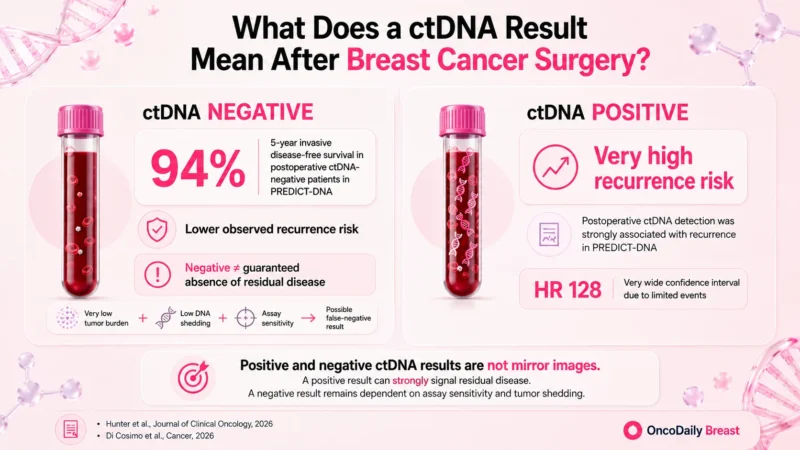
- 94% 5-year IDFS among postoperative ctDNA-negative patients in PREDICT-DNA
- HR 128 Recurrence risk associated with postoperative ctDNA detection in PREDICT-DNA
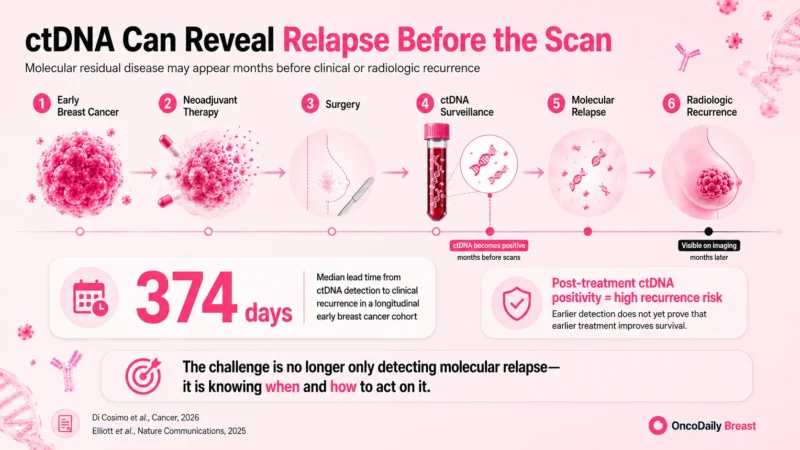
- 374 days Median molecular lead time before recurrence in a longitudinal cohort
- 72% of ctDNA-positive c-TRAK TN intervention patients already had metastatic disease on staging
Circulating tumor DNA is moving closer to one of the most important unanswered questions in early breast cancer: can molecular evidence of residual disease identify relapse early enough to change its course?
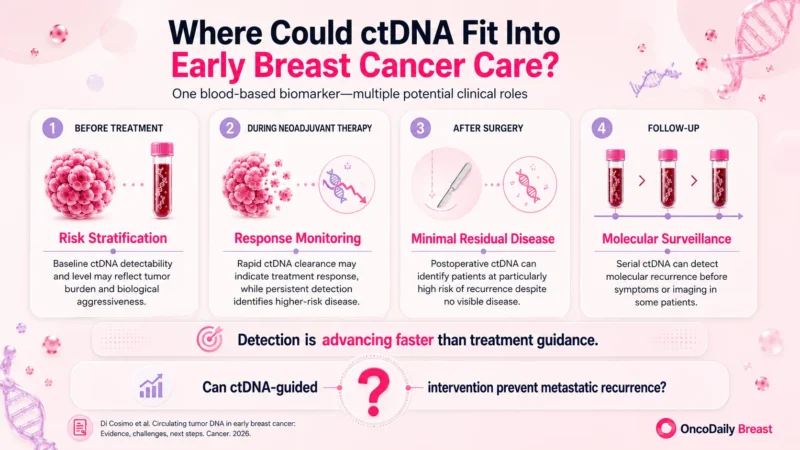
A 2026 narrative review published in Cancer by Serena Di Cosimo and colleagues brings together the rapidly expanding evidence for circulating tumor DNA (ctDNA) across the early breast cancer pathway, from baseline risk assessment and neoadjuvant treatment monitoring to postoperative minimal residual disease detection and molecular surveillance.
The central message is both encouraging and cautious. ctDNA is a powerful prognostic biomarker in early breast cancer, but it is not yet a routinely actionable biomarker. Detectable ctDNA after curative-intent treatment can identify patients at very high risk of recurrence and can precede radiologic or symptomatic relapse by months or even years. However, low tumor DNA shedding, differences between assays, sampling frequency and the absence of definitive evidence that treating molecular relapse improves outcomes remain major barriers to clinical implementation (Di Cosimo et al., 2026).
What Is ctDNA and Why Is It Different From Cell-Free DNA?
Cell-free DNA consists of short DNA fragments circulating in plasma and released from normal and malignant cells. Circulating tumor DNA represents the tumor-derived fraction of this cell-free DNA.
In metastatic cancer, tumor burden can generate sufficient ctDNA for genomic profiling using conventional assays. Early breast cancer presents a more difficult analytical problem because the amount of tumor-derived DNA can be extremely small.
This becomes particularly challenging after surgery, when the clinical objective is to detect molecular residual disease (MRD)—microscopic cancer that remains in the body despite no evidence of disease on conventional imaging or examination.
The 2026 Cancer review emphasizes that ctDNA detection depends not only on whether residual cancer exists but also on tumor biology, tumor volume, vascularity, metastatic location, DNA shedding characteristics, blood collection, plasma processing and assay sensitivity (Di Cosimo et al., 2026).
This explains why a positive ctDNA result and a negative ctDNA result do not carry identical implications.
A positive result can be highly informative. A negative result can sometimes mean that no molecular disease is detectable, but it can also reflect disease below the assay’s detection threshold.
Can Baseline ctDNA Tell Us Which Patients Have Higher-Risk Disease?
Increasing evidence suggests that it can provide prognostic information even before treatment begins.
Di Cosimo and colleagues describe baseline ctDNA detectability and quantitative ctDNA levels as markers that can reflect tumor burden and biological aggressiveness. Higher ctDNA levels have generally been associated with less favorable clinicopathologic features and poorer outcomes, although detectability varies considerably between breast cancer subtypes (Di Cosimo et al., 2026).
Long-term results from the ABCSG-34 trial, published in npj Breast Cancer in 2026, reinforce this point.
Among 109 patients with long-term ctDNA and clinical follow-up, with a median follow-up of 7.1 years, baseline ctDNA positivity was associated with worse overall survival.
Overall survival was 62.7% among ctDNA-positive patients versus 81.2% among ctDNA-negative patients, corresponding to an HR of 2.12. Detectable baseline ctDNA was also associated with shorter event-free intervals across several long-term outcomes (Egle et al., 2026).
These findings support ctDNA as a marker of underlying disease biology, but baseline detection alone does not establish which treatment should be given.
Can ctDNA Show Whether Neoadjuvant Therapy Is Working?
This is one of the most promising applications.
If ctDNA decreases rapidly during neoadjuvant treatment, it can provide a molecular indication that tumor burden is responding. Persistent ctDNA, conversely, has repeatedly been associated with poorer pathologic response and greater recurrence risk.
In a 2025 Nature Communications analysis by Elliott and colleagues, a highly sensitive tumor-informed assay was evaluated in patients receiving neoadjuvant treatment for early breast cancer.
Among 114 patients with baseline samples, ctDNA was detectable in 77.2%. Persistent ctDNA midway through neoadjuvant treatment was associated with recurrence, particularly in HER2-negative disease, and added prognostic information to residual cancer burden assessment (Elliott et al., 2025).
Another 2026 npj Breast Cancer study of patients with stage II–III disease found baseline ctDNA in all 24 patients with evaluable pretreatment plasma. Among patients with baseline-detectable ctDNA, 94% cleared ctDNA during treatment, and postoperative or follow-up detection was associated with recurrence (Cabel et al., 2026).
The evidence therefore increasingly supports ctDNA dynamics rather than a single isolated value as an important area of investigation.
Can ctDNA Replace Pathologic Complete Response?
No, and the prospective PREDICT-DNA study provides an important demonstration of why.
PREDICT-DNA evaluated patients with stage II–III HER2-positive breast cancer or triple-negative breast cancer receiving neoadjuvant therapy using an ultrasensitive tumor-informed assay.
Among 227 enrolled patients, 220 were evaluable for pathologic complete response. Approximately 41% achieved pCR.
All patients achieving pCR were ctDNA-negative after neoadjuvant therapy. However, 40% of patients who did not achieve pCR were also ctDNA-negative.
The negative predictive value for identifying pCR was therefore only 60%, meaning ctDNA negativity could not replace surgical pathology for determining whether residual invasive disease remained (Hunter et al., 2026).
This finding highlights an important biological distinction.
Pathologic response measures residual disease in the breast and regional lymph nodes. ctDNA potentially reflects systemic molecular disease.
A patient can therefore have residual tumor in the breast but no detectable ctDNA in plasma.
Where PREDICT-DNA Became Much More Important
Although ctDNA could not reliably predict pCR, its association with subsequent recurrence was striking.
Detectable ctDNA after neoadjuvant therapy was associated with a substantially increased recurrence risk:
- HR 8.9; 95% CI, 2.4–33
and remained prognostic independently of pCR.
After surgery, the separation became even greater. Detectable postoperative ctDNA was associated with an HR for recurrence of:
- 128; 95% CI, 15–1083
while patients who remained ctDNA-negative after surgery had a 94% 5-year invasive disease-free survival (Hunter et al., 2026).
The very wide confidence interval around the postoperative HR reflects the limited number of events and should temper interpretation of the point estimate.
Nevertheless, the direction of the finding is consistent with a growing body of evidence: post-treatment ctDNA positivity identifies a population at exceptionally high risk of recurrence.
Can ctDNA Detect Breast Cancer Relapse Before Imaging?
In many patients, yes.
This is perhaps the most compelling clinical feature of MRD surveillance.
In the Elliott study, postoperative or follow-up ctDNA positivity had a 100% positive predictive value for recurrence in the analyzed cohort. The median interval between molecular detection and clinical recurrence was:
- 374 days
- with a range from 13 to 1010 days (Elliott et al., 2025).
Earlier breast cancer studies have similarly reported molecular lead times lasting several months before radiologic recurrence. A 2026 npj Breast Cancer study summarized prior evidence as generally showing median lead times of approximately 6–12 months, although the interval depends considerably on tumor subtype, assay sensitivity and sampling schedule (Cabel et al., 2026).
Di Cosimo and colleagues emphasize that newer ultrasensitive approaches can sometimes anticipate recurrence by substantially longer periods, potentially extending into years in individual patients (Di Cosimo et al., 2026).
That creates an attractive clinical concept:
molecular relapse → intervention → prevention or delay of overt metastatic recurrence.
The difficulty is that the middle step has not yet been proven.
Why Is Finding Molecular Relapse Not the Same as Improving Outcomes?
This is currently the central challenge for ctDNA in early breast cancer.
A biomarker can be:
- prognostic, meaning it tells us what is likely to happen,
without being:
- clinically actionable, meaning changing treatment according to that result improves patient outcomes.
Two major 2026 reviews, one in Cancer and another in JAMA Oncology, reach essentially the same conclusion. ctDNA MRD assays have demonstrated strong analytical and clinical validity, but evidence that ctDNA-guided intervention improves outcomes beyond standard care remains limited (Di Cosimo et al., 2026; Schlam et al., 2026).
This distinction matters because detecting recurrence earlier can create a longer period during which a patient knows that molecular disease is present without necessarily having a proven treatment capable of eliminating it.
The clinical value of surveillance therefore depends not simply on finding ctDNA earlier, but on whether intervening at molecular recurrence is superior to waiting for conventional recurrence.
What Did c-TRAK TN Teach Us?
The c-TRAK TN trial, published in Annals of Oncology, was the first prospective breast cancer trial designed to use ctDNA surveillance to trigger therapeutic intervention.
It enrolled patients with moderate- or high-risk early-stage triple-negative breast cancer after definitive treatment.
Among 161 patients undergoing ctDNA surveillance, ctDNA was detected in 44 patients within 12 months, corresponding to a detection rate of 27.3% (Turner et al., 2023).
But an important problem emerged.
Among patients allocated to the intervention arm who became ctDNA-positive, 72% already had metastatic disease detectable on staging scans at the time molecular recurrence was identified.
Only five ultimately began pembrolizumab, and none achieved sustained ctDNA clearance (Turner et al., 2023).
The trial therefore did not show that ctDNA-triggered pembrolizumab could eradicate molecular residual TNBC.
Instead, it produced an important lesson for future studies: the surveillance strategy must detect disease early enough for there to be a genuine molecular-only treatment window.
Does Testing More Frequently Matter?
Probably, but the optimal schedule remains unknown.
Consider a patient whose ctDNA becomes detectable two weeks after a negative blood draw.
If surveillance is performed every three months, molecular relapse could remain undetected for nearly another three months. In an aggressive disease such as TNBC, clinically visible metastases could emerge during that interval.
The 2026 Cancer review identifies sampling frequency as a major determinant of lead time. More intensive surveillance can potentially detect molecular recurrence earlier, but it increases cost, logistical burden and the possibility of uncertain results (Di Cosimo et al., 2026).
The JAMA Oncology review similarly concludes that neither the optimal timing nor frequency of MRD testing in early breast cancer has been established (Schlam et al., 2026).
A universal schedule across all breast cancer subtypes is therefore unlikely to be straightforward.
Why Is a Negative ctDNA Result More Complicated Than a Positive One?
Because early breast cancer can be an extremely low-shedding disease.
A patient can harbor residual malignant cells while releasing too little tumor DNA into plasma for detection.
This is particularly relevant when disease volume is microscopic.
Assay sensitivity therefore becomes fundamental. A negative result from a method capable of detecting tumor fractions at extremely low concentrations is not equivalent to a negative result from a less-sensitive assay.
Elliott and colleagues used a tumor-informed assay with a reported analytical limit of detection around 0.001%, allowing detection of extremely small ctDNA fractions. Even with a highly sensitive method, however, most patients who later relapsed were not ctDNA-positive at the immediate postoperative measurement and became positive only during longitudinal surveillance (Elliott et al., 2025).
This suggests that serial testing may be more informative than a single postoperative blood draw.
Why Do Breast Cancer Subtypes Matter?
Breast cancer is not biologically uniform, and neither is ctDNA shedding.
Tumor proliferation, burden, vascularity, metastatic pattern and genomic complexity can influence how much tumor DNA enters the bloodstream.
HR-positive/HER2-negative cancers can be particularly challenging because they can relapse many years after initial treatment and can sometimes have relatively low ctDNA shedding.
By contrast, more proliferative cancers such as TNBC can produce greater circulating tumor DNA levels but can also progress rapidly, narrowing the time between molecular detection and clinically apparent relapse.
The 2026 reviews therefore argue against interpreting ctDNA results without considering breast cancer subtype, disease stage, treatment history and assay characteristics (Di Cosimo et al., 2026; Schlam et al., 2026).
Tumor-Informed or Tumor-Agnostic Testing?
This is another major methodological debate.
Tumor-informed assays first sequence a patient’s tumor and identify a personalized collection of mutations. Plasma is then repeatedly analyzed for those specific alterations.
The advantage is high specificity and potentially very high sensitivity because the assay knows exactly which genomic signals to search for.
The disadvantages include dependence on adequate tumor tissue, additional sequencing steps and longer assay development.
Tumor-agnostic approaches do not require prior sequencing of the tumor. They can analyze predefined genomic alterations or integrate other biological features such as methylation or fragmentation patterns.
Di Cosimo and colleagues highlight growing interest in multimodal cell-free DNA approaches, in which mutation detection can be combined with epigenetic, fragmentomic or other molecular signals to improve detection when the absolute amount of ctDNA is extremely low.
The optimal strategy for MRD detection in early breast cancer remains unsettled.
Can ctDNA Be Used to Escalate Adjuvant Therapy?
Conceptually, this is one of its most attractive applications.
A patient with otherwise apparently cured early breast cancer who remains ctDNA-positive after surgery has a substantially higher recurrence risk than a similar patient who remains molecularly negative.
Such patients could represent an ideal population for testing additional therapy.
Instead of escalating treatment according only to stage, nodal status, residual cancer burden or genomic risk scores, future trials could select patients according to direct evidence that molecular disease remains present.
PREDICT-DNA provides particularly strong support for investigating this strategy because postoperative ctDNA positivity identified an extremely high-risk population despite conventional curative-intent therapy (Hunter et al., 2026).
But this remains a research strategy.
No prospective breast cancer trial has yet demonstrated that escalating therapy solely because ctDNA becomes positive improves survival sufficiently to establish routine use. Both major 2026 reviews emphasize this gap (Di Cosimo et al., 2026; Schlam et al., 2026).
Could ctDNA Also Help De-Escalate Treatment?
Potentially, and this may ultimately be equally important.
PREDICT-DNA found that postoperative ctDNA-negative patients had a 94% 5-year invasive disease-free survival, suggesting that molecular negativity can identify populations with particularly favorable outcomes (Hunter et al., 2026).
This raises the possibility of using ctDNA to identify patients who might safely avoid additional systemic therapy.
However, de-escalation requires especially strong evidence because a false-negative result could lead to withholding potentially curative treatment.
The high prognostic value of ctDNA negativity therefore does not itself justify treatment omission.
Prospective randomized trials would need to demonstrate that ctDNA-guided de-escalation preserves disease control while reducing toxicity.
What Are the Main Barriers to Routine ctDNA Use?
The barriers are no longer primarily about whether ctDNA carries biological information. The evidence that it does is substantial.
The major barriers now involve standardization and clinical actionability.
Assays differ in which mutations they track, how many variants they follow, sequencing depth, error suppression, detection thresholds and whether they incorporate genomic or epigenomic information.
Blood collection timing and plasma processing can also influence the amount and quality of recoverable cell-free DNA.
Tumor shedding itself varies across patients and disease subtypes.
And there remains no universally established definition of the optimal postoperative MRD window, surveillance frequency or management of an isolated positive result.
Di Cosimo and colleagues identify these biological, preanalytical and analytical variables as central reasons why ctDNA has not yet entered routine early breast cancer management (Di Cosimo et al., 2026).
The Next Step Is Not Simply a Better Test
Increasing analytical sensitivity is important, but the larger clinical question has shifted.
The field already knows that highly sensitive ctDNA assays can identify patients who are likely to relapse.
The next generation of trials needs to demonstrate that acting on that information changes what happens to the patient.
That means determining whether molecular relapse represents a therapeutic window during which residual cancer can still be eradicated, or whether it is simply an earlier marker of metastatic disease that has already become biologically established.
It also means determining whether persistent ctDNA during neoadjuvant therapy should trigger an early treatment switch, whether postoperative positivity warrants additional systemic treatment, and whether sustained molecular negativity can safely support treatment de-escalation.
As Schlam and colleagues concluded in their 2026 JAMA Oncology review, the clinical utility of ctDNA remains unproven despite established analytical and prognostic validity.
The Bottom Line
ctDNA has become one of the most promising biomarkers in early breast cancer.
Evidence now supports several important observations.
Baseline ctDNA can contribute prognostic information. Changes during neoadjuvant treatment can reflect treatment response. Persistent or recurrent ctDNA after curative-intent therapy identifies patients at particularly high risk of relapse. And longitudinal surveillance can detect molecular recurrence months before conventional clinical recurrence (Di Cosimo et al., 2026).
Recent studies make the prognostic signal increasingly difficult to ignore.
In PREDICT-DNA, postoperative ctDNA positivity was associated with an HR for recurrence of 128, while ctDNA-negative patients had 94% 5-year IDFS. In another longitudinal cohort, postoperative or surveillance ctDNA detection had a 100% positive predictive value for recurrence, with a median 374-day lead time (Hunter et al., 2026; Elliott et al., 2025).
But c-TRAK TN showed the other side of the problem: by the time ctDNA became detectable under its surveillance strategy, 72% of ctDNA-positive patients allocated to intervention already had metastatic disease on imaging (Turner et al., 2023).
The central question in 2026 is therefore no longer:
Can ctDNA predict breast cancer recurrence?
Increasingly, it can.
The question is:
Can clinicians intervene at molecular relapse early enough, and with an effective enough therapy, to prevent clinical recurrence?
Until prospective interventional trials answer that question, ctDNA in early breast cancer remains a powerful predictor searching for a proven therapeutic action.
References
- Di Cosimo S, Appierto V, Reduzzi C, De Cecco L, Valenza C, Gerratana L, Agostinetto E, Llombart-Cussac A, Ignatiadis M, Cortes J, Cristofanilli M, Fusco N, Curigliano G, Pruneri G. Circulating tumor DNA in early breast cancer: Evidence, challenges, next steps. Cancer. 2026;132(14):e70521. doi:10.1002/cncr.70521.
- Schlam I, Tolaney SM, Lin NU, Parsons H, Morganti S. Circulating Tumor DNA in Early Breast Cancer: A Review. JAMA Oncology. 2026;12(7):773–784. doi:10.1001/jamaoncol.2026.1465.
- Hunter NB, et al. The Pathologic Response Evaluation and Detection in Circulating Tumor-DNA Study: Ultrasensitive Circulating Tumor-DNA Assessment of Breast Cancer Minimal Residual Disease. Journal of Clinical Oncology. 2026. doi:10.1200/JCO-25-02934.
- Elliott MJ, Echelard P, Pipinikas C, et al. Longitudinal evaluation of circulating tumor DNA in patients undergoing neoadjuvant therapy for early breast cancer using a tumor-informed assay. Nature Communications. 2025;16:1837. doi:10.1038/s41467-025-56658-4.
- Turner NC, Swift C, Jenkins B, et al. Results of the c-TRAK TN trial: a clinical trial utilising ctDNA mutation tracking to detect molecular residual disease and trigger intervention in patients with moderate- and high-risk early-stage triple-negative breast cancer. Annals of Oncology. 2023;34:200–211. doi:10.1016/j.annonc.2022.11.005.
- Egle D, Hlauschek D, Gampenrieder SP, et al. Long-term prognostic value of ctDNA in early breast cancer: insights from the neoadjuvant ABCSG-34 Trial. npj Breast Cancer. 2026;12:77. doi:10.1038/s41523-026-00934-z.
- Cabel L, An JAR, Kim HK, et al. Monitoring of circulating tumor DNA in patients with stage II-III breast cancer treated with neoadjuvant chemotherapy. npj Breast Cancer. 2026;12:22. doi:10.1038/s41523-025-00878-w.