





Ten years after the first FDA approval of a CDK4/6 inhibitor, the field is no longer asking whether CDK inhibition works in breast cancer. That question has already been answered.
The more important question now is different: how can CDK inhibitors be used more intelligently, more safely, and beyond their current limits?
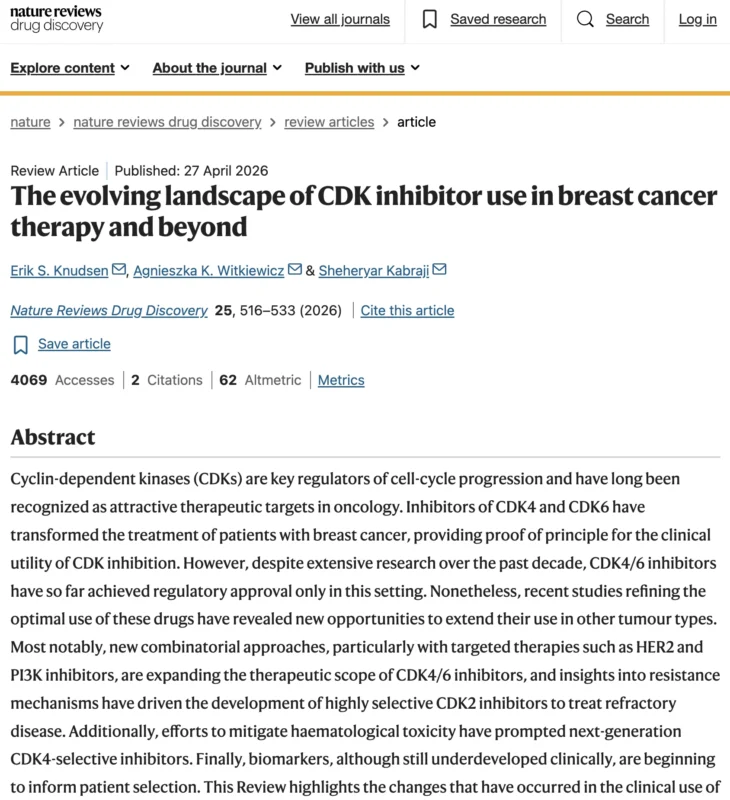
A new review published in Nature Reviews Drug Discovery, examines the changing role of CDK inhibitors in breast cancer and the broader oncology landscape. The review highlights how CDK4/6 inhibitors transformed treatment for hormone receptor-positive breast cancer, while also showing that the next phase of progress will depend on combinations, resistance biology, next-generation inhibitors, and better biomarkers.
A Decade of Clinical Proof in Breast Cancer
Cyclin-dependent kinases are central regulators of cell-cycle progression. For decades, they were considered attractive oncology targets, but clinical translation was difficult.
That changed with selective CDK4/6 inhibitors.
In HR-positive/HER2-negative breast cancer, CDK4/6 inhibitors became one of the defining therapeutic advances of the modern era. Palbociclib, ribociclib, and abemaciclib established that cell-cycle control could be targeted successfully in a common solid tumor.
The review emphasizes that breast cancer remains the clearest proof of principle for CDK inhibition in oncology. However, despite years of research, CDK4/6 inhibitors have so far achieved regulatory approval primarily in this setting.
That creates both confidence and frustration: the biology is powerful, but translating it beyond breast cancer has been harder than expected.
The Field Is Moving From “Use” to “Optimization”
The first decade of CDK4/6 inhibition was about establishing efficacy.
The next decade may be about optimization.
In breast cancer, this includes deciding when CDK4/6 inhibition should be used, how long it should be continued, how to sequence therapy after progression, and how to select patients most likely to benefit.
The review points to several areas of active development: earlier-stage disease, post-progression strategies, rational combinations, biomarkers of sensitivity and resistance, and new CDK-directed agents.
This is especially relevant because CDK4/6 inhibitors are now being used across multiple breast cancer settings, including metastatic disease and selected high-risk early breast cancer.
Combination Strategies Are Expanding the Therapeutic Scope
One of the most important themes of the review is combination therapy.
CDK4/6 inhibitors are increasingly being paired with other targeted approaches, including HER2-directed therapy and PI3K pathway inhibition. These combinations reflect a deeper understanding that cell-cycle signaling does not operate in isolation.
In HR-positive/HER2-negative disease, PI3K pathway alterations, endocrine resistance, and CDK4/6 inhibitor resistance are closely connected. In HER2-positive disease, CDK4/6 inhibition is also being explored as part of strategies that combine endocrine therapy and HER2 blockade.
The review frames these combinations as a way to extend the value of CDK4/6 inhibitors beyond their original clinical niche.
Resistance Is Now Driving Drug Development
Resistance remains one of the biggest challenges in CDK4/6 inhibitor therapy.
Tumors may escape through multiple mechanisms, including changes in RB pathway control, cyclin E/CDK2 activation, loss of endocrine dependence, PI3K pathway activation, and broader cell-cycle plasticity.
This has shifted the field toward next-generation approaches.
One major direction is the development of selective CDK2 inhibitors, designed to address resistance states where CDK2 becomes a key driver of cell-cycle progression. Another direction is the development of CDK4-selective inhibitors, which may help preserve efficacy while reducing hematologic toxicity linked to CDK6 inhibition.
This is an important evolution. The field is not simply trying to make “another CDK4/6 inhibitor.” It is trying to understand which CDK matters, in which tumor, at which time, and under which resistance pressure.
Toxicity Is Also Shaping the Next Generation
CDK4/6 inhibitors are highly effective, but toxicity remains clinically relevant.
Hematologic toxicity, particularly neutropenia, is a major issue with some CDK4/6 inhibitors. Diarrhea and fatigue can also affect adherence and quality of life, depending on the agent.
The review highlights efforts to mitigate toxicity through next-generation CDK4-selective inhibitors. The logic is biologically attractive: preserve antitumor cell-cycle suppression while reducing effects on hematopoietic cells.
Whether this approach will translate into meaningful clinical advantage remains an active question, but it reflects a more mature phase of drug development.
Biomarkers Remain the Unfinished Part of the Story
Perhaps the most important limitation in the field is biomarker development.
Despite the success of CDK4/6 inhibitors in breast cancer, clinically useful predictive biomarkers remain underdeveloped. Current treatment decisions still rely heavily on clinical subtype, disease setting, endocrine sensitivity, and trial eligibility rather than a precise biomarker that predicts benefit or resistance.
The review notes that biomarkers are beginning to inform patient selection, but this area remains incomplete.
This is a major gap. As new CDK inhibitors enter development, and as combinations become more complex, biomarker-driven selection will become increasingly important. Without it, the field risks exposing patients to toxicity without knowing who is most likely to benefit.
Beyond Breast Cancer: Promise, But No Simple Translation
CDK biology is relevant across many cancers, but success outside breast cancer has been more limited.
The review discusses the broader potential of CDK inhibitors in other tumor types, including rational combinations and histology-agnostic approaches guided by molecular vulnerabilities.
However, one lesson is clear: single genetic alterations may not be enough to predict response. The cell cycle is highly adaptable, and tumors can compensate through alternative pathways.
This helps explain why CDK inhibitor development outside breast cancer has been challenging. The biology is not wrong, but patient selection and combination design need to be more refined.
What This Means for Breast Oncology
For breast cancer specialists, this review is a reminder that CDK inhibition is no longer a single therapeutic category with one clinical question.
It now includes several overlapping questions:
- How should CDK4/6 inhibitors be optimized in early breast cancer?
- Which patients benefit most in metastatic disease?
- What should be done after progression?
- Can CDK2 inhibition overcome resistance?
- Can CDK4-selective drugs reduce toxicity?
- Can biomarkers finally guide treatment selection?
These questions will define the next chapter of CDK-directed therapy.
The Bottom Line
The first decade of CDK4/6 inhibitors changed breast cancer care.
The next decade will likely be defined by refinement.
According to the Nature Reviews Drug Discovery review, the field is moving toward smarter combinations, resistance-directed strategies, next-generation CDK2 and CDK4-selective inhibitors, and better biomarker development.
For OncoDaily Breast readers, the message is clear: CDK inhibition is no longer just a success story. It is an evolving therapeutic platform.
The challenge now is to move from broad use to biologically precise use.
References
- Knudsen ES, Witkiewicz AK, Kabraji S. The evolving landscape of CDK inhibitor use in breast cancer therapy and beyond. Nature Reviews Drug Discovery. 2026;25:516-533. doi:10.1038/s41573-026-01431-5.
- Morrison L, Loibl S, Turner NC. The CDK4/6 inhibitor revolution — a game-changing era for breast cancer treatment. Nature Reviews Clinical Oncology. 2024;21:89-105.
- Rastogi P, O’Shaughnessy J, Martin M, et al. Adjuvant abemaciclib plus endocrine therapy for hormone receptor-positive, HER2-negative, high-risk early breast cancer: 5-year efficacy outcomes. Journal of Clinical Oncology. 2024;42:987-993.
- Crown J, Stroyakovskiy D, Yardley DA, et al. Adjuvant ribociclib plus nonsteroidal aromatase inhibitor therapy in patients with HR-positive/HER2-negative early breast cancer: 5-year follow-up of NATALEE efficacy outcomes and updated overall survival. ESMO Open. 2025;10:105858.
- Kalinsky K, Bianchini G, Hamilton E, et al. Abemaciclib plus fulvestrant in advanced breast cancer after progression on CDK4/6 inhibition: results from the phase III postMONARCH trial. Journal of Clinical Oncology. 2025;43:1101-1112.