
The NCCN Clinical Practice Guidelines in Oncology for Breast Cancer, Version 4.2026, provide an updated framework for the management of recurrent unresectable or stage IV metastatic breast cancer.
The new JNCCN guideline article focuses on metastatic disease and organizes treatment around tumor biology, prior therapy, disease-free interval, disease burden, visceral crisis, HER2 expression, germline and somatic biomarkers, and patient-centered goals.
The central message is clear: metastatic breast cancer treatment is no longer defined only by hormone receptor status and HER2 status. It increasingly depends on when recurrence occurs, which targeted therapies have already been used, whether bone or visceral disease is present, and whether actionable biomarkers such as PIK3CA, AKT1, PTEN, ESR1, BRCA1/2, PALB2, MSI-H/dMMR, TMB-H, NTRK fusions, RET fusions, FGFR alterations, or HER2 mutations are found.
At the same time, the guidelines continue to emphasize supportive care, quality of life, toxicity minimization, shared decision-making, and clinical trial participation throughout all treatment lines.
First Principles: Biology, Prior Therapy, and Patient Goals
For recurrent or de novo stage IV breast cancer, NCCN recommends that treatment strategy be guided by tumor biology and clinical factors.
These include hormone receptor status, HER2 expression, prior adjuvant therapy, disease-free interval, cumulative prior drug exposure, disease tempo, metastatic sites, performance status, comorbidities, and patient preference.
A recurrence more than 12 months after completing adjuvant therapy may allow rechallenge with prior agents in selected settings. In contrast, recurrence within 12 months of completing adjuvant therapy generally suggests acquired resistance and usually supports switching to a different drug class.
This distinction is particularly important in hormone receptor-positive disease, where endocrine resistance shapes the next treatment decision.
The guideline also makes a clear palliative-care point: metastatic breast cancer treatment aims to prolong survival, relieve symptoms, maintain or improve quality of life, and minimize toxicity.
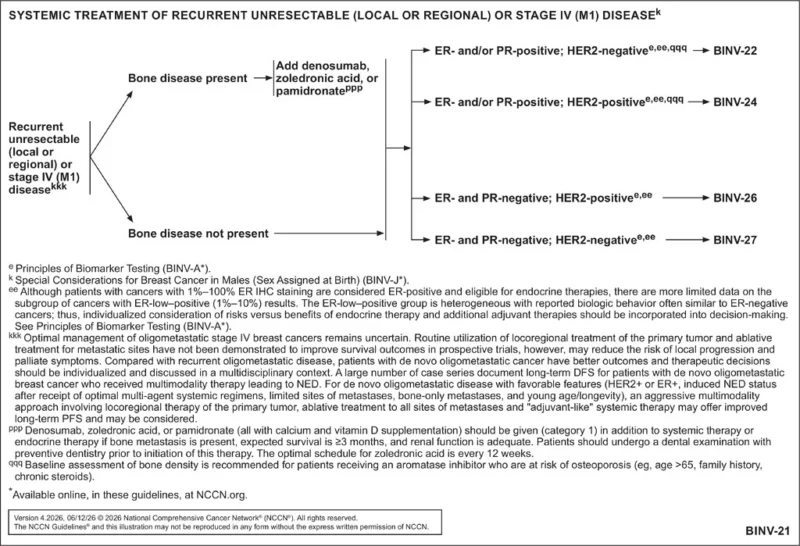
Bone Metastases: Bone-Modifying Agents Remain Standard
For patients with bone metastases, NCCN recommends adding a bone-modifying agent to systemic or endocrine therapy when expected survival is at least 3 months and renal function is adequate.
Recommended options include denosumab, zoledronic acid, or pamidronate.
The guideline notes that bisphosphonates reduce skeletal-related events, pathologic fractures, and the need for radiation therapy or surgery for bone pain, but do not improve overall survival.
For zoledronic acid, NCCN recommends an optimal dosing interval of every 12 weeks, based on randomized trials showing that 12-week dosing did not compromise efficacy compared with 4-week dosing.
The guideline also emphasizes calcium and vitamin D supplementation, renal monitoring for bisphosphonates, and dental evaluation before starting bisphosphonate or denosumab therapy because of the risk of osteonecrosis of the jaw.
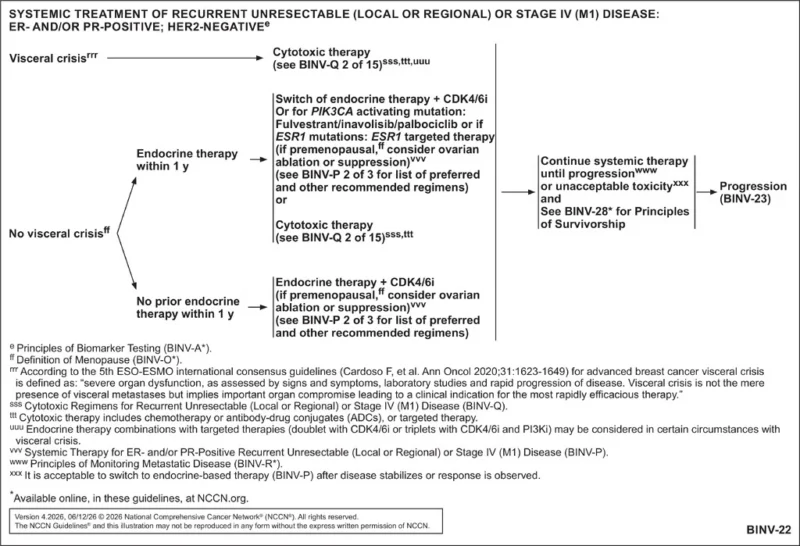
HR-Positive, HER2-Negative Disease: Endocrine-Based Therapy Remains the Backbone
For hormone receptor-positive, HER2-negative metastatic breast cancer, endocrine-based therapy remains the preferred backbone for patients without visceral crisis.
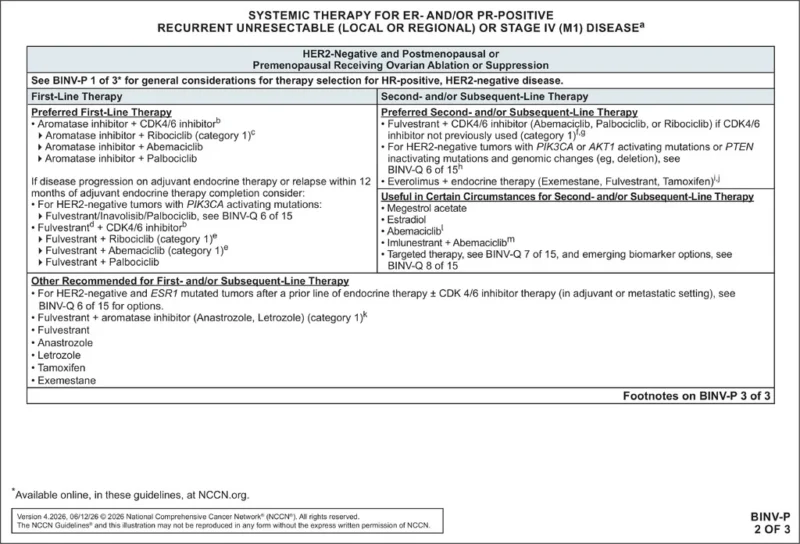
NCCN continues to list aromatase inhibitor plus CDK4/6 inhibitor as the preferred first-line approach in postmenopausal patients and in premenopausal patients receiving ovarian ablation or suppression.
Ribociclib plus aromatase inhibitor is listed as a category 1 option, reflecting overall survival benefit in MONALEESA trials. Abemaciclib and palbociclib plus aromatase inhibitor remain category 2A options.
The guideline also highlights that CDK4/6 inhibitors have not been directly compared in randomized trials, and treatment selection should consider efficacy, toxicity, comorbidities, monitoring requirements, and patient preference.
For patients with disease progression on adjuvant endocrine therapy or relapse within 12 months of completing adjuvant endocrine therapy, NCCN includes fulvestrant-based combinations with targeted agents or CDK4/6 inhibitors.
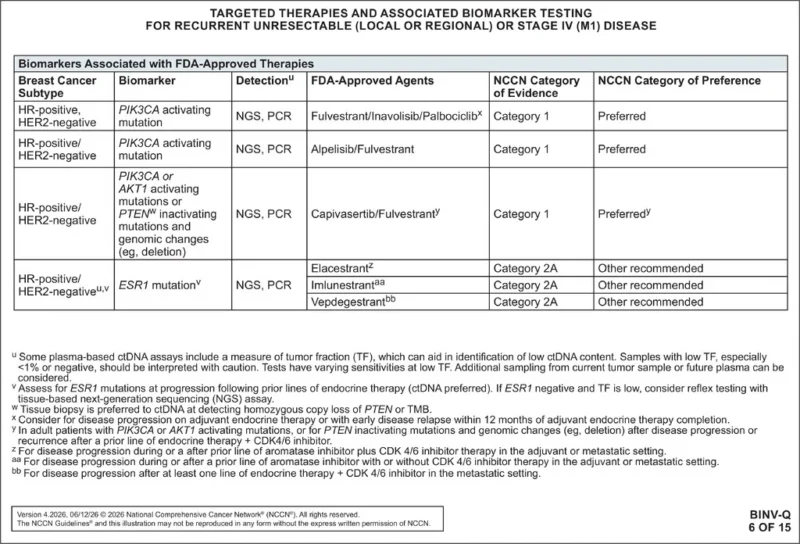
PIK3CA, AKT1, PTEN, and ESR1 Testing Now Shape Later-Line Choices
The 2026 guideline further reinforces biomarker-directed treatment in HR-positive, HER2-negative disease.
For PIK3CA-activating mutations, fulvestrant/inavolisib/palbociclib is listed as a category 1 preferred option after progression on or early relapse after adjuvant endocrine therapy, based on INAVO120.
Alpelisib plus fulvestrant remains a category 1 preferred option for PIK3CA-mutated disease.
For tumors with PIK3CA or AKT1 activating mutations, or PTEN inactivating mutations or genomic changes, capivasertib plus fulvestrant is also listed as a category 1 preferred option after progression on prior endocrine-based therapy.
For ESR1-mutated tumors after prior endocrine therapy, NCCN lists elacestrant, imlunestrant, and vepdegestrant as options.
The guideline recommends assessing for ESR1 mutations at progression after prior endocrine therapy, with ctDNA preferred. However, it cautions that plasma tests with low tumor fraction should be interpreted carefully, and tissue-based testing may be considered when ctDNA is negative or uninformative.
This reflects a broader shift: treatment selection in metastatic breast cancer increasingly depends on repeated biomarker assessment as resistance emerges.
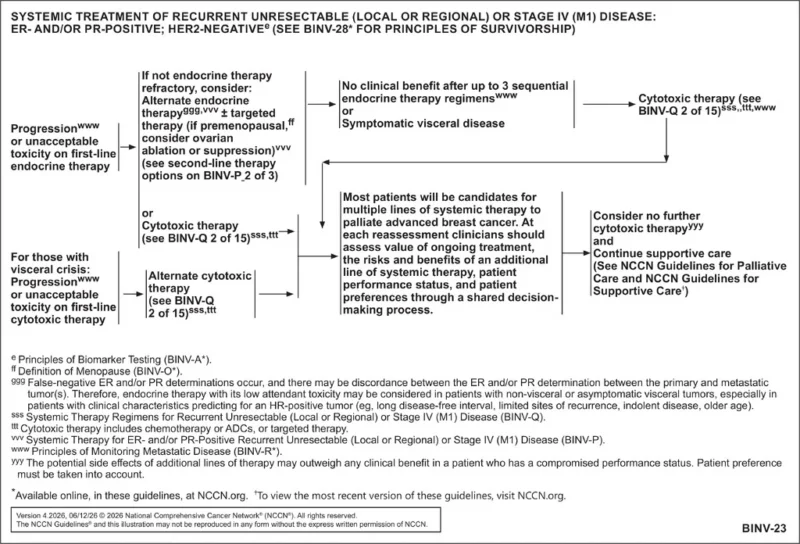
ADCs Expand Across HER2-Low, HER2-Ultralow, and Endocrine-Refractory Disease
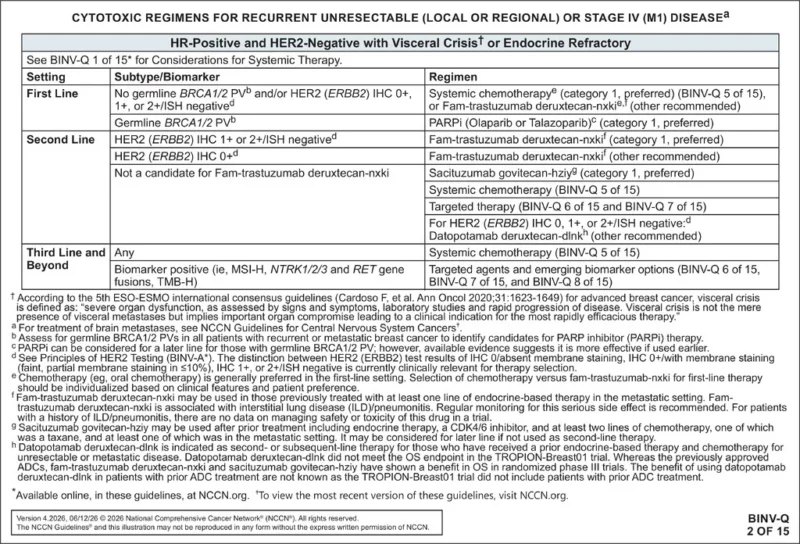
For HR-positive, HER2-negative metastatic breast cancer that becomes endocrine refractory or presents with visceral crisis, NCCN includes cytotoxic regimens, antibody-drug conjugates, and targeted therapies.
Fam-trastuzumab deruxtecan-nxki is included as an option for patients with HER2 IHC 0+, 1+, or 2+/ISH-negative disease who were previously treated with at least one line of endocrine-based therapy in the metastatic setting.
The guideline discusses DESTINY-Breast06, where trastuzumab deruxtecan improved progression-free survival versus chemotherapy in patients with HR-positive, HER2-low or HER2-ultralow metastatic breast cancer previously treated with endocrine therapy and without prior chemotherapy for metastatic disease.
However, NCCN notes that overall survival data were not yet statistically significant and that the trial did not allow crossover. Therefore, the optimal timing of trastuzumab deruxtecan versus later-line use remains a clinical sequencing question.
In the second-line and later setting, fam-trastuzumab deruxtecan, sacituzumab govitecan, and datopotamab deruxtecan are included among options, with distinctions based on HER2 expression, prior treatment, survival benefit, and toxicity profile.
The guideline repeatedly highlights the need to monitor for interstitial lung disease or pneumonitis with trastuzumab deruxtecan.
HER2-Positive Disease: THP Still Preferred First Line, With T-DXd Plus Pertuzumab as an Alternative
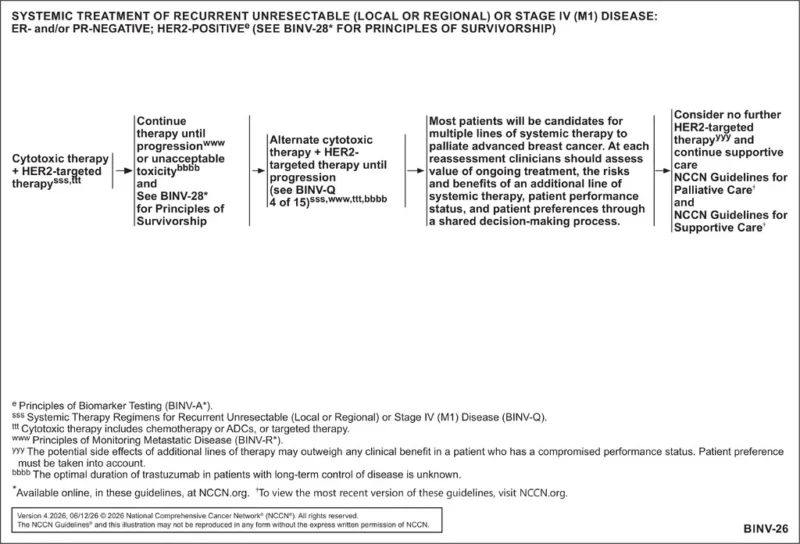
For HER2-positive metastatic breast cancer, NCCN continues to recommend HER2-targeted therapy in combination with cytotoxic therapy.
Docetaxel, trastuzumab, and pertuzumab followed by maintenance trastuzumab and pertuzumab remains a category 1 preferred first-line regimen, based on CLEOPATRA. Paclitaxel with trastuzumab and pertuzumab is also listed as a preferred option.
A major addition in Version 4.2026 is fam-trastuzumab deruxtecan-nxki plus pertuzumab as another recommended first-line option.
The guideline cites DESTINY-Breast09, where trastuzumab deruxtecan plus pertuzumab improved median progression-free survival compared with THP. Median PFS was 40.7 months with trastuzumab deruxtecan plus pertuzumab versus 26.9 months with THP.
However, NCCN does not position this as the preferred first-line option for most patients.
The reason is important: trastuzumab deruxtecan carries a risk of interstitial lung disease or pneumonitis, including rare fatal events, and DESTINY-Breast09 did not allow crossover. Because trastuzumab deruxtecan is active in later lines, the trial does not fully answer whether frontline use is superior to later-line use for all patients.
For most patients with previously untreated HER2-positive metastatic breast cancer, THP remains the preferred approach.
HER2-Positive Later Lines: CNS Disease Remains Central to Sequencing
For HER2-positive metastatic disease, NCCN lists capecitabine/tucatinib plus trastuzumab as a category 1 preferred option in patients with both systemic and CNS progression in the third-line setting and beyond, and notes that it may be given in the second-line setting.
Fam-trastuzumab deruxtecan is also a category 1 preferred option in second or third line.
The guideline discusses DESTINY-Breast03 and DESTINY-Breast02, where trastuzumab deruxtecan improved progression-free survival and overall survival compared with T-DM1 or physician’s choice therapy.
T-DM1 remains an option, particularly when a patient is not a candidate for trastuzumab deruxtecan.
For later lines, NCCN lists several HER2-directed combinations, while noting that the optimal sequence after pertuzumab-based therapy, T-DM1, trastuzumab deruxtecan, and tucatinib-containing regimens remains unknown.
This is a key practical issue for clinicians: the number of active HER2-directed therapies has grown, but evidence-based sequencing after modern first- and second-line therapy remains incomplete.
HR-Positive, HER2-Positive Disease: Maintenance Therapy Becomes More Nuanced
For HR-positive, HER2-positive metastatic breast cancer, endocrine therapy may be used with HER2-targeted therapy in selected settings, especially after initial chemotherapy plus trastuzumab and pertuzumab.
The guideline discusses PATINA, which evaluated maintenance endocrine therapy with or without palbociclib in combination with anti-HER2 therapy after induction chemotherapy. Median PFS was 44 months with palbociclib versus 29 months without it.
NCCN notes that after taxane-based chemotherapy with pertuzumab and trastuzumab, maintenance endocrine therapy with an aromatase inhibitor, with or without palbociclib, may be added to maintenance trastuzumab and pertuzumab.
This reflects a growing effort to personalize maintenance therapy in hormone receptor-positive, HER2-positive disease while balancing benefit and toxicity.
Triple-Negative Breast Cancer: First-Line Choices Now Depend on PD-L1 and BRCA Status
For metastatic triple-negative breast cancer, NCCN organizes first-line therapy around PD-L1 combined positive score and germline BRCA1/2 pathogenic variant status.
For PD-L1 CPS ≥10, preferred first-line options include chemotherapy plus pembrolizumab or sacituzumab govitecan plus pembrolizumab.
The guideline cites KEYNOTE-355, where pembrolizumab plus chemotherapy improved outcomes in patients with PD-L1 CPS ≥10.
It also includes ASCENT-04/KEYNOTE-D19, where sacituzumab govitecan plus pembrolizumab improved progression-free survival compared with chemotherapy plus pembrolizumab in previously untreated PD-L1-positive locally advanced unresectable or metastatic TNBC.
For PD-L1 CPS <10 and no germline BRCA1/2 pathogenic variant, NCCN lists sacituzumab govitecan and datopotamab deruxtecan as category 1 preferred first-line options, along with systemic chemotherapy.
For PD-L1 CPS <10 and germline BRCA1/2 pathogenic variant, PARP inhibitors or platinum therapy are preferred category 1 options.
This is a major evolution in TNBC treatment: first-line therapy is increasingly shaped by immune biomarkers, germline testing, and ADC availability.
Germline Testing Is Essential in Recurrent or Metastatic Breast Cancer
NCCN recommends assessing germline BRCA1/2 pathogenic variants in all patients with recurrent or metastatic breast cancer to identify candidates for PARP inhibitor therapy.
Olaparib and talazoparib are category 1 preferred options for germline BRCA1/2 pathogenic variants.
Although FDA indications are in HER2-negative disease, the NCCN panel supports PARP inhibitor use in any breast cancer subtype associated with a germline BRCA1/2 pathogenic variant, while acknowledging lower-level evidence for HER2-positive tumors.
NCCN also includes olaparib as an option for germline PALB2-mutated disease previously treated with chemotherapy, based on phase II data, although this is not an FDA-approved indication.
Tumor-Agnostic and Emerging Biomarkers Enter the Breast Cancer Algorithm
The guideline includes targeted therapies for rare but clinically actionable biomarkers in metastatic breast cancer.
These include NTRK1/2/3 fusions, MSI-H/dMMR, TMB-high tumors, RET fusions, HER2 activating mutations, somatic BRCA1/2 mutations, and FGFR1-3 alterations.
For NTRK fusions, entrectinib, larotrectinib, or repotrectinib may be used in appropriate settings.
For MSI-H/dMMR tumors, pembrolizumab or dostarlimab-gxly are listed options.
For TMB-high tumors, pembrolizumab is included.
For RET fusion-positive tumors, selpercatinib is listed.
The guideline also includes emerging options useful in certain circumstances, such as HER2 mutation-directed therapy and FGFR-targeted therapy, while acknowledging that the data remain limited.
This section highlights a growing reality in breast oncology: rare biomarkers may matter, even in a disease historically classified by ER, PR, and HER2 alone.
Shared Decision-Making Is Not Optional
Across subtypes, NCCN repeatedly emphasizes that most patients with metastatic breast cancer may be candidates for multiple lines of systemic therapy.
At each reassessment, clinicians should evaluate the value of continuing treatment, the risks and benefits of another line of therapy, performance status, patient goals, toxicity burden, and preferences.
The guideline also notes that in patients with compromised performance status, additional lines of therapy may offer more harm than benefit.
This is an important counterbalance to the expanding treatment landscape.
More options do not automatically mean more benefit for every patient.
The goal remains to choose treatment that is clinically meaningful, tolerable, and aligned with patient priorities.
The Bottom Line
NCCN Breast Cancer Version 4.2026 reflects a metastatic treatment landscape that is increasingly biomarker-directed, subtype-specific, and sequencing-focused.
For HR-positive, HER2-negative disease, endocrine therapy plus CDK4/6 inhibition remains central, with growing use of PIK3CA, AKT1, PTEN, and ESR1 testing to guide later-line therapy.
For HER2-positive disease, THP remains the preferred first-line regimen for most patients, while trastuzumab deruxtecan plus pertuzumab becomes an important alternative in selected cases.
For triple-negative breast cancer, first-line therapy now depends heavily on PD-L1 CPS and germline BRCA1/2 status, with ADCs moving earlier in the treatment pathway.
Across all subtypes, the guidelines reinforce the same principle: metastatic breast cancer care must combine precision medicine with toxicity awareness, supportive care, clinical trial access, and shared decision-making.
The question is no longer only which drug works.
It is which treatment sequence offers the most meaningful benefit for this patient, at this moment, with the least unnecessary harm.
References
- Gradishar WJ, Moran MS, Abraham J, Abramson V, Aft R, Agnese D, et al. Breast Cancer, Version 4.2026, NCCN Clinical Practice Guidelines in Oncology. Journal of the National Comprehensive Cancer Network. 2026;24(7). doi:10.6004/jnccn.2026.0033.
- Cardoso F, Paluch-Shimon S, Senkus E, et al. 5th ESO-ESMO international consensus guidelines for advanced breast cancer. Annals of Oncology. 2020;31:1623–1649.
- Hortobagyi GN, Stemmer SM, Burris HA, et al. Overall survival with ribociclib plus letrozole in advanced breast cancer. New England Journal of Medicine. 2022;386:942–950.
- Jhaveri KL, Im SA, Saura C, et al. Overall survival with inavolisib in PIK3CA-mutated advanced breast cancer. New England Journal of Medicine. 2025;393:151–161.
- Jhaveri KL, Neven P, Casalnuovo ML, et al. Imlunestrant with or without abemaciclib in advanced breast cancer. New England Journal of Medicine. 2025;392:1189–1202.
- Lu YS, Mahidin EIBM, Azim H, et al. Final results of RIGHT Choice: ribociclib plus endocrine therapy versus combination chemotherapy in premenopausal women with clinically aggressive HR-positive/HER2-negative advanced breast cancer. Journal of Clinical Oncology. 2024;42:2812–2821.
- Turner NC, Im SA, Saura C, et al. Inavolisib-based therapy in PIK3CA-mutated advanced breast cancer. New England Journal of Medicine. 2024;391:1584–1596.
- Turner NC, Oliveira M, Howell SJ, et al. Capivasertib in hormone receptor-positive advanced breast cancer. New England Journal of Medicine. 2023;388:2058–2070.
- Bardia A, Cortes J, Bidard FC, et al. Elacestrant in ER-positive, HER2-negative metastatic breast cancer with ESR1-mutated tumors: subgroup analyses from the phase III EMERALD trial. Clinical Cancer Research. 2024;30:4299–4309.
- Lu YS, Im SA, Colleoni M, et al. Updated overall survival of ribociclib plus endocrine therapy versus endocrine therapy alone in pre- and perimenopausal patients with HR-positive/HER2-negative advanced breast cancer in MONALEESA-7. Clinical Cancer Research. 2022;28:851–859.