The phase III JCOG1919E AMBITION trial, presented by Fumikata Hara at the 2026 ASCO Annual Meeting, evaluated whether adding atezolizumab to paclitaxel plus bevacizumab could improve outcomes in patients with hormone receptor-positive/HER2-negative advanced breast cancer (Hara et al., 2026).
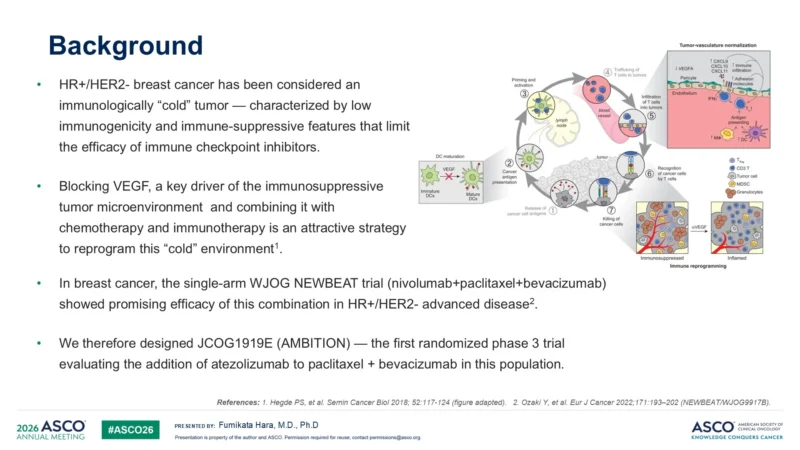
The study tested an important biological question. HR+/HER2− breast cancer is often considered an immunologically “cold” tumor type, with lower immunogenicity and an immune-suppressive tumor microenvironment. Because VEGF-mediated angiogenesis may contribute to immune suppression, the trial explored whether VEGF inhibition with bevacizumab could help reprogram the tumor microenvironment and improve the activity of immune checkpoint blockade.
Why AMBITION Was Conducted
Immune checkpoint inhibitors have shown limited benefit in unselected HR+/HER2− advanced breast cancer. The rationale behind AMBITION was that combining anti-VEGF therapy, chemotherapy, and PD-L1 blockade could potentially make this tumor type more responsive to immunotherapy.
Previous single-arm data from the WJOG NEWBEAT trial, which evaluated nivolumab with paclitaxel and bevacizumab, suggested promising activity in HR+/HER2− advanced disease. AMBITION was designed as the first randomized phase III trial to formally test this strategy with atezolizumab added to paclitaxel plus bevacizumab (Hara et al., 2026).
Study Design
JCOG1919E AMBITION was a multicenter, open-label, randomized phase III trial. Eligible patients had HR+/HER2− advanced breast cancer, no prior chemotherapy for advanced disease, and endocrine-resistant disease or visceral crisis.
Patients were randomized 1:1 to receive either paclitaxel plus bevacizumab or paclitaxel plus bevacizumab with atezolizumab.
Paclitaxel was administered on days 1, 8, and 15 of a 28-day cycle. Bevacizumab was administered on days 1 and 15. In the atezolizumab arm, atezolizumab was also administered on days 1 and 15.
Randomization was stratified by disease status, liver metastasis, and PD-L1 expression by SP142 assay. The primary endpoint was investigator-assessed progression-free survival. Secondary endpoints included overall survival, objective response rate, PFS by blinded independent central review, and safety (Hara et al., 2026).
Patient Population
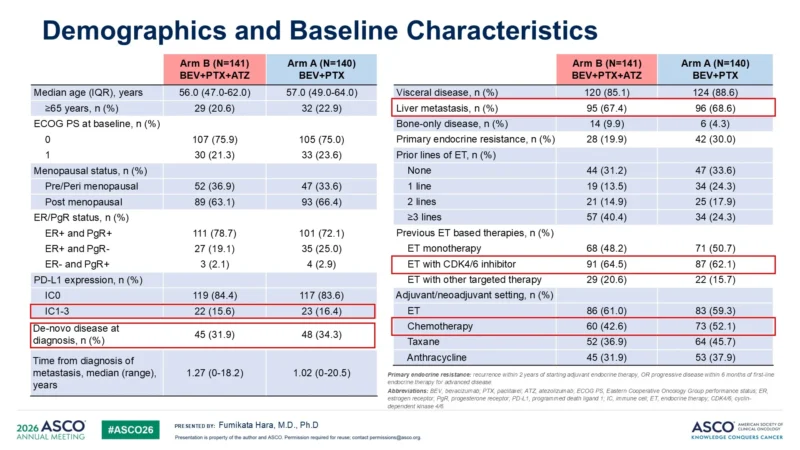
From September 2021 to September 2023, 281 patients were randomized: 140 to paclitaxel plus bevacizumab and 141 to paclitaxel plus bevacizumab with atezolizumab.
Baseline characteristics were generally balanced. Median age was 57 years in the paclitaxel-bevacizumab arm and 56 years in the atezolizumab arm. Most patients had ECOG performance status 0. Approximately one-third had de novo disease at diagnosis, and about two-thirds had liver metastases. PD-L1 positivity was uncommon, seen in approximately 16% of patients by SP142 immune cell scoring.
A large proportion of patients had prior endocrine therapy exposure, and more than 60% in both arms had received endocrine therapy with a CDK4/6 inhibitor.
Primary Endpoint Was Not Met
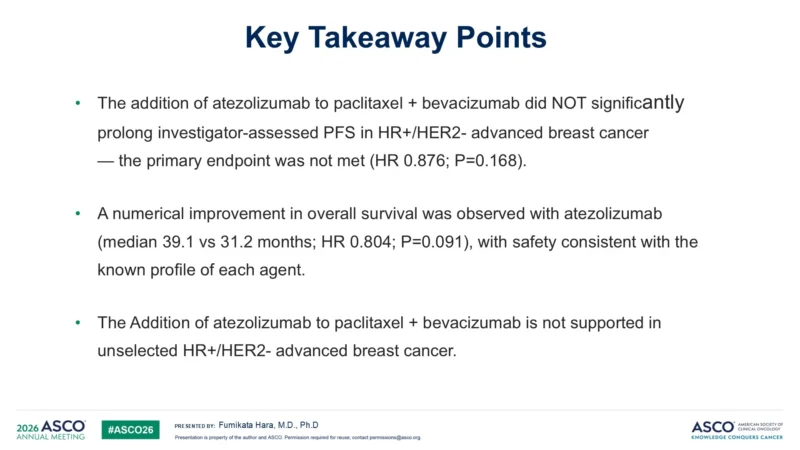
At a median follow-up of 30 months, the addition of atezolizumab did not significantly prolong investigator-assessed progression-free survival.
Median PFS was 11.2 months with paclitaxel plus bevacizumab and 12.4 months with paclitaxel plus bevacizumab plus atezolizumab. The hazard ratio was 0.876, with a 95% confidence interval of 0.670–1.145, and the P value was 0.168 (Hara et al., 2026).
This means the trial did not meet its primary endpoint. Although the numerical difference slightly favored the atezolizumab arm, the improvement was not statistically significant.
PD-L1 Subgroup Findings
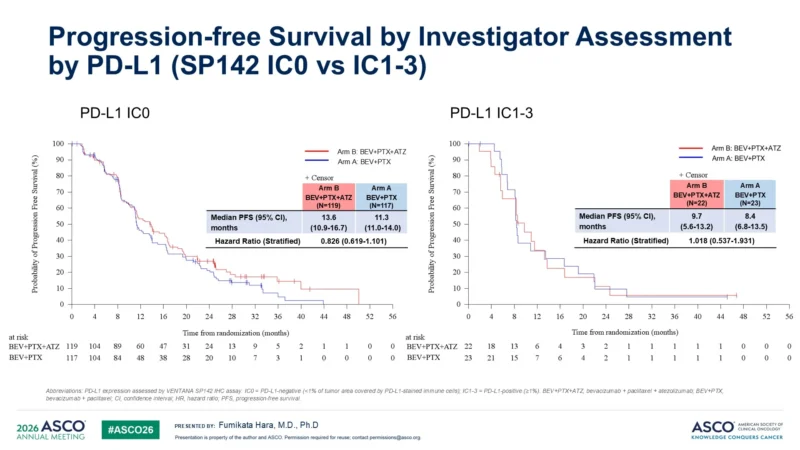
The slides also reported PFS by PD-L1 status using SP142 immune cell scoring.
In the PD-L1 IC0 group, median PFS was 13.6 months with atezolizumab plus paclitaxel and bevacizumab versus 11.3 months with paclitaxel plus bevacizumab. The stratified hazard ratio was 0.826.
In the PD-L1 IC1–3 group, median PFS was 9.7 months with the atezolizumab-containing regimen versus 8.4 months with paclitaxel plus bevacizumab. The stratified hazard ratio was 1.018.
These subgroup results did not identify a clear PD-L1-defined population deriving meaningful PFS benefit from atezolizumab in this study.
Overall Survival Showed A Numerical Trend
Overall survival was immature at the time of analysis, but a numerical improvement was observed with the addition of atezolizumab.
Median OS was 39.1 months with paclitaxel plus bevacizumab plus atezolizumab versus 31.2 months with paclitaxel plus bevacizumab. The hazard ratio was 0.804, with a 95% confidence interval of 0.584–1.108. According to the key takeaway slide, the P value was 0.091 (Hara et al., 2026).
This OS signal is interesting but remains exploratory because the primary endpoint was not met and the OS analysis was not statistically significant.
Response And Safety
Objective response rates were high and similar between the two arms: 73.0% with atezolizumab plus paclitaxel and bevacizumab versus 71.9% with paclitaxel plus bevacizumab.
Grade 3 or higher adverse events were similar between arms. The most common immune-related adverse events of any grade in the atezolizumab arm were rash, reported in 17.3%, adrenal insufficiency, reported in 11.5%, and hypothyroidism, reported in 10.8%.
No treatment-related deaths were observed, and no new safety signals emerged.
Clinical Meaning
AMBITION is an important negative phase III study. It shows that adding atezolizumab to paclitaxel plus bevacizumab does not significantly improve PFS in unselected patients with HR+/HER2− advanced breast cancer.
The findings suggest that simply combining chemotherapy, VEGF inhibition, and PD-L1 blockade may not be enough to overcome the immune resistance of HR+/HER2− disease in a broad population.
The numerical OS trend will likely generate discussion, but it does not change the main conclusion: the addition of atezolizumab is not supported in unselected HR+/HER2− advanced breast cancer based on these data.
Key Takeaway
The JCOG1919E AMBITION trial did not meet its primary endpoint. Adding atezolizumab to paclitaxel plus bevacizumab did not significantly improve investigator-assessed PFS in frontline HR+/HER2− advanced breast cancer.
Although overall survival numerically favored the atezolizumab arm, the result was not statistically significant. The safety profile was consistent with the known profiles of each agent, with no treatment-related deaths and no new safety signals.