Key takeaways
- Agentic AI can manage multi-step clinical workflows, not just single tasks.
- It may help prepare tumor-board cases, retrieve evidence, and screen trials.
- It can combine EHR, imaging, pathology, genomics, and treatment data.
- Key risks include errors, bias, privacy issues, and overreliance.
- Agentic AI will likely support tumor boards, not replace clinicians.
Agentic AI in clinical oncology could change how cancer care teams prepare, synthesize, and act on increasingly complex clinical information. Unlike conventional AI tools that answer a question or generate a single prediction, agentic systems are designed to pursue a defined goal through a sequence of coordinated steps—retrieving data, using external tools, checking intermediate outputs, and adapting the workflow as new information becomes available.
For oncology, the appeal is clear. Treatment decisions increasingly require simultaneous interpretation of imaging, pathology, molecular profiling, prior therapies, organ function, clinical guidelines, and trial eligibility. Agentic AI could help organize these fragmented data into structured workflows for tumor boards, precision oncology, clinical trial matching, documentation, and clinical decision support.
However, this remains an emerging field. Recent reviews show that most healthcare AI-agent systems are still prototypes or early technical evaluations, with relatively little prospective evidence demonstrating improvement in patient or system-level outcomes. The near-term question is therefore not whether AI will independently run tumor boards, but whether carefully constrained agents can reduce the administrative and cognitive burden surrounding multidisciplinary cancer care while preserving clinician oversight.
What Is Agentic AI in Clinical Oncology?
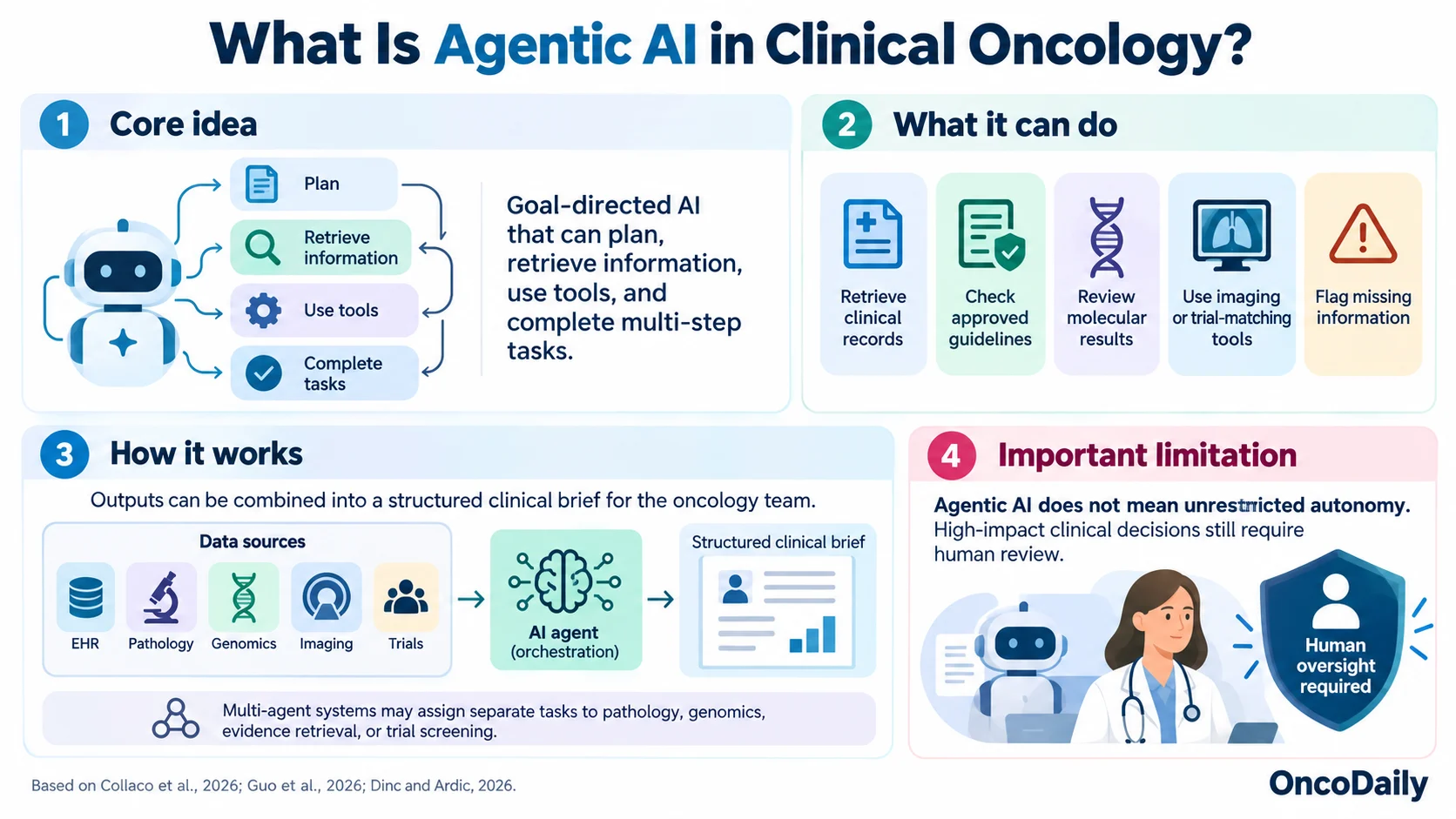
Agentic AI refers to systems that can work toward a defined objective through multi-step planning, tool use, information retrieval, and iterative task execution. The terminology is still evolving, and there is no universally accepted boundary between an ‘AI agent‘ and ‘agentic AI’. Across current literature, the most consistent features are goal-directed behavior, some degree of operational autonomy, and the ability to initiate actions or call external tools within a defined environment (Collaco et al., 2026).
In oncology, an agent might retrieve relevant clinical records, query an approved guideline repository, examine structured molecular results, call a validated imaging or trial-matching tool, identify missing information, and assemble these outputs into a clinical brief. Multi-agent architectures extend this model by assigning specific functions to separate agents for example, pathology extraction, genomic interpretation, evidence retrieval, or trial screening before their outputs are coordinated by an orchestration layer (Guo et al., 2026).
Importantly, multi-agent design is not required for a system to be agentic, and agentic AI should not be equated with unrestricted clinical autonomy. Current healthcare literature favors bounded systems in which the scope of action is predefined and clinically consequential decisions remain subject to human review (Dinc and Ardic, 2026).
How Is Agentic AI Different From Traditional AI Co-Pilots?
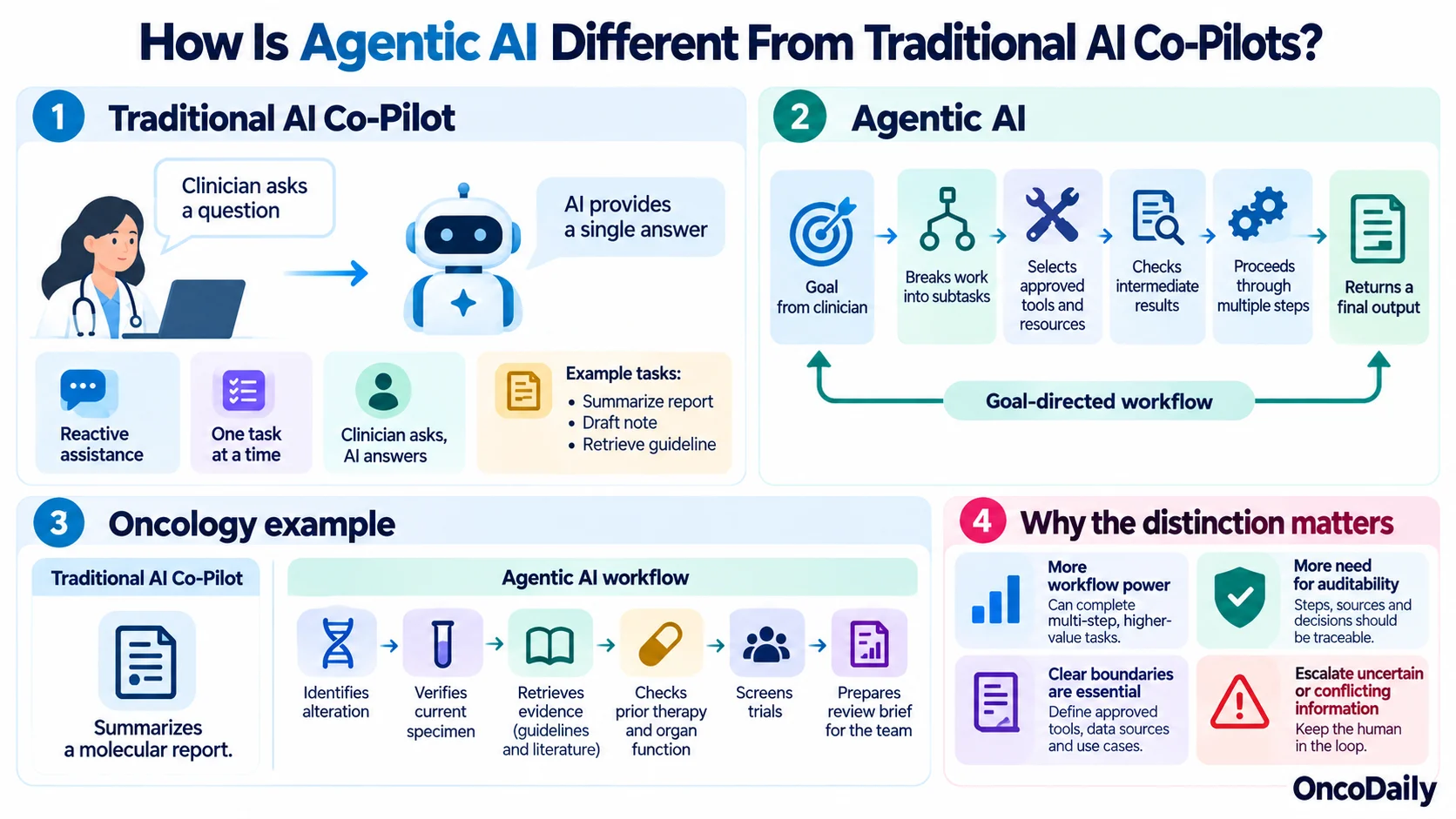
Traditional AI co-pilots are predominantly reactive. A clinician asks the system to summarize a pathology report, draft a clinical note, retrieve a guideline, or answer a question, and the model returns an output. The clinician largely determines each subsequent step.
Agentic AI shifts the emphasis from single-task assistance to workflow execution. Given an objective, an agent can decompose it into subtasks, determine which approved resources are required, evaluate intermediate results, and proceed to the next step without needing a new prompt at every stage.
In oncology, a co-pilot might summarize a molecular report. An agentic workflow could identify the relevant genomic alteration, verify that the result belongs to the current tumor specimen, retrieve evidence associated with that alteration, check prior therapies and organ function, screen relevant trials, and assemble the findings for review.
The distinction is operational rather than simply linguistic. The greater the system’s ability to select tools, sequence actions, and modify subsequent steps, the greater its potential usefulness but also the greater the need for auditability, explicit boundaries, and escalation when information is uncertain or contradictory (Dinc and Ardic, 2026; Kolbinger and Kather, 2026).
How Could AI Agents Automate Tumor Board Workflows?
The most realistic application of agentic AI is not an autonomous tumor board making cancer-treatment decisions. It is automation of the workflow surrounding multidisciplinary discussion.
Before a tumor board, an agent could extract the diagnosis, stage, pathology, molecular findings, relevant imaging reports, prior treatment, performance status, and major comorbidities. It could identify missing staging studies or biomarkers, construct a disease timeline, retrieve current guidelines and trial information, and prepare a source-linked case summary. After the meeting, the system could draft the MDT record and track unresolved tests or referrals, provided these outputs remain subject to clinical approval (Nardone et al., 2024; Liu et al., 2026).
Clinical trial matching provides one of the clearest real-world examples of this approach. In a 2026 prospective evaluation involving 3,804 patients, a neuro-symbolic multi-agent system combined automated record extraction, an oncology knowledge graph, eligibility logic, and oncologist review. It achieved an F1 score of approximately 0.82 for trial matching and reduced median screening time from roughly 120 minutes manually to about 30 minutes with AI-assisted review. Crucially, ambiguous cases were escalated for clinician judgment rather than resolved autonomously (Loaiza-Bonilla et al., 2026).
This is closer to the likely clinical role of agentic AI: automating repetitive synthesis and screening while directing multidisciplinary attention toward the cases that genuinely require expert interpretation.
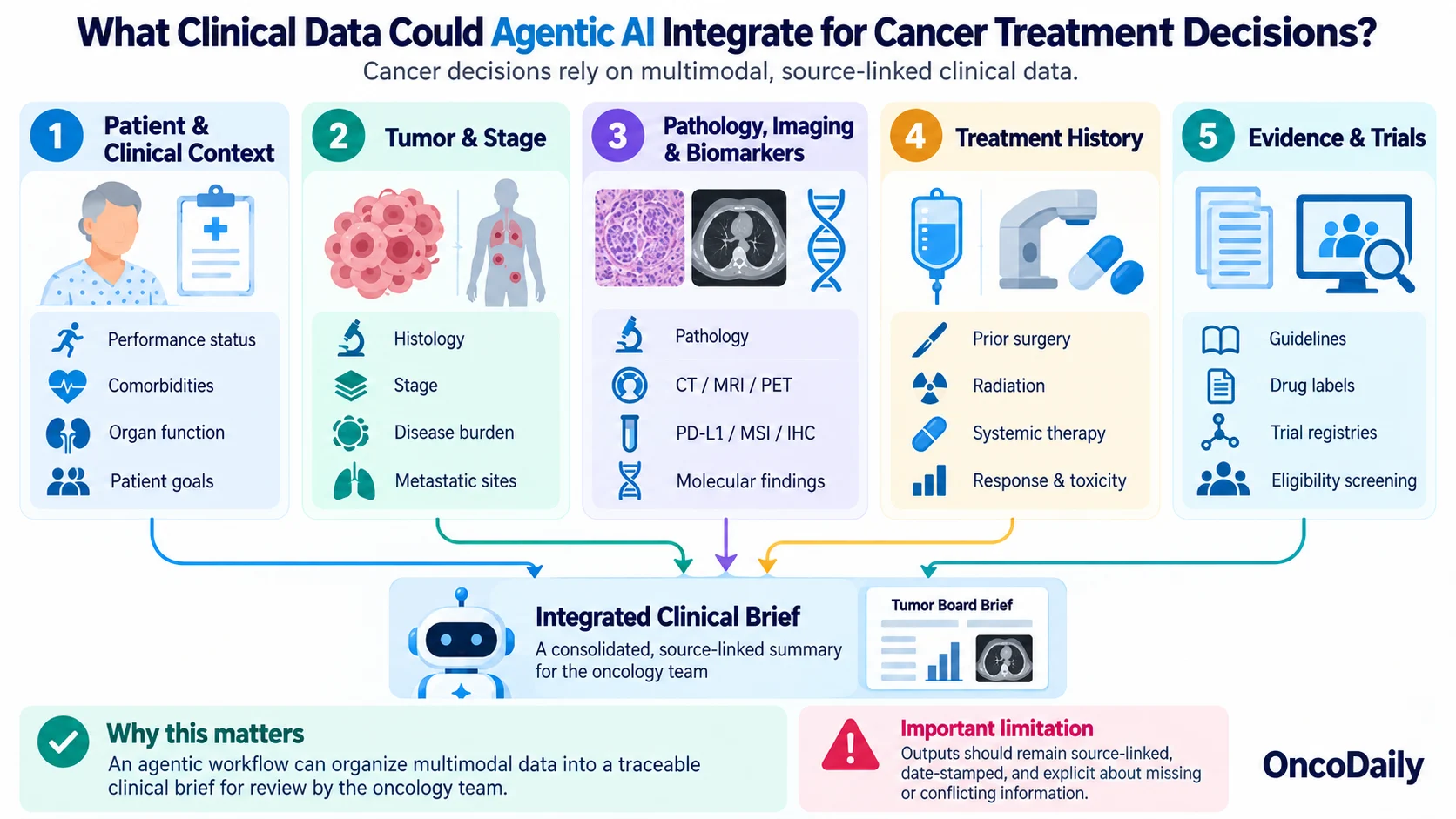
What Clinical Data Could Agentic AI Integrate for Cancer Treatment Decisions?
Cancer care is inherently multimodal. A single treatment decision may depend on histology and stage, radiographic disease burden, molecular alterations, prior therapy, performance status, laboratory values, comorbidities, toxicity history, and the patient’s priorities.
An agentic system could potentially coordinate information from the electronic health record, pathology, radiology, molecular diagnostics, laboratory systems, treatment history, clinical guidelines, drug labels, and clinical-trial registries. In precision oncology, this could allow clinically relevant information to be assembled around a specific decision rather than reviewed separately across multiple systems (Guo et al., 2026).
That does not mean one general-purpose model should independently interpret every modality. A more defensible architecture would allow an agent to orchestrate outputs from validated domain-specific systems for example, a pathology model, radiology algorithm, genomic knowledge base, or trial-matching engine and preserve the provenance of each result.
This distinction is important because multimodal healthcare agents remain immature. A 2026 scoping review of 37 studies found that current systems were still predominantly text-centered and largely at the prototype or early evaluation stage; prospective validation, fairness assessment, and real-world outcome data remained limited (Yu et al., 2026).
Data quality may ultimately be as important as model capability. Missing pathology results, incorrectly dated scans, duplicated medication records, outdated trial status, or conflicting molecular reports can propagate through an automated workflow. Clinically important outputs therefore need source provenance, dates, uncertainty indicators, and mechanisms for escalating inconsistent or incomplete information.
What Are the Risks of Autonomous AI in Oncology?
The central safety concern is not simply that an AI model can make an error. An agent can potentially carry that error through several connected actions. A misread biomarker could affect evidence retrieval, treatment summarization, and trial matching before the problem becomes visible to the clinician.
Relevant risks include hallucinated or unsupported clinical statements, incorrect extraction of patient data, automation bias, algorithmic bias, privacy and cybersecurity failures, outdated evidence, model drift, inappropriate tool use, and unclear responsibility when an AI-supported workflow contributes to harm.
These problems become particularly important in oncology because many decisions are high consequence and context dependent. WHO guidance on large multimodal models emphasizes accuracy, privacy, transparency, accountability, equity, and meaningful human control, and specifically cautions that generative systems can produce highly plausible information that is nevertheless incorrect (WHO, 2024).
Clinical deployment therefore requires more than good benchmark performance. Agentic systems need predefined operational boundaries, source-linked outputs, uncertainty detection, access controls, audit logs, independent validation in the population where they will be used, monitoring for performance drift and bias, and explicit approval gates before actions can affect the medical record or patient care (Dinc and Ardic, 2026; Zhu et al., 2026).
A system may be allowed to identify a potentially relevant trial, for example, without being allowed to declare a patient definitively eligible. It may draft a tumor-board recommendation without being permitted to finalize it. That distinction between automation and clinical authority is likely to remain fundamental.
Will Agentic AI Replace Tumor Boards or Redefine How They Work?
Current evidence supports augmentation rather than replacement.
A 2026 systematic review of 29 studies reported AI–tumor board concordance of approximately 62%–76% across several cancer types, with stronger performance in relatively structured, guideline-driven decisions and persistent weaknesses in complex or individualized cases. These concordance figures should not be interpreted as proof of clinical equivalence or safety; they measure agreement with MDT recommendations, not patient outcomes (Liu et al., 2026).
Individual studies show the same pattern. In breast cancer, LLM-generated recommendations showed meaningful agreement with multidisciplinary decisions but varied according to clinical complexity (Nazlı et al., 2026). In a retrospective analysis of 152 soft-tissue sarcoma cases, GPT-4o generated clinically relevant recommendations but showed important discrepancies in treatment sequencing and chemotherapy selection—areas where specialist judgment remains essential (Dehdab et al., 2026).
Tumor boards do more than retrieve guidelines. They reconcile uncertain pathology, imaging interpretation, surgical feasibility, previous treatment, competing toxicities, prognosis, patient preference, access to care, and the practical consequences of different treatment strategies. These are precisely the situations in which current AI evidence is least mature.
The more plausible model is therefore an AI-enhanced tumor board: agentic systems prepare and verify the information surrounding the decision, while clinicians remain responsible for interpreting uncertainty, weighing competing options, communicating with the patient, and authorizing the final plan. Broader evidence on human–AI collaboration in healthcare similarly suggests that successful performance depends heavily on task design, workflow integration, training, and appropriately calibrated clinician trust rather than AI performance in isolation (Strong et al., 2026).
Agentic AI may ultimately automate a substantial portion of the machinery around multidisciplinary cancer care. The tumor board itself, however, is likely to become more human in what it concentrates on: uncertainty, competing risks, patient priorities, and clinical judgment while machines handle more of the information retrieval and workflow orchestration underneath it.
FAQ
What is agentic AI in oncology?
Agentic AI is designed to manage multi-step clinical tasks, use tools, retrieve information, and coordinate workflows toward a defined goal.
How is agentic AI different from an AI co-pilot?
A co-pilot usually responds to one clinician request, while agentic AI can plan and execute several connected steps within defined limits.
How could agentic AI help tumor boards?
It could organize patient data, identify missing information, retrieve guidelines, screen clinical trials, and prepare structured case summaries.
Can agentic AI make cancer treatment decisions on its own?
Not safely in current practice. High-impact decisions should remain under clinician review and approval.
Will agentic AI replace tumor boards?
Most likely not. It's near-term role to reduce the administrative work and support multidisciplinary teams with better-organized information.