
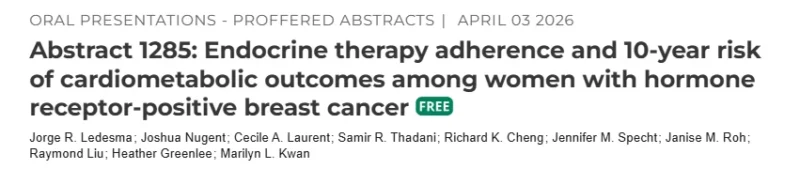
At the AACR Annual Meeting 2026, new data highlighted an important survivorship challenge in hormone receptor-positive breast cancer, showing that longer adherence to endocrine therapy may increase the long-term risk of cardiometabolic conditions, particularly among patients receiving aromatase inhibitors.
Background
Adjuvant endocrine therapy remains a cornerstone in the management of hormone receptor-positive breast cancer, significantly reducing recurrence and improving survival outcomes. However, as the number of long-term survivors continues to grow, attention is increasingly shifting toward treatment-related comorbidities that may impact overall health.
Cardiometabolic conditions such as hypertension, dyslipidemia, and diabetes are particularly relevant in this population, given their association with cardiovascular disease and long-term morbidity. While endocrine therapy is typically recommended for at least five years, the relationship between adherence duration and cardiometabolic risk has not been well defined. This study aimed to address this gap by evaluating how cumulative adherence to endocrine therapy influences the 10-year incidence of key cardiometabolic outcomes.
Methods
This prospective cohort study included 8,365 postmenopausal women with stage I–III hormone receptor-positive breast cancer treated within Kaiser Permanente Northern California. All patients initiated endocrine therapy between 2005 and 2013.
Adherence to endocrine therapy was assessed annually over a five-year period and categorized into cumulative adherence durations ranging from 0 to 5 years. Cardiometabolic outcomes were identified using a combination of clinical diagnoses, laboratory results, and medication records.
To estimate the 10-year cumulative incidence of hypertension, dyslipidemia, and diabetes under different adherence durations, investigators applied sequentially doubly robust estimation with Super Learner modeling. Analyses accounted for all-cause mortality as a competing risk and included stratification by endocrine therapy type, specifically aromatase inhibitors and tamoxifen.
Study Design
The study evaluated real-world adherence patterns and long-term outcomes in a large, integrated healthcare setting. Among the cohort, 40.8% of patients remained adherent to endocrine therapy for at least five years.
Baseline characteristics differed between adherence groups. Women who maintained long-term adherence were more likely to be aged 50–70 years (73.7% vs 64.0%), reside in higher-income neighborhoods ($80,395 vs $70,417), receive chemotherapy (34.1% vs 20.9%), and were less likely to smoke (5.92% vs 10.5%) compared with those who were never adherent.
Results
Among women who were never adherent to endocrine therapy, the adjusted 10-year cumulative incidence of hypertension was 22.7%, dyslipidemia 25.6%, and diabetes 8.91%.
In contrast, patients who were adherent for five years experienced higher rates across all cardiometabolic outcomes. The 10-year cumulative incidence reached 29.1% for hypertension, 32.4% for dyslipidemia, and 12.6% for diabetes.
These findings correspond to absolute increases of 6.37% for hypertension, 6.83% for dyslipidemia, and 3.73% for diabetes when comparing five-year adherence with no adherence. Importantly, the cumulative incidence of all outcomes increased progressively with each additional year of adherence, suggesting a duration-dependent effect.
When stratified by endocrine therapy type, aromatase inhibitors demonstrated a consistent association with increased cardiometabolic risk. Five-year adherence to aromatase inhibitors was associated with higher incidence of hypertension (+6.85%), dyslipidemia (+8.32%), and diabetes (+4.21%) compared with never-adherent patients.
In contrast, tamoxifen adherence was associated only with an increased risk of hypertension (+5.83%) and showed no significant association with dyslipidemia or diabetes.Direct comparison between therapies revealed that aromatase inhibitors were associated with higher cumulative incidence of dyslipidemia (+10.2%) and diabetes (+2.96%) compared with tamoxifen.
Key Findings
Longer adherence to endocrine therapy is associated with increased 10-year cardiometabolic risk in postmenopausal women with hormone receptor-positive breast cancer. This association is most pronounced with aromatase inhibitors, which impact hypertension, lipid metabolism, and glucose regulation.
Tamoxifen appears to have a more limited cardiometabolic profile, with increased risk observed primarily for hypertension. The progressive increase in risk with longer duration of adherence reinforces the importance of long-term monitoring.
Conclusion
This large prospective analysis presented at the AACR Annual Meeting 2026 provides important insight into the long-term health implications of endocrine therapy in breast cancer survivors. While the oncologic benefits of therapy remain clear, the observed increase in cardiometabolic risk—particularly with aromatase inhibitors—highlights the need for a more individualized approach to treatment and follow-up.
As survivorship care continues to evolve, these findings support closer collaboration between oncology and cardiovascular care, ensuring that the benefits of endocrine therapy are maintained while minimizing long-term health risks.